
Last updated: September 3, 2026
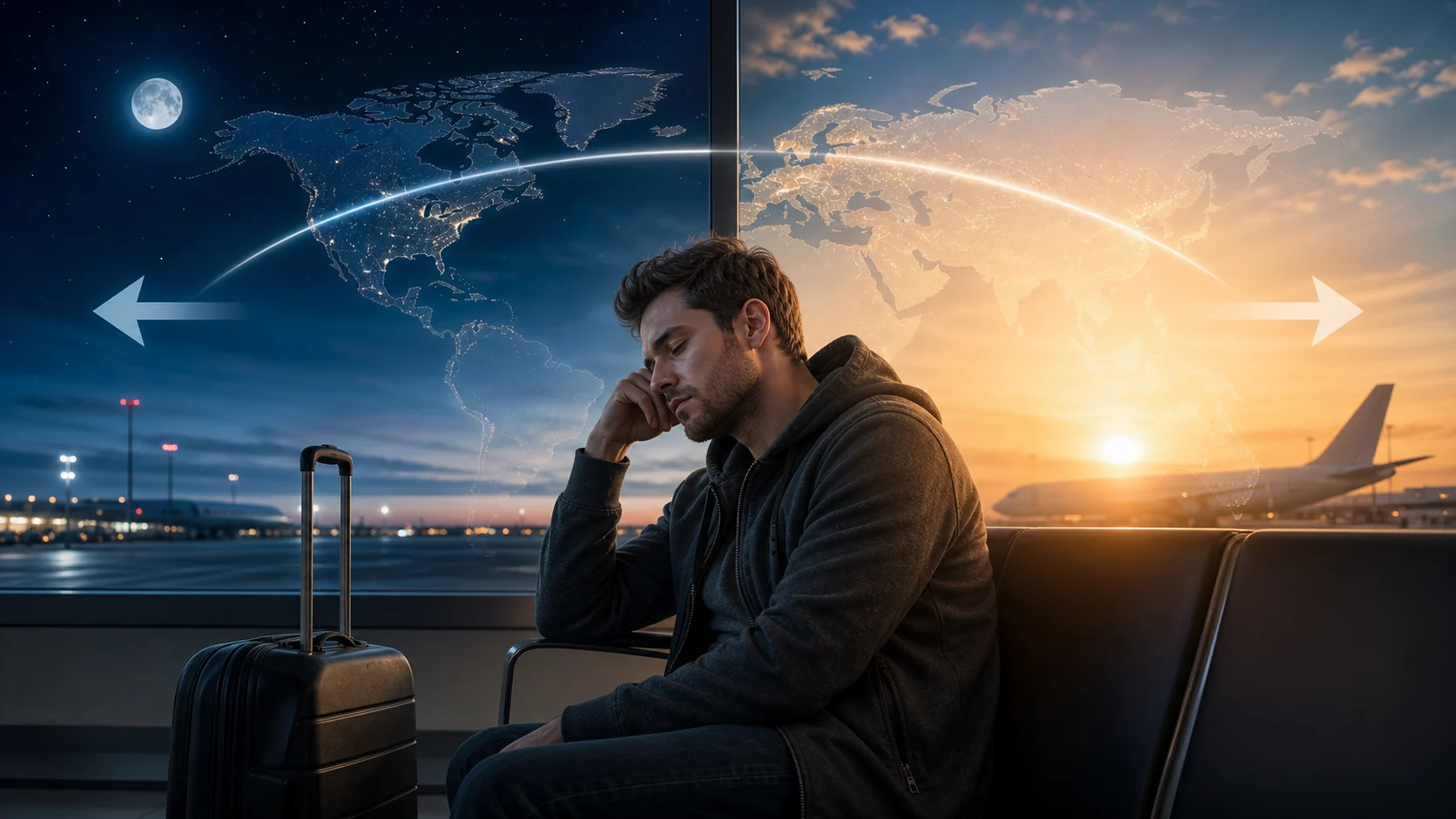
It’s a well-known feeling among frequent flyers: flying London to New York feels manageable, but flying New York back to London wrecks your sleep for days. There’s actual science behind why eastbound jet lag hits so much harder — and a small set of practical tools that genuinely help. Here’s a friendly walk-through.
The science of your circadian rhythm
Your body operates on a roughly 24-hour internal clock called the circadian rhythm. This clock controls when you feel alert, when your body releases melatonin to make you sleepy, when your core body temperature dips overnight, and when your digestive system expects meals.
The interesting bit: human circadian rhythms are naturally slightly longer than 24 hours — closer to 24.2 hours on average. Because of this, it’s biologically easier for your body to delay sleep (stay up later) than to advance it (force sleep earlier). That single fact explains most of what’s coming next.
Flying west: chasing the sun (delaying the clock)
When you fly west — say, Europe to North America — you’re moving “backwards” through time zones. Your day gets longer.
If you land in New York at 6 PM, your body thinks it’s 11 PM UK time. You might feel tired early in the evening, but you just need to stay awake a few more hours before going to bed. Because your body naturally finds it easier to stay up later, adjusting to a westbound time zone is comparatively gentle. The rule of thumb is roughly one day of adjustment per time zone crossed.
Flying east: losing time (advancing the clock)
Eastbound is the harder direction. You’re moving “forward” through time zones, and your day gets shorter.
A typical New York to London red-eye leaves at 8 PM and lands at 8 AM local time. But your body thinks it’s 3 AM. You’re being asked to start a new day when your biological clock is screaming at you to be in deep sleep. Worse, when it’s bedtime in London (say, 10 PM), your body thinks it’s only 5 PM — not nearly tired enough to fall asleep.
Forcing your body to sleep earlier and wake earlier means advancing your circadian rhythm, which is biologically the hard direction. The rule of thumb here is roughly 1.5 days of adjustment per time zone crossed — about 50% slower than westbound recovery.
Light: the most powerful lever you have
Of all the tools available for shifting your body clock, daylight exposure is by far the strongest. Your circadian rhythm takes more information from light than from anything else — not from meals, not from melatonin pills, not from caffeine. Bright morning light tells your brain “this is morning”; the absence of light at night tells it “this is night.” Using light deliberately is the most reliable way to shift faster.
For eastbound travel: when you land in the morning, get outside in daylight as soon as you can. Even on a grey day, outdoor light is many times brighter than indoor lighting and it’s enough to shift your clock. In the evening, dim indoor lights and avoid bright screens for the last hour before bed.
For westbound travel: do the opposite. Try to stay awake in the local evening with bright light, then sleep through the night.
Meal timing as a secondary signal
Your gut also has a circadian rhythm, and eating at local meal times helps reset it. It’s a weaker signal than light, but free and easy to apply: when you arrive, eat breakfast, lunch and dinner at local times even if you aren’t hungry. Avoid late-night meals on day one in the new time zone, as a heavy meal close to bedtime makes it harder to fall asleep.
What about melatonin and sleeping aids?
Melatonin is the most-studied option for jet lag, and the evidence supports it for eastbound travel of 5+ time zones. Studies typically use a small dose (0.5–3 mg) taken about 30 minutes before your target bedtime in the new time zone; larger doses aren’t more effective and can make morning grogginess worse. Note that melatonin is a prescription-only medicine in the UK (it is sold over the counter as a supplement in the US), so speak to a pharmacist or doctor before using it — especially if you are pregnant, take other medication or have a health condition.
Prescription sleeping pills can knock you out for a flight, but they don’t shift your circadian rhythm — you’ll wake up feeling rested for that one sleep but still jet-lagged. If you’re considering anything stronger than melatonin, talk to a doctor first.
Caffeine: use it like a tool
Coffee can be the right call or the wrong call, depending on timing. On a westbound arrival, a strong coffee at 4 PM local time can help you stay awake until a normal bedtime. On an eastbound arrival, coffee after lunch can make it harder to fall asleep at night and slow your adjustment. Treat caffeine like a stimulant on a schedule: use it to push through to bedtime, not after.
How to beat eastbound jet lag
- Start shifting early. Begin going to bed 30–60 minutes earlier than usual for a few days before your trip. Even a small head start makes a big difference.
- Sleep on the plane if you can. A red-eye flight is your chance to get a few hours of sleep on local schedule. Use an eye mask, earplugs and skip the in-flight wine.
- Get bright light on arrival morning. Outside, ideally. This is the single most effective thing you can do.
- Eat at local meal times. Three regular meals on local time, no big late-night snacks.
- Skip the long nap. If you must nap after a red-eye, keep it under 90 minutes and finish by mid-afternoon. Any longer and you’ll struggle to sleep that night.
- Consider melatonin. A small dose before your target bedtime can help for the first 2–3 nights.
A worked example: London → New York → London
Suppose you fly Heathrow to JFK on Friday morning and back to Heathrow on Sunday evening. Here’s what the typical traveller experiences:
- Westbound (LHR → JFK). Land at JFK around 3 PM local (8 PM UK). Stay up until 10 PM local (3 AM UK), sleep, wake up around 7 AM. Within 1–2 days you’re on local time. Most people barely notice the shift.
- Eastbound (JFK → LHR). Red-eye lands at LHR Monday at 8 AM (3 AM body time). You’ve slept maybe 4 hours on the plane. You push through Monday on caffeine, fall asleep way too early Monday evening, wake up at 3 AM Tuesday. It takes most of the week to feel normal.
That’s exactly the pattern the circadian science predicts — and exactly why a small head start, good light exposure and well-timed melatonin can shave days off recovery.
Plan your sleep shift
Don’t guess when to start shifting your sleep. Use our jet lag planner to generate a personalised pre-trip schedule that gradually shifts your body clock before you even step on the plane. For long-haul flights specifically, the long-haul jet lag planner guide goes deeper on light timing and meal scheduling for trips of 6+ time zones. And if you’ve got an overnight flight ahead of you, the red-eye flight survival guide covers what to do on the plane and the morning after.
Frequently asked questions
Is jet lag worse going east or west?
For most people, jet lag is worse travelling east. Around 75% of travellers find eastward trips harder because your body clock has to advance (sleep earlier), which is more difficult than delaying it.
Why is jet lag worse when you fly east?
Your internal body clock naturally runs slightly longer than 24 hours (about 24.2 hours), so it adapts more easily to longer days. Flying west lengthens your day, which feels natural; flying east shortens it, forcing your clock to advance against its natural drift.
Why is it easier to recover flying west?
Westward travel delays your body clock, effectively staying up later, which matches your natural tendency to drift later. That makes adapting faster and recovery easier than advancing your clock for eastward travel.
How long does jet lag last?
It depends on direction and time zones crossed. After a long eastward flight, recovery can take 5 to 9 days; going west, most people recover in 2 to 5 days. Eastward trips take roughly 50% longer to recover from.
How many days does it take to recover per time zone?
A common rule of thumb is about one day of recovery for each time zone crossed. Recovery tends to be faster going west and slower going east.
How many time zones do you need to cross to get jet lag?
Jet lag usually starts when you cross about three or more time zones. The more zones you cross, the stronger and longer the jet lag tends to be.
Do you get jet lag flying north or south?
No. Jet lag is caused by crossing time zones (east-west travel), not distance. A long north-south flight that stays in the same time zone will not cause jet lag, though you may still feel travel fatigue.
What are the symptoms of jet lag?
Common symptoms include difficulty sleeping, daytime tiredness, trouble concentrating, irritability, headaches and digestive upset. They usually appear a day or two after crossing several time zones.
How can I reduce jet lag when flying east?
Shift your schedule earlier a few days before you travel, seek bright light in the morning and avoid bright light in the evening at your destination, and consider melatonin at your destination bedtime.
How can I reduce jet lag when flying west?
Shift your schedule later before you travel, get bright light in the evening and avoid it early in the morning at your destination, and stay active in the late afternoon to help delay your body clock.
Does melatonin help with jet lag?
Yes, for many people. A small dose (around 0.5 to 3 mg) taken at your destination bedtime can reduce adjustment time by a day or two, and it is most useful for eastward travel where you need to advance your clock. In the UK melatonin is a prescription-only medicine, so check with a pharmacist or doctor first.
How does light exposure affect jet lag?
Light is the strongest signal for your body clock. For eastbound travel, get morning light and avoid evening light; for westbound travel, get evening light and avoid early-morning light. Timed correctly, light can cut recovery time significantly.
Should I adjust my sleep schedule before I fly?
Yes, if you can. Shifting your bedtime earlier (for eastward travel) or later (for westward travel) by 30 to 60 minutes a day for a few days before departure gives your body a head start.
Does jet lag get worse with age?
It often does. Older travellers tend to find their body clocks adjust more slowly, so jet lag can feel stronger and last a little longer than it did when they were younger.
Does staying hydrated and moving on the plane help?
It helps how you feel. Dehydration, sitting still and disrupted sleep all worsen the symptoms, so drink water, move regularly and try to sleep when it is night at your destination, but the main driver of jet lag is still the number of time zones and the direction.
Guidance based on sleep-science sources including the CDC and Cleveland Clinic. Speak to a pharmacist or doctor before using melatonin or sleep aids.

Reviewed by Muhammad Umar Khan
Founder and editor of TripBuffer. Reviewed against official airport, airline and transport-provider information. For our research standards, see the Editorial Policy.