Category: Travel Planning

  • Jet2 Hand Luggage & Baggage Allowance 2026: Sizes & Rules

    Jet2 Hand Luggage & Baggage Allowance 2026: Sizes & Rules

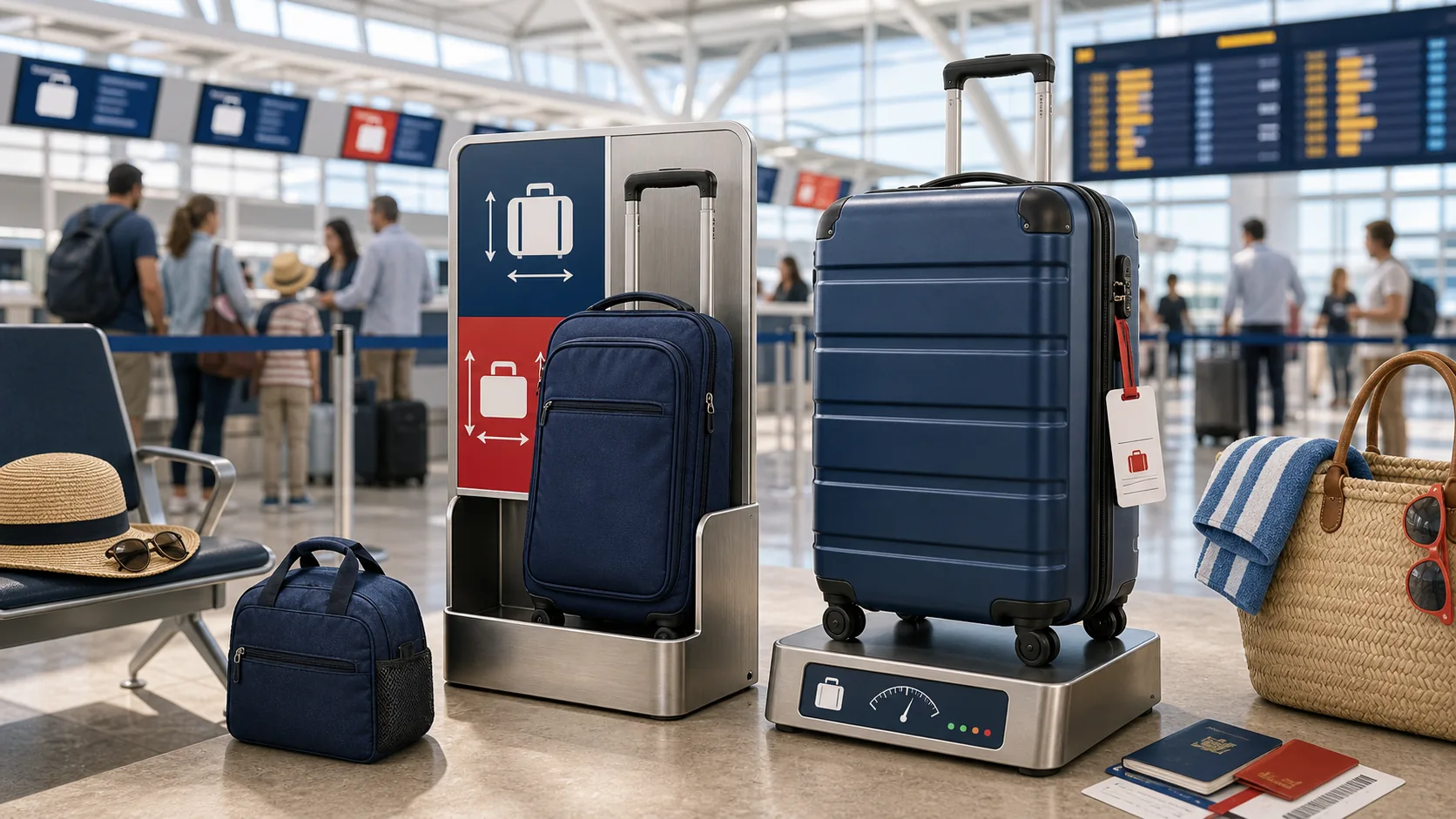
    Jet2 10kg cabin bag, small under-seat bag and 22kg hold bag with size labels, illustrating Jet2 baggage allowance 2026
    Updated for 2026 · Last checked 10 July 2026

    Jet2 hand luggage includes one cabin bag weighing up to 10kg and measuring no more than 56 × 45 × 25cm, plus one small under-seat bag up to 40 × 30 × 20cm — free for every passenger. Hold luggage is separate: you can add up to three 22kg bags per person, and on package holidays a 22kg bag is usually included. Here is the full Jet2 baggage allowance for 2026.

    Quick answer: Jet2 baggage allowance

    • Main cabin bag: up to 56 × 45 × 25cm and 10kg — included free.
    • Small under-seat bag: up to 40 × 30 × 20cm (handbag or laptop bag) — also included.
    • Hold luggage: up to three 22kg bags per person; no single bag over 32kg.
    • Package holidays (Jet2holidays / Jet2CityBreaks) usually include a 22kg hold bag; flight-only bookings do not.
    • On busy flights, Jet2 may place your 10kg cabin bag in the hold at no charge.

    Jet2 baggage allowance at a glance

    Jet2 gives every passenger (excluding infants) two pieces of hand luggage, with hold bags added separately. Here is how the Jet2 baggage allowance breaks down:

    Bag typeMaximum sizeWeightIncluded or paidWhere it is stored
    Small under-seat bag40 × 30 × 20cmIncludedUnder the seat in front
    Main cabin bag56 × 45 × 25cm10kgIncludedOverhead locker (or hold if busy)
    22kg hold bagStandard suitcase22kgIncluded on packages; paid on flight-onlyAircraft hold
    Additional hold bagsStandard suitcase22kg each (max 32kg)PaidAircraft hold

    Source: Jet2 official baggage policy. Allowances are the current 2026 rules and can change; baggage prices vary by route, flight and booking. Always confirm with Jet2 before you travel.

    Jet2 hand luggage size and weight

    Jet2 allows one cabin bag up to 56 × 45 × 25cm and 10kg, including wheels and handles.

    The Jet2 cabin bag size limit applies to the widest points of your bag, so a hard-shell case must fit within 56 × 45 × 25cm at its wheels and handles, not just the main body. A soft holdall has a small advantage here because it can squeeze into a sizer more easily, but the stated limit is the same for both. Measure the bag fully packed, as it can bulge. The 10kg weight applies to the bag and its contents together. In short, the Jet2 cabin bag size and the Jet2 hand luggage size are one and the same allowance: a single 56 × 45 × 25cm, 10kg bag.

    Jet2 small under-seat bag

    Jet2 also allows one small under-seat bag up to 40 × 30 × 20cm, separate from the 10kg cabin bag.

    This is your personal item — a handbag, a laptop bag or a small backpack — and it must fit beneath the seat in front of you. It is one bag, not several, so it does not cover multiple shopping bags on top of your cabin bag. Keep the things you want during the flight here: phone, documents, medication and a book.

    Can you take two bags on Jet2?

    Yes. Every Jet2 passenger can take two pieces of hand luggage: the 10kg cabin bag plus one small under-seat bag.

    That combination — a 56 × 45 × 25cm cabin bag and a 40 × 30 × 20cm personal item — is included in the fare, with no priority upgrade needed. It is one of the simpler hand-luggage setups among UK airlines.

    Does Jet2 weigh hand luggage?

    The 10kg cabin-bag limit is official, and Jet2 can weigh or measure your bag at check-in or the gate.

    Jet2 does not publish how often bags are actually weighed, and it varies by airport and flight. The safe assumption is that your bag may be checked, so pack to the 10kg limit rather than hoping it slips through. A luggage scale at home removes the guesswork. You can plan the whole bag with our Packing List Generator.

    How strict is Jet2 with hand luggage size?

    Jet2’s policy is a firm 10kg and 56 × 45 × 25cm; how it is enforced at the airport can vary.

    The official limits are clear and do not change from flight to flight. Enforcement, though, depends on the airport, the staff and how full the flight is — so a marginally oversized bag might be waved through one day and stopped the next. Because you cannot predict an individual gate agent, the reliable approach is to stay inside the limits rather than rely on being let off.

    What happens if a Jet2 cabin bag is too large or heavy?

    A cabin bag that is over the size or weight limit may have to be checked into the hold, and a charge may apply.

    If your bag exceeds 10kg or 56 × 45 × 25cm, Jet2 can require it to travel in the hold. The exact charge depends on the route and how you pay, so there is no single universal fee — and paying at the airport is generally more expensive than adding a hold bag online in advance. You can estimate likely costs with our Airline Bag Fee Estimator.

    What is Jet2 Guaranteed Cabin Luggage?

    Guaranteed Cabin Luggage
    A paid, availability-dependent Jet2 add-on intended to keep your compliant 10kg cabin bag with you in the cabin, rather than having it moved to the hold when locker space runs out.

    It is worth being clear about what this is and is not. Your 10kg cabin bag is already included free — Guaranteed Cabin Luggage is not how you buy the basic allowance. It is an optional extra that reduces the chance of your bag being placed in the hold on a full flight. It is subject to availability and operational requirements, so it is not an absolute guarantee in every situation. If having your bag in the cabin matters (for example, for tight connections), it can be worth considering.

    Jet2 hold-luggage allowance

    Jet2 hold luggage is a paid extra on flight-only bookings; a 22kg bag is usually included on Jet2holidays packages. You can add up to three 22kg bags per person.

    Each purchased or included hold bag adds a 22kg allowance, and you can take up to three per person per flight. No single item may weigh more than 32kg (a manual-handling limit). Excess weight above your allowance is charged per kilogram, so it is usually cheaper to add a bigger allowance up front than to pay for excess at the airport. Prices vary by route and booking, so check the current cost when you book or in Manage My Booking.

    Jet2 baggage allowance for infants and children

    Infants without their own seat are not included in the standard cabin-bag and hold-bag allowance.

    Children who occupy a seat get the same allowance as an adult. Infants (generally under two, travelling on a lap) do not receive the standard cabin-bag allowance, though Jet2 normally allows essential baby items such as a pushchair or car seat. Because infant and baby-equipment rules are detailed, confirm the current policy directly with Jet2 before you travel.

    Jet2 versus Ryanair and easyJet

    The stand-out point for Jet2 is that the 10kg cabin bag is included as standard — you do not need a priority add-on or a particular fare to bring it into the cabin. Here is how the hand-luggage basics compare:

    Jet2RyanaireasyJet
    Free under-seat bag40 × 30 × 20cm40 × 30 × 20cm45 × 36 × 20cm
    Main cabin bag56 × 45 × 25cm55 × 40 × 20cm56 × 45 × 25cm
    Cabin bag weight10kg10kgLift it yourself
    Main cabin bag included?Yes, as standardNo — needs PriorityNo — needs a fare/membership
    May be moved to the hold?Yes (free, on busy flights)

    For the full picture, see our hand luggage size comparison, and the dedicated guides to Ryanair cabin bag size and easyJet hand luggage size. British Airways works differently again and has its own guide.

    How to avoid Jet2 baggage problems

    • Measure your bag at its widest points, including wheels and handles, against 56 × 45 × 25cm.
    • Weigh it at home so the cabin bag stays within 10kg fully packed.
    • Keep essentials accessible — medication, documents, valuables, power banks and anything you need during the flight — in case the cabin bag goes in the hold.
    • Prepare for the hold. On a full flight your 10kg bag may be placed below, so do not pack irreplaceable items you cannot check.
    • Check restricted items and liquids separately — the baggage size rules are different from security rules.
    • Reconfirm your allowance in Manage My Booking before you travel, as prices and details can change.

    Frequently asked questions

    What is Jet2’s hand luggage allowance in 2026?

    Every passenger can take one cabin bag up to 10kg and 56 × 45 × 25cm, plus one small under-seat bag up to 40 × 30 × 20cm. Both are included free. Hold luggage is added separately.

    What size is a Jet2 cabin bag?

    Up to 56 × 45 × 25cm, including wheels and handles. It must also weigh no more than 10kg.

    What is the Jet2 hand luggage weight limit?

    The main cabin bag can weigh up to 10kg, including its contents. The small under-seat bag has no separately published weight but must fit under the seat.

    Is Jet2’s 10kg cabin bag free?

    Yes. One 10kg cabin bag is included free for every fare-paying passenger, with no priority upgrade needed to bring it into the cabin.

    Can I take a cabin suitcase and a handbag on Jet2?

    Yes. You can take the 10kg cabin bag (up to 56 × 45 × 25cm) plus one small under-seat item such as a handbag or laptop bag (up to 40 × 30 × 20cm).

    What is the Jet2 under-seat bag size?

    Up to 40 × 30 × 20cm. It must fit beneath the seat in front of you and is separate from the main cabin bag.

    Does Jet2 weigh hand luggage?

    The 10kg limit is official and Jet2 can weigh or measure bags at check-in or the gate. How often this happens varies, so pack to the limit to be safe.

    How strict is Jet2 about cabin bags?

    The policy is a firm 10kg and 56 × 45 × 25cm. Airport enforcement can vary by flight and staff, so staying within the limits is the reliable approach.

    Does Jet2 include wheels and handles?

    Yes. The 56 × 45 × 25cm measurement includes wheels and handles, so measure your bag at its widest points.

    What happens if my Jet2 bag weighs more than 10kg?

    An overweight or oversized cabin bag may have to be checked into the hold, and a charge may apply. The exact fee varies by route and is usually higher at the airport than online.

    Can Jet2 place my hand luggage in the hold?

    Yes. On busy flights where locker space runs out, Jet2 may place your compliant 10kg cabin bag in the hold at no charge.

    What is Guaranteed Cabin Luggage?

    A paid, availability-dependent add-on intended to keep your compliant 10kg cabin bag in the cabin rather than in the hold. Your basic 10kg allowance is already free; this only concerns keeping the bag with you.

    How many 22kg bags can I take on Jet2?

    Up to three 22kg hold bags per person per flight. No single item may weigh more than 32kg.

    Is Jet2 more generous than Ryanair?

    Jet2 includes a 10kg cabin bag as standard, whereas on Ryanair the larger cabin bag requires the paid Priority add-on. Both include a similar small under-seat bag.

    Is Jet2 more generous than easyJet?

    Both include a small under-seat bag. Jet2 also includes a 10kg cabin bag as standard, whereas easyJet’s larger cabin bag needs a specific fare or membership. easyJet’s free under-seat bag is slightly larger.

    Sources and update statement

    Based on Jet2’s official baggage policy: jet2.com/en/baggage, Jet2 Terms and restricted items. Checked 10 July 2026. Airline baggage rules and charges can change, so confirm your allowance with Jet2 before travelling.
  • ETIAS for UK Travellers 2026: Cost & When You Need It

    ETIAS for UK Travellers 2026: Cost & When You Need It

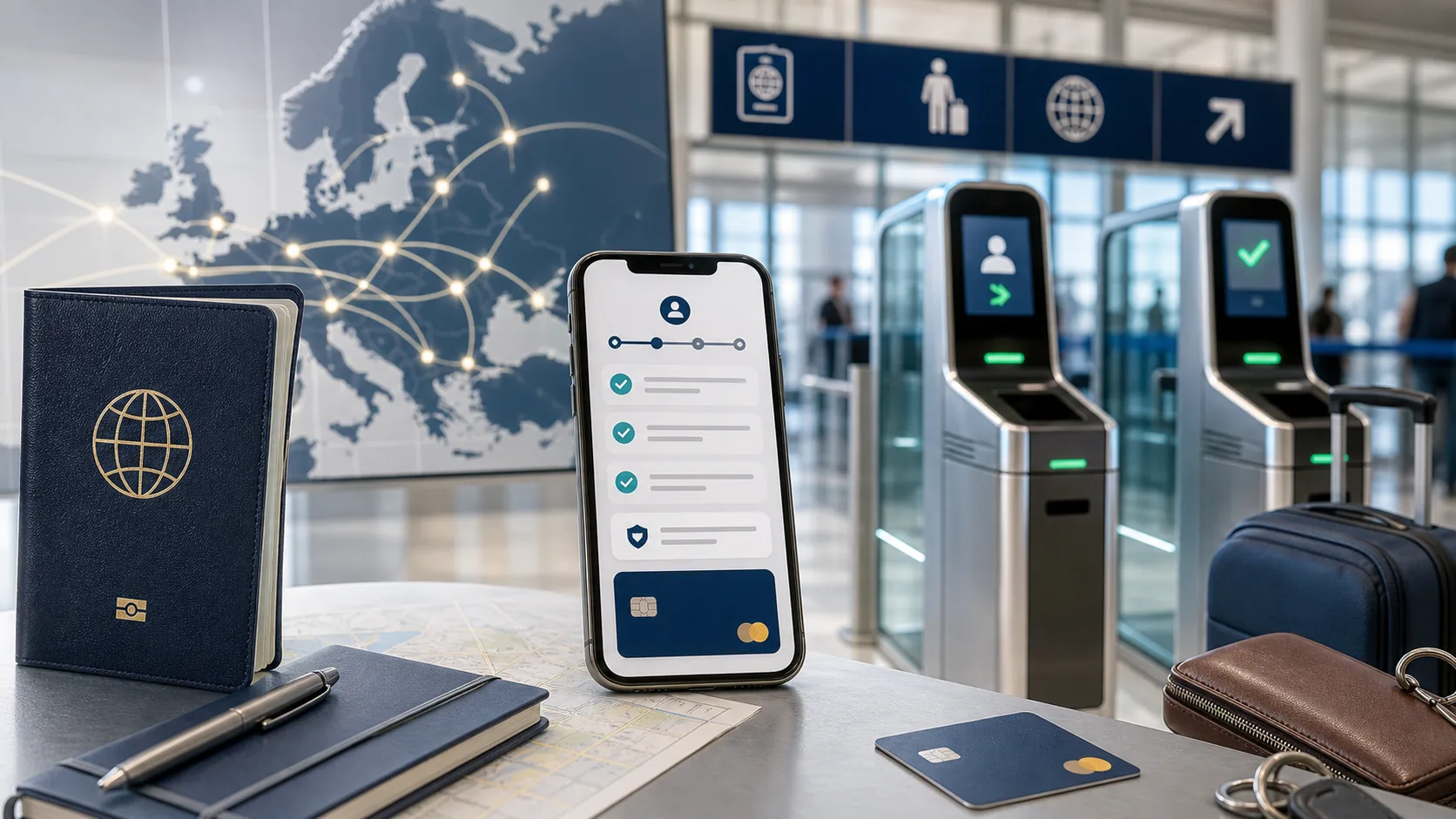
    A UK passport with a travel-authorisation approval and EU stars, illustrating ETIAS for UK travellers in 2026
    Updated for 2026 · Last checked 9 July 2026

    ETIAS for UK travellers is a new pre-travel authorisation you will need for short trips to most of Europe once the system launches, expected in the last quarter of 2026. It is not a visa, it costs €20 (free for under-18s and over-70s), and it lasts up to three years. You do not need to apply yet — the system is not live — but it is worth understanding before you book.

    ETIAS quick facts

    • What it is: the European Travel Information and Authorisation System — an online travel authorisation, not a visa.
    • Who needs it: UK passport holders (and other visa-exempt travellers) for short stays in the Schengen area and Cyprus.
    • When: expected to start in the last quarter of 2026; the exact date is not yet confirmed.
    • Cost: €20 (about £17), free for travellers under 18 or over 70.
    • Validity: up to 3 years, or until your passport expires — whichever comes first.
    • Where to apply: only the official EU ETIAS website or app, once it opens. It is not open yet.
    • Not the same as EES: ETIAS is a pre-travel authorisation; the EU Entry/Exit System (EES) is the biometric check at the border.

    What is ETIAS?

    ETIAS is the European Travel Information and Authorisation System — an online travel authorisation for visa-exempt visitors to Europe, sometimes loosely called an ETIAS visa waiver. It is not a visa.

    Once live, UK passport holders will complete a short online application, linked to their passport, before travelling to participating European countries for short stays. It is designed as a light-touch security pre-check, similar in spirit to the US ESTA. Because the UK is outside the EU, British travellers fall into the group that will need this Europe travel authorisation for the first time.

    Do UK travellers need ETIAS in 2026?

    Not yet — but you will once ETIAS launches, expected in late 2026, if you do not already hold a visa or residence permit.

    UK passport holders travelling to the Schengen area and Cyprus for short stays (up to 90 days in any 180) will need an approved ETIAS before they travel, once the system is running. Until it officially opens, there is nothing to apply for and nothing to pay. If your trip is booked before ETIAS goes live, you will not need it for that journey — but keep an eye on the launch timing for trips later in the year.

    When does ETIAS start?

    ETIAS is expected to start in the last quarter of 2026, but the exact date has not been confirmed.

    The launch is tied to the rollout of the new EU border checks under the Entry/Exit System, which came first. ETIAS is expected to follow roughly six months later, with the official start date announced several months in advance. There is also likely to be a transition period after launch, during which travellers are given time to comply. In short: expect it around Q4 2026, but treat any single date as provisional until the EU confirms it.

    How much does ETIAS cost?

    ETIAS costs €20 (about £17). It is free for applicants under 18 or over 70.

    The fee was confirmed at €20 — higher than the €7 figure quoted in earlier reports, so ignore older €7 references. One approved ETIAS covers multiple trips during its validity, so it is a one-off cost rather than a per-trip charge. You pay only when you apply through the official system; there is nothing to pay now.

    Fee exemption: travellers under 18 or over 70 still need an ETIAS but do not pay the €20 fee.

    How long does ETIAS last?

    An approved ETIAS is valid for up to three years, or until your passport expires — whichever comes first.

    Because it is linked to your passport, renewing your passport means applying for a new ETIAS. Within its validity, you can use the same authorisation for multiple short trips to participating countries, so most travellers will only apply every few years.

    How to apply for ETIAS from the UK

    You will apply online through the official EU ETIAS website or app once it opens — it is not open yet.

    When the system is live, the application is expected to take a few minutes: enter your passport details, answer some background questions, pay the €20 fee, and most approvals should come through quickly. You cannot apply today, and you should never use a third-party site claiming to take ETIAS applications now.

    Beware of scam websites. Any site currently charging for ETIAS is fraudulent. Only apply through the official EU ETIAS website or app, and only once it has launched.

    Which countries will require ETIAS?

    ETIAS will apply to the Schengen area and Cyprus — around 30 European countries. It will not apply to Ireland.

    That covers popular UK destinations such as Spain, France, Italy, Portugal, Greece, the Netherlands and Germany. Ireland is not in the Schengen area, and UK travellers use the Common Travel Area, so you will not need ETIAS for trips to Ireland. Always check the official list of ETIAS countries for your specific destination before you travel.

    ETIAS vs EES: what’s the difference?

    EES registers your entry and exit at the border with biometrics; ETIAS is an online authorisation you get before you travel.

    ETIASEES
    What it isPre-travel authorisationBorder entry/exit registration
    When it happensBefore you travel (online)At the border (in person)
    Cost€20 (exemptions apply)Free
    What’s involvedShort online form + passportFingerprints + facial scan
    ValidityUp to 3 years / passportRecord kept per crossing

    They work together: you get your ETIAS before the trip, then your details are recorded by EES at the border. For the border-queue side of the story, see our full EES guide for UK travellers.

    Quick definitions

    ETIAS
    European Travel Information and Authorisation System — an online pre-travel authorisation for visa-exempt visitors to Europe.
    Travel authorisation
    Permission to travel granted before departure — lighter than a visa, tied to your passport.
    Schengen Area
    A group of European countries with shared external border rules; the main area where ETIAS will apply, along with Cyprus.
    EES (Entry/Exit System)
    The EU’s biometric system that records non-EU travellers entering and leaving at the border.
    UK ETA
    The UK’s own travel authorisation for visiting or transiting the UK — a completely separate system from ETIAS. If your trip also includes Britain, see our UK ETA 2026 guide.

    Do I need ETIAS? A quick check

    You will most likely need ETIAS (once it launches) if all of these apply:

    • You hold a UK (or other visa-exempt) passport.
    • You are travelling to a Schengen-area country or Cyprus for a short stay.
    • You do not already hold a visa or residence permit for that country.

    You will not need ETIAS for Ireland, and you do not need it for any trip taken before the system officially launches.

    What UK travellers should do before booking Europe trips

    • Check your passport validity well ahead — ETIAS is linked to your passport, and Europe has its own passport-validity rules.
    • Note the expected launch (Q4 2026) so you know whether a given trip will need ETIAS.
    • Bookmark the official EU ETIAS site and apply only there, once it opens.
    • Plan for the border checks too — read our EES for UK travellers guide and build in extra time at busy periods.
    • Sort your airport logistics early with our airport arrival time calculator.

    Common ETIAS mistakes to avoid

    • Applying too early on a scam site — the official system is not open yet; anyone charging now is fraudulent.
    • Confusing ETIAS with a visa — it is a lighter travel authorisation, not a visa.
    • Assuming it covers Ireland — it does not.
    • Relying on the old €7 figure — the confirmed fee is €20.
    • Forgetting the passport link — renew your passport and you will need a fresh ETIAS.

    FAQs about ETIAS for UK travellers

    Do UK citizens need ETIAS?

    Yes, once ETIAS launches (expected in the last quarter of 2026), UK passport holders will need it for short stays in the Schengen area and Cyprus, unless they already hold a visa or residence permit.

    When will ETIAS start?

    ETIAS is expected to start in the last quarter of 2026. The exact date is not yet confirmed, and there is likely to be a transition period after launch.

    How much does ETIAS cost?

    €20 (about £17). It is free for travellers under 18 or over 70. One approved ETIAS covers multiple trips during its validity.

    Is ETIAS a visa?

    No. ETIAS is a travel authorisation for visa-exempt travellers, not a visa. It is a lighter, online pre-travel check.

    Do children need ETIAS?

    Yes, all travellers need an ETIAS, but applicants under 18 are exempt from the €20 fee.

    How long is ETIAS valid?

    Up to three years, or until your passport expires, whichever comes first. It is linked to the passport you apply with.

    Do I need ETIAS for Ireland?

    No. Ireland is not in the Schengen area, and UK travellers use the Common Travel Area, so ETIAS is not required for trips to Ireland.

    What is the difference between ETIAS and EES?

    EES registers your entry and exit at the border using biometrics; ETIAS is an online authorisation you obtain before you travel. You get ETIAS first, then EES records you at the border.

    Can I apply for ETIAS now?

    No. The system is not live yet, so there is nothing to apply for. Any website taking ETIAS applications today is a scam.

    Where should I apply for ETIAS?

    Only through the official EU ETIAS website or app, and only once it has launched. Avoid third-party sites that charge extra fees.

    The bottom line

    ETIAS for UK travellers is coming, most likely in the last quarter of 2026: a €20 online travel authorisation, valid up to three years, for short trips to the Schengen area and Cyprus. There is nothing to do yet — the system is not open — but understanding it now means no surprises when you book. When it launches, apply only through the official EU site, and remember it works alongside the EES border checks rather than replacing them.

    Disclaimer: Travel rules can change. Always check official EU and GOV.UK guidance before travelling.

    Planning a Europe trip? TripBuffer helps you prepare for smoother journeys, airport transfers, and travel updates before you go.

    Sources

    Based on the official EU Travel Europe (ETIAS) and GOV.UK EU Entry/Exit System guidance. Last checked 9 July 2026 — ETIAS timing and details can change, so confirm on the official EU and GOV.UK pages before you travel.

  • UK Airport Drop-Off Charges 2026: Every Airport Compared

    UK Airport Drop-Off Charges 2026: Every Airport Compared

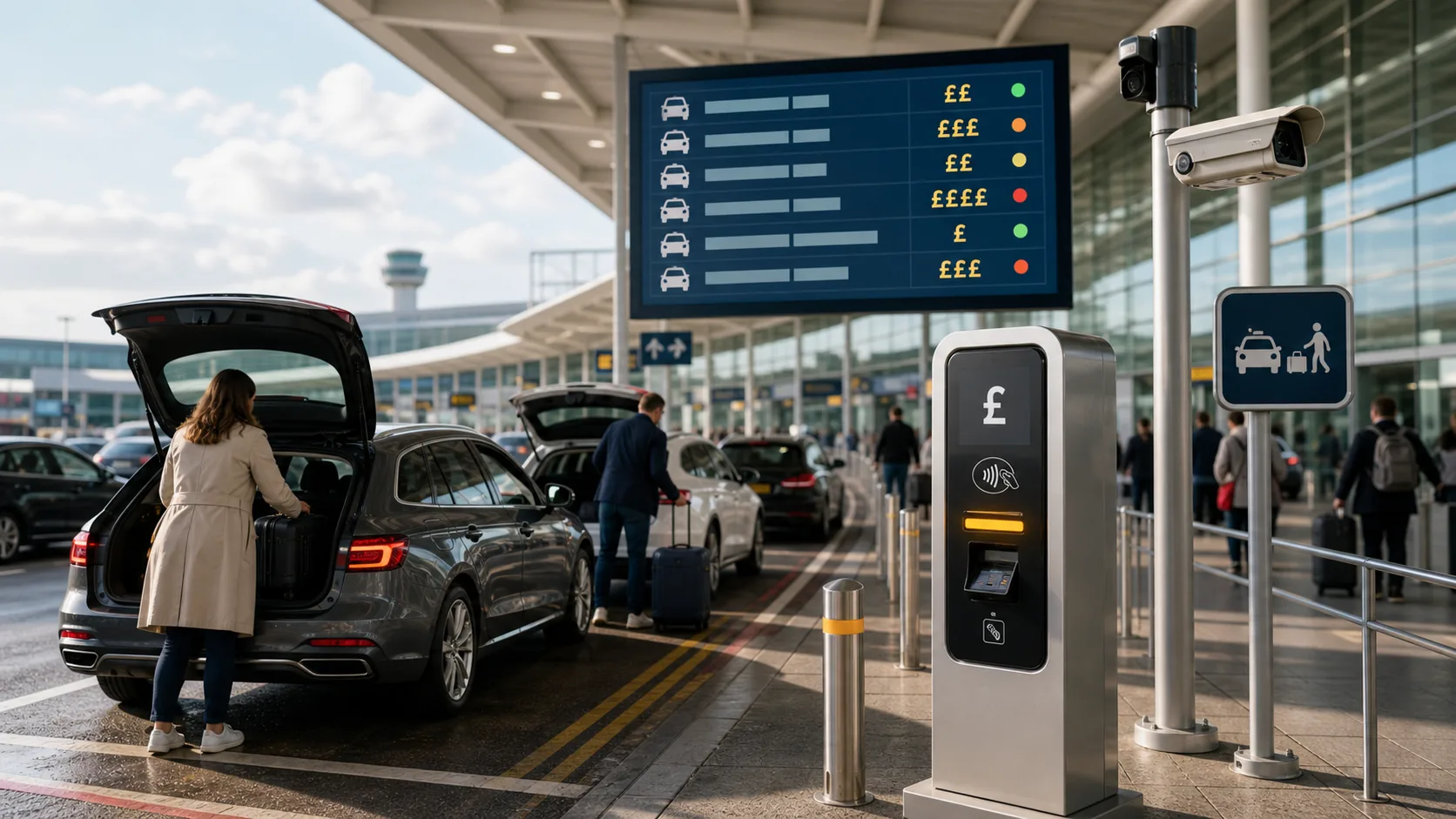
    A car dropping off a passenger with luggage at a UK airport terminal kerbside, illustrating 2026 drop-off charges
    Updated for 2026 · Last checked 9 July 2026

    Most major UK airports now charge drivers to drop passengers directly outside the terminal, with fees ranging from around £3 to £13 for roughly 10 minutes in 2026. A handful of airports still offer free drop-off, but these zones are usually further from the terminal and need a short walk or shuttle bus. This guide compares the UK airport drop-off charges for every major airport, shows where the free options are, and explains how to avoid paying more than you need to.

    At a glance: UK airport drop-off charges 2026

    • Most expensive: London City at £13, followed by Gatwick and Stansted at £10.
    • Cheapest paid drop-off: Cardiff at £3, then Inverness (£3.90) and Belfast City (£4).
    • Free terminal drop-off: a few regional airports (e.g. Cornwall Newquay); Birmingham has a free drop-off zone with a free bus.
    • Free alternative everywhere: nearly every airport offers a free long-stay or “park & ride” option a short walk or shuttle away.
    • Best way to avoid charges: use the free zone, or for two or more travellers, compare airport transfer prices against fuel, parking and drop-off combined.

    UK airport drop-off charges 2026: full comparison table

    The table below lists the standard terminal (or “express”) drop-off charge at each airport, the time it buys you, the penalty for overstaying to 30 minutes where one applies, and whether a free option exists nearby. Charges are ordered from most to least expensive.

    Airport2026 drop-off chargeTime allowedOverstay (to 30 min)Free option?
    London City£1310 min maxNo
    Gatwick£1010 min£30Yes — long-stay free 2 hrs + shuttle
    Stansted£1010 min£28Yes — mid-stay free 1 hr + shuttle (~7 min)
    Bristol£8.5010 min£13Yes — free 1-hr waiting zone + buses
    Edinburgh£8.5010 min£28.50Yes — long-stay free 30 min, ~10-min walk
    Bournemouth£810 min£8Limited
    Leeds Bradford£810 min£13.50Yes — free 1-hr zone, 3–4 min walk
    Norwich£810 min£15Limited
    Southend£810 min maxLimited
    Aberdeen£710 min£22Yes — long-stay free 1 hr + shuttle
    Birmingham£7 (express)10 min£24Yes — free drop-off zone 10 min + free bus
    Glasgow£710 min£22Yes — long-stay free 1 hr + shuttle
    Heathrow£710 min maxYes — park & ride free up to 29 min + bus
    Luton£710 min£27Yes — long-stay free 2 hrs + shuttle
    Southampton£710 min£15Yes — Airport Parkway free option
    Manchester£5 (5 min), up to £6.50 (10 min)5–10 min£25Yes — JetParks 1 free + 5-min shuttle
    Liverpool£610 min£25Yes — Drop Off 2 free 20 min, 5–10 min walk
    Newcastle£610 min£12Yes — waiting zone free 1.5 hrs + shuttle
    Exeter£610 min£15Yes — Car Park P4 free 30 min
    Belfast International£510 min£13Yes — long-stay free 15 min, 6-min walk
    East Midlands£510 min£20Yes — long-stay free 1 hr + bus
    Glasgow Prestwick£4.5010 min£4.50Limited
    Belfast City£410 min£20Yes — long-stay free 10 min, 5-min walk
    Inverness£3.9010 min£3.90Yes — short-stay free 15 min
    Cardiff£310 min£9Yes — Car Park 2 free 20 min
    Cornwall NewquayFree10 minFree drop-off

    Last checked: 9 July 2026. Figures based on official airport pages and consumer reporting (see methodology). Charges and time limits change frequently — always check the airport’s own website before you travel. Where a fee could not be confirmed, we have marked the free option as “Limited”; check the airport website before travel.

    The key finding: nearly every large UK airport now charges for terminal drop-off, and the fees have crept up — but almost all of them also run a free drop-off or park & ride option a few minutes’ walk or shuttle away. The charge you see at the barrier is rarely the only choice; the cheapest option is usually signposted as “free drop-off”, “park & ride” or “long-stay”.

    Quick definitions

    Drop-off charge
    A fee to stop your car directly outside the terminal to let passengers out, usually for around 10 minutes.
    Kiss & fly
    The informal name for the terminal drop-off zone — a quick goodbye before the driver leaves.
    Express drop-off
    The premium zone closest to the terminal doors, which is the one that carries the charge at most airports.
    Free drop-off zone
    A no-cost drop-off area, typically in a long-stay or park & ride car park, reached by a short walk or a free shuttle bus.

    Which UK airport has the highest drop-off charge in 2026?

    London City is the most expensive at £13, followed by Gatwick and Stansted at £10.

    At the pricier airports the sting is also in the overstay penalty: linger past your free minutes and Edinburgh charges up to £28.50, Stansted £28 and Luton £27 for staying to 30 minutes. If your passenger is slow to unload, those minutes add up fast — another reason to plan the drop-off, not improvise it. Our airport arrival time calculator helps you time the run so no one is left waiting at the kerb.

    Which UK airports still offer free drop-off?

    A few regional airports (such as Cornwall Newquay) still offer free terminal drop-off, and Birmingham runs a genuinely free drop-off zone with a free bus.

    Beyond those, “free” almost always means a free drop-off zone in a long-stay or park & ride car park, reached by a short walk or shuttle. Gatwick, Stansted and Luton all offer up to 1–2 hours free there; Heathrow’s park & ride is free for up to 29 minutes with a free bus. It is the same airport, just a slightly longer walk — and often the difference between paying £10 and paying nothing.

    Heathrow drop-off charge 2026

    Heathrow’s terminal drop-off charge is £7 for up to 10 minutes in 2026.

    There is no cash option — payment is by number-plate recognition, and you must pay by midnight the day after (miss it and you risk a fine). To avoid the Heathrow drop-off charge entirely, use the free park & ride for your terminal, which allows up to 29 minutes free with a free bus transfer to departures. If you are heading into the city afterwards, compare your options for Heathrow airport transfers as well.

    Gatwick drop-off fee 2026

    Gatwick charges £10 for 10 minutes at the terminal drop-off in 2026, with penalties up to £30 if you stay to 30 minutes.

    Gatwick is one of the most expensive kiss & fly zones in the UK. The free alternative is the long-stay car park, which gives up to two hours free plus a 10–12 minute shuttle to the terminal — ideal if you have time to spare or are collecting someone. For onward travel, see Gatwick airport transfers.

    Manchester Airport drop-off charge 2026

    Manchester charges around £5 for the first 5 minutes at the terminal, rising to about £6.50 for 10 minutes, with overstay penalties up to £25.

    Manchester’s drop-off is tiered, so the true cost depends on how long you stop. The free option is JetParks 1, which offers free drop-off with a five-minute shuttle to the terminals. With three busy terminals, it pays to know which one your flight uses before you set off — check your UK airport travel guides and booking confirmation.

    How to avoid UK airport drop-off charges

    You have more options than the barrier suggests:

    • Use the free drop-off / park & ride zone. Almost every airport has one; follow signs for “free drop-off”, “long-stay” or “park & ride” and take the shuttle.
    • Drop at a nearby station. At airports with a rail or tram link (Gatwick, Stansted, Luton, Manchester, Birmingham), dropping at the station and letting passengers take the short transfer can be free.
    • Don’t overstay. Unload quickly — the overstay penalties (up to £28.50) dwarf the base fee.
    • Pay on time. Most airports use number-plate cameras and require payment by the following day; a missed payment becomes a fine of £60+.
    • Check Blue Badge rules. Many airports waive or reduce the charge for Blue Badge holders — check the airport’s accessibility page.
    • Consider a pre-booked transfer if several of you are travelling — more on that next.

    Is an airport transfer cheaper than paying drop-off and parking fees?

    For two or more travellers, a pre-booked airport transfer can work out cheaper and less stressful than fuel, drop-off and parking combined.

    A single drop-off looks cheap at £7–£10, but add the return journey to collect someone, fuel both ways, and any parking while you wait, and the real cost climbs. If a group is travelling together, one fixed-price transfer removes the drop-off fee, the parking, the fuel and the waiting-time stress in one go. It is worth running the numbers rather than assuming driving is always cheapest — compare airport transfer prices for your route and see how they stack up against the total driving cost.

    Drop-off charges vs airport transfer: which is better?

    SituationUsually betterWhy
    Solo traveller, someone free to driveFree drop-off zoneNo fare to pay; just a short walk or shuttle
    Two or more travellers with luggagePre-booked transferOne fixed price often beats fuel + drop-off + parking
    Very early or late flightTransferNo one has to make a round trip at 4am
    Collecting arrivalsFree long-stay + waitFree waiting time while the flight lands
    Tight connection or unfamiliar airportTransferDoor-to-door, no parking hunt

    There is no single winner — it depends on group size, timing and whether someone can drive. Use the best time to leave calculator and the transfer comparison together to decide.

    Tips for families, elderly passengers, business travellers and early flights

    • Families: the free zone plus a shuttle is usually worth it with children — but allow extra minutes for car seats and buggies so you don’t overstay the paid zone.
    • Elderly or reduced-mobility passengers: check Blue Badge concessions and pre-book special assistance; the terminal drop-off may be worth the fee for a shorter walk.
    • Business travellers: a pre-booked transfer with a fixed price and no parking is often the fastest, most predictable option.
    • Early-morning flights: plan the drop-off time carefully with our airport arrival time calculator so you are not rushing, and factor in the shuttle wait if you use a free zone.

    Key takeaways

    • Most UK airports charge £3–£13 for terminal drop-off in 2026; London City (£13), Gatwick and Stansted (£10) are the priciest.
    • Overstay penalties are the real trap — up to £28.50 — so unload quickly.
    • Almost every airport has a free drop-off or park & ride option a short walk or shuttle away.
    • Pay by number plate on time (usually by the next day) to avoid a £60+ fine.
    • For groups and awkward flight times, a pre-booked transfer can beat drop-off, fuel and parking combined.

    How we checked these fees (methodology)

    The charges above were compiled from official UK airport websites and cross-checked against up-to-date consumer reporting, then last verified on 9 July 2026. Airport fees change frequently and can vary by zone, time of day and vehicle type, so we have flagged anything we could not confirm rather than guess. TripBuffer focuses on helping travellers plan airport timing and compare transfer options, so where a charge affects the best way to reach the airport, we have linked to the relevant tool or comparison.

    Disclaimer: Airport fees can change without notice. Always check the official airport website before travelling, and confirm your terminal and drop-off arrangements in your booking confirmation.

    FAQs

    What is an airport drop-off charge?

    A fee some airports charge for stopping your car directly outside the terminal to let passengers out, typically covering around 10 minutes.

    Why do UK airports charge for drop-off?

    Airports say the charges manage congestion at the terminal forecourt and encourage the use of public transport and car parks; they are also a significant source of revenue.

    Which UK airport has the highest drop-off charge in 2026?

    London City at £13, followed by Gatwick and Stansted at £10.

    Can I drop someone at Heathrow for free?

    Yes. The terminal drop-off costs £7, but Heathrow’s park & ride is free for up to 29 minutes with a free bus to departures.

    How much is Gatwick drop-off in 2026?

    £10 for 10 minutes at the terminal, with penalties up to £30 if you stay to 30 minutes. The long-stay car park offers up to two hours free plus a shuttle.

    How much is Manchester Airport drop-off?

    Around £5 for the first 5 minutes, rising to about £6.50 for 10 minutes, with overstay penalties up to £25. JetParks 1 offers free drop-off with a shuttle.

    What happens if I do not pay an airport drop-off charge?

    Most airports use number-plate cameras and require payment by the following day. Miss the deadline and the charge usually becomes a fine of £60 or more.

    Are taxis and private hire vehicles charged airport drop-off fees?

    Often yes, though many airports have separate taxi and private hire arrangements or permits. Drivers should check the airport’s operator rules.

    Is there a free drop-off zone at most UK airports?

    Yes. Nearly every large UK airport offers a free drop-off or park & ride option, usually a short walk or shuttle from the terminal.

    Is it cheaper to book an airport transfer?

    It can be, especially for two or more travellers, once you add fuel, drop-off and parking for a driving trip. Compare a fixed-price transfer against the total driving cost.

    What is kiss and fly at an airport?

    “Kiss & fly” is the informal name for the terminal drop-off zone — a quick goodbye before the driver leaves. At most UK airports it now carries a charge.

    How can I avoid airport drop-off charges?

    Use the free drop-off or park & ride zone, drop at a nearby station where there is a rail or tram link, avoid overstaying, and consider a pre-booked transfer for groups.

    The bottom line

    UK airport drop-off charges are now the norm rather than the exception in 2026, ranging from £3 at Cardiff to £13 at London City — with steep penalties for overstaying. But the barrier is rarely your only option: almost every airport has a free drop-off or park & ride zone a short shuttle away, and for groups a pre-booked transfer can beat driving once fuel and parking are added. Check your airport’s official page before you travel, plan your timing, and you can usually avoid paying more than you need to.

    Sources

    Fee data compiled from official UK airport websites and cross-checked against MoneySavingExpert (last updated 26 June 2026). Last checked 9 July 2026 — airport charges change frequently, so always confirm on the official airport website before travelling.

  • Can You Take a Power Bank on a Plane? UK Rules 2026

    Can You Take a Power Bank on a Plane? UK Rules 2026

    A power bank charging a phone in an aircraft cabin bag, illustrating UK power bank flight rules for 2026
    Updated 14 July 2026 · new ICAO/CAA rules from 27 March 2026

    Can you take a power bank on a plane? Yes — but only in your hand luggage, never in checked baggage. Power banks up to 100Wh are allowed without airline approval, those between 100Wh and 160Wh need your airline’s permission, and anything over 160Wh is banned. Under the 2026 rules you can carry a maximum of two per person and must not recharge them in flight. Here is exactly what that means for UK travellers.

    Quick answer: are power banks allowed on planes?

    • Yes, in hand luggage only — power banks are spare lithium batteries and are banned from checked luggage.
    • Up to 100Wh: allowed, no approval needed (covers most power banks, e.g. a 20,000mAh unit).
    • 100Wh–160Wh: allowed only with airline approval.
    • Over 160Wh: not allowed on passenger aircraft.
    • Maximum of two power banks per passenger; do not recharge them on board.
    • Airlines can be stricter than the UK baseline — always check yours before you fly.

    What changed in the 2026 ICAO/IATA power bank rules?

    From 27 March 2026, updated international guidance from ICAO and IATA — reflected by the UK Civil Aviation Authority — tightened how passengers can carry power banks and spare lithium batteries. The headline changes are:

    • A clear maximum of two power banks per person.
    • Power banks must not be recharged on board the aircraft.
    • They should not be used to charge other devices during the flight.
    • They must not be stored in the overhead lockers — keep them within reach, in the seat pocket or under the seat in front, so crew can act fast if a battery overheats.
    • Each spare battery must be individually protected from short circuits (kept in its case or a bag, terminals covered).

    The watt-hour limits (100Wh and 160Wh) themselves are unchanged — what changed in 2026 is the quantity, in-flight use and packaging guidance.

    UK power bank flight rules at a glance

    Here are the power bank flight rules in a form you can scan in seconds:

    Power bank capacityRoughly (at 3.7V)In hand luggage?Airline approval?Max number
    Up to 100WhUp to ~27,000mAhYesNo2
    100Wh – 160Wh~27,000–43,000mAhYesYes — required2
    Over 160WhOver ~43,000mAhNo — banned0
    Any size in checked luggageNo — never0

    Based on UK CAA / IATA guidance effective 27 March 2026. Approximate mAh figures assume a typical 3.7V lithium-ion cell. Always check your airline before flying.

    Quick definitions

    Power bank
    A portable battery pack that stores energy to charge phones, tablets and other devices on the go. Airlines treat it as a spare lithium battery.
    Portable charger
    Another name for a power bank — the rules are identical.
    Watt-hour (Wh)
    The energy capacity of a battery, and the figure airlines use to decide if it is allowed. Calculated as Wh = mAh × V ÷ 1000.
    Spare lithium battery
    Any lithium battery not installed inside a device — including power banks. These must travel in the cabin, never in the hold.

    Can you take a power bank on a plane in hand luggage?

    Yes. A power bank must go in your hand luggage (cabin baggage) and can be up to 100Wh without approval.

    Because a power bank is a spare lithium battery, aviation rules require it to be in the cabin with you, where crew can act quickly in the rare event of a battery fault. Keep it easy to reach for the security tray, and protect the terminals so it cannot short circuit against keys or coins. For everything else that goes in your bag, see our full UK hand luggage rules.

    Can you put a power bank in checked luggage?

    No. Power banks are banned from checked luggage on UK and international flights.

    Spare lithium batteries are not allowed in the hold because a fault there would be much harder to detect and control. If security or check-in staff find a power bank in a checked bag, they will ask you to remove it — and it may be confiscated if you have already dropped the bag. Never pack a power bank, spare phone battery or loose lithium cell in your checked baggage.

    Can you take a portable charger on a plane?

    Yes — a portable charger is just another name for a power bank, so the same rules apply.

    Carry your portable charger on a plane in your hand luggage, keep it under 100Wh (or get airline approval for 100–160Wh), and bring no more than two. There is no separate category for “portable chargers” — security treats them exactly like power banks.

    What size power bank is allowed on a plane?

    Up to 100Wh with no approval; 100–160Wh with airline approval; over 160Wh is not allowed.

    The power bank size limit is measured in watt-hours (Wh), not physical size or mAh alone. Most consumer power banks sit comfortably under 100Wh, so they are fine. The trouble starts with very high-capacity chargers marketed at 30,000mAh and above, which can cross the 100Wh line.

    How to check your power bank’s Wh rating

    Many power banks print the Wh figure on the casing. If yours only shows mAh, work it out with this formula:

    Wh = mAh × V ÷ 1000
    Most power banks use a 3.7V lithium-ion cell, so:

    • 10,000mAh × 3.7 ÷ 1000 = 37Wh — fine
    • 20,000mAh × 3.7 ÷ 1000 = 74Wh — fine
    • 27,000mAh × 3.7 ÷ 1000 = 99.9Wh — just under the limit
    • 30,000mAh × 3.7 ÷ 1000 = 111Wh — over 100Wh, needs airline approval

    As a rule of thumb, anything up to about 27,000mAh at 3.7V stays under 100Wh. Above that, check the Wh rating and your airline’s policy.

    Can you use a power bank during a flight?

    Under the 2026 rules you should not use a power bank to charge devices during the flight, and many airlines now prohibit it.

    The updated CAA guidance says power banks should not be used to charge other portable electronic devices on board. Some airlines allow limited, supervised use; a growing number ban it outright, especially storing a power bank in the overhead locker while it is in use. The safe approach in 2026: charge your devices before you board and keep the power bank switched off in the cabin unless your airline clearly permits use.

    Can you charge a power bank on the plane?

    No. You must not recharge a power bank on board, for example from a seat-back USB port.

    Recharging a power bank in flight is specifically not allowed under the 2026 rules. Seat USB ports are intended for phones and tablets, not for topping up spare batteries. Arrive with your power bank already charged.

    How many power banks can you take on a plane?

    A maximum of two power banks per passenger.

    The 2026 guidance sets a clear ceiling of two power banks per person. If you are travelling as a family, each traveller has their own allowance, but pack sensibly — two well-marked, sub-100Wh power banks cover almost any trip.

    What about larger power banks between 100Wh and 160Wh?

    Allowed only with your airline’s prior approval, and still limited to two per person.

    Power banks in the 100–160Wh band — typically high-capacity units around 30,000–43,000mAh — are permitted only if your airline agrees in advance. Contact the airline before you travel; do not assume approval, as staff can refuse an oversized battery at the gate.

    Airline rules can be stricter

    The CAA sets the UK baseline, but individual airlines can — and increasingly do — add their own restrictions on using or storing power banks in the cabin. A rule that is fine on one carrier may be tighter on another, and destination countries can differ too. Always check the operating airline’s dangerous-goods or restricted-items page before you fly, especially for connecting or long-haul flights.

    Airline power bank rules compared (2026)

    Some carriers are now noticeably stricter than the UK baseline — a few allow only one power bank, and the major US airlines have explicitly banned storing them in the overhead lockers. Here is how popular airlines compare in 2026:

    AirlineMax power banksWh limitUse to charge devices in flight?Overhead locker?
    British Airways2Up to 110WhCruise onlyNo — under the seat in front
    easyJet2Up to 160WhCruise onlyNo — keep with you
    Ryanair2Up to 100WhCruise onlyNo — under seat / on you
    Jet22Up to 160Wh*Cruise onlyNo — keep with you
    Emirates1Up to 100WhNo — in-flight use bannedNo
    American Airlines2Up to 100WhKeep visible; must not recharge the bankNo — banned
    Delta Air Lines2Up to 100WhKeep visible; must not recharge the bankNo — banned
    United Airlines2Up to 160WhCarry-on only; must not recharge the bankNo — banned
    Southwest1Up to 100WhNo — use/recharge bannedNo — banned

    *Jet2 requires a clearly printed Wh rating and short-circuit protection. Compiled from each airline’s published guidance and reputable 2026 reporting; verified 14 July 2026. Southwest’s one-charger limit applied from 20 April 2026 and the US carriers’ overhead-locker ban from around 1 May 2026. Airlines change these frequently — confirm with your carrier before you fly.

    The 2026 headline for every airline: keep power banks in the cabin, don’t recharge them in flight, and don’t stow them in the overhead locker — keep them within reach.

    UK airport power bank rules: Heathrow, Gatwick, Manchester and beyond

    The power bank rules are set nationally, so they are the same at every UK airport — Heathrow, Gatwick, Manchester, Luton, Stansted, Birmingham, Edinburgh, Glasgow, Bristol and the rest. Security at any UK airport can ask to see your power bank, check its Wh or mAh marking, and refuse it if it is over the limit or unmarked. What varies is not the airport but your airline and your destination, so plan around those.

    Power bank rules vs UK liquid rules

    Travellers often lump power banks in with the liquids rule, but they work very differently:

    Power banksLiquids
    Where they goHand luggage onlyHand luggage (hold is fine too)
    Checked luggageBannedAllowed
    Limit100Wh / 160Wh with approval100ml or 2 litres, by airport
    Plastic bag neededNoNo (at most UK airports now)

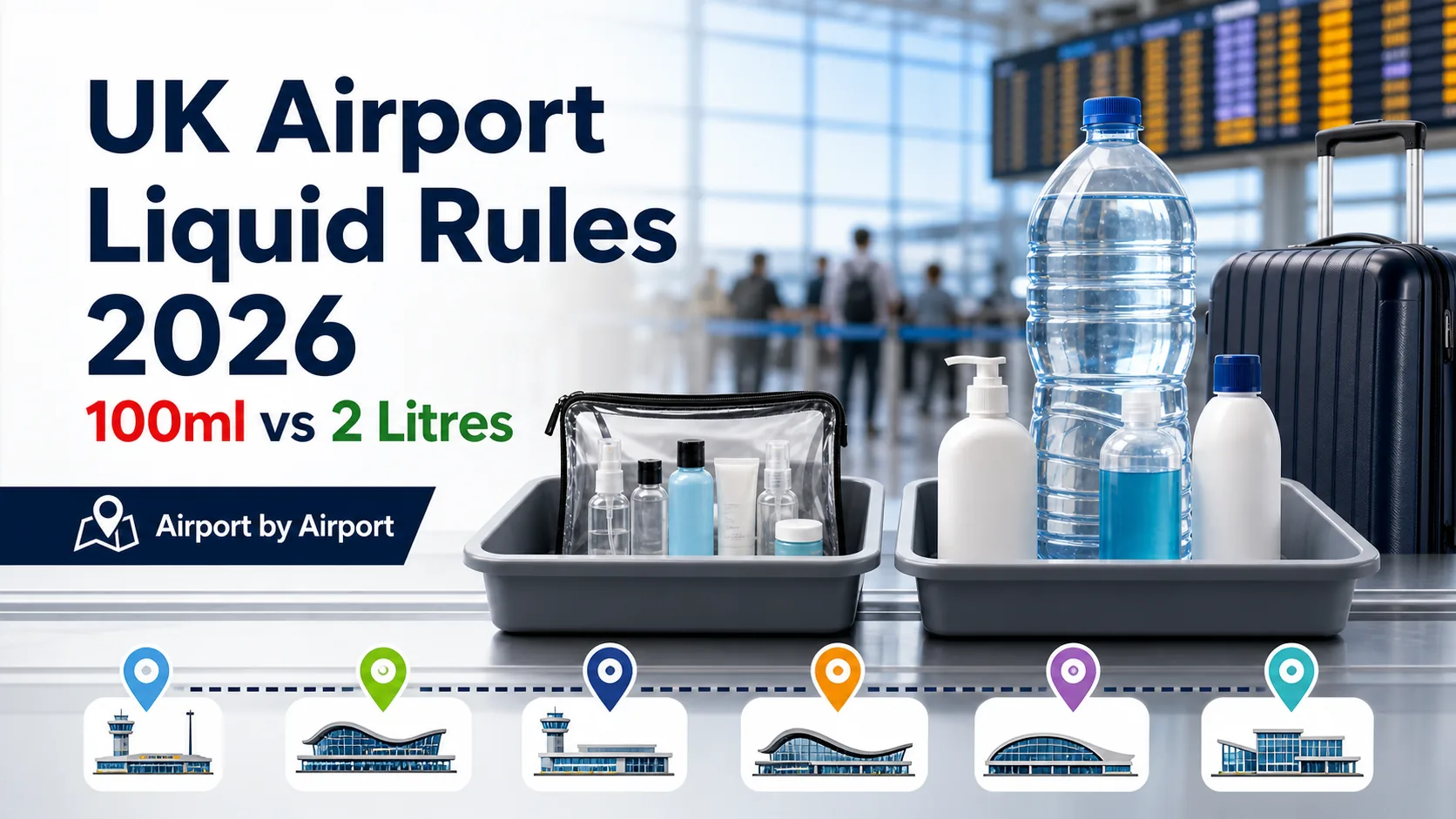
    In short, liquids can go in the hold but power banks cannot. For the latest security-lane liquid limits, see our guide to the UK airport liquid rules.

    Common mistakes that could get your power bank refused

    • Packing it in checked luggage — the single most common reason a power bank is pulled or confiscated.
    • No visible Wh or mAh marking — if staff cannot confirm the capacity, they can refuse it.
    • Assuming a 30,000mAh unit is fine — it is likely over 100Wh and needs approval.
    • Bringing three or more — over the two-per-person limit.
    • Loose in a bag with keys or coins — a short-circuit risk; keep terminals protected.
    • Recharging or using it in flight where the airline prohibits it.

    Packing checklist before you fly

    ✓ Power bank(s) in your hand luggage, never checked
    ✓ Capacity under 100Wh (or airline approval for 100–160Wh)
    No more than two power banks per person
    Wh/mAh marking visible on the casing
    Fully charged before boarding (you can’t recharge on board)
    ✓ Terminals protected from short circuits
    ✓ Checked your airline’s specific policy

    FAQs

    Can you take a power bank on a plane in the UK?

    Yes. A power bank is allowed in hand luggage only. Up to 100Wh needs no approval, 100–160Wh needs airline approval, and over 160Wh is banned. You can carry a maximum of two, and they must never go in checked luggage.

    Can I take a portable charger in hand luggage?

    Yes. A portable charger is the same as a power bank and must be carried in your hand luggage or cabin bag, up to 100Wh without approval.

    Can I put a power bank in checked luggage?

    No. Power banks are spare lithium batteries and are banned from checked luggage. They must travel in the cabin with you.

    What is the power bank size limit for planes?

    100Wh without approval, 100–160Wh with airline approval, and over 160Wh not allowed. The limit is measured in watt-hours, not physical size.

    Is a 20,000mAh power bank allowed on a plane?

    Yes. At 3.7V a 20,000mAh power bank is about 74Wh, well under the 100Wh limit, so it is allowed in hand luggage without approval.

    Is a 30,000mAh power bank allowed on a plane?

    Usually only with airline approval. At 3.7V a 30,000mAh power bank is about 111Wh, just over 100Wh, placing it in the 100–160Wh band that requires the airline’s permission.

    How many power banks can I take on a plane?

    A maximum of two power banks per passenger under the 2026 UK CAA and IATA guidance.

    Can I charge my phone with a power bank during a flight?

    Under the 2026 rules you should not use a power bank to charge devices on board, and many airlines now prohibit it. Charge your devices before you fly and check your airline’s policy.

    Can I recharge my power bank on the plane?

    No. Power banks must not be recharged on board, including from a seat-back USB port. Arrive with it already charged.

    Can I keep a power bank in the overhead locker?

    No. Under the 2026 rules power banks must stay within reach — in the seat pocket or under the seat in front — not in the overhead locker, so crew can act quickly if a battery overheats. US airlines including American, Delta, United and Southwest now ban overhead-bin storage outright.

    Do airport security staff check power bank capacity?

    They can. Security may inspect the Wh or mAh marking and refuse a power bank that is over the limit or unmarked.

    What happens if my power bank has no Wh label?

    It may be refused, because staff cannot confirm it is within limits. Keep the original capacity markings visible, or note the Wh rating.

    Are power bank rules the same for all airlines?

    No. The CAA sets a UK baseline, but airlines can be stricter and destinations can differ. Always check your operating airline before flying.

    Final answer

    So, can you take a power bank on a plane? Yes — in your hand luggage, up to 100Wh without approval, up to 160Wh with your airline’s permission, never in checked baggage, and no more than two per person. Keep it marked, keep it charged before boarding, don’t recharge or use it in flight where prohibited, and check your specific airline. Do that and your power bank will sail through security at any UK airport in 2026.

    Sources

    Based on the UK Civil Aviation Authority guidance on lithium batteries and power banks (rules effective 27 March 2026), aligned with ICAO and IATA passenger lithium-battery guidance. The airline comparison table is compiled from each carrier’s published guidance and reputable 2026 reporting. Verified 14 July 2026 — rules and airline policies change frequently, so confirm with your airline before you travel.

  • easyJet Hand Luggage Size 2026: Cabin Bag Rules & Fees

    easyJet Hand Luggage Size 2026: Cabin Bag Rules & Fees

    easyJet cabin bags - the free 45x36x20 cm under-seat bag and the larger 56x45x25 cm cabin bag, 2026

    easyJet hand luggage is more generous than most budget airlines — but the rules on the free bag versus the larger cabin bag still catch people out. This guide explains the easyJet hand luggage size for 2026 in full: exactly what is free, how to bring a bigger bag, the weight limits, and how to avoid paying more at the airport.

    Quick answer

    • Free for everyone: one small under-seat cabin bag up to 45 x 36 x 20 cm and 15 kg — the most generous free bag of the budget airlines.
    • Large cabin bag (up to 56 x 45 x 25 cm) goes in the locker — free with easyJet Plus, an Inclusive fare, or an Up Front / Extra Legroom seat, or bookable as a paid add-on.
    • Hold luggage (15 kg or 23 kg) is a separate paid extra.
    • Always add the large bag online — it is cheaper than at the airport.

    easyJet hand luggage size 2026: the basics

    easyJet gives every passenger one free bag and offers a larger bag on top. Here is the easyJet hand luggage size breakdown at a glance:

    BagSizeWeightHow to get it
    Small cabin bag (under seat)45 x 36 x 20 cmUp to 15 kgFree on all fares
    Large cabin bag (locker)56 x 45 x 25 cmMust lift it yourselfeasyJet Plus, Inclusive fare, Up Front / Extra Legroom seat, or paid add-on

    Dimensions include handles and wheels. Allowances are the current 2026 rules and can change — always check easyJet before you fly.

    The free easyJet cabin bag (45 x 36 x 20 cm)

    Every easyJet passenger, on every fare, can bring one small cabin bag up to 45 x 36 x 20 cm for free. It must fit under the seat in front of you. At 45 x 36 x 20 cm, the easyJet cabin bag size for the free bag is noticeably bigger than Ryanair’s free allowance, so a small carry-on or a large backpack usually fits without paying anything extra.

    easyJet large cabin bag (56 x 45 x 25 cm)

    If you want a second, bigger bag in the overhead locker, the easyJet large cabin bag can be up to 56 x 45 x 25 cm. You get it free if you are an easyJet Plus member, on an Inclusive fare, or seated in Up Front or Extra Legroom; otherwise you can book a large cabin bag as a paid add-on when you buy your flight. It is always cheaper to add online than at the gate.

    easyJet cabin bag weight

    The free small cabin bag can weigh up to 15 kg, but there is a practical catch: you must be able to lift and carry it yourself. There is no separate weigh-in for the small bag as long as it fits the sizer and you can handle it. The large cabin bag follows the same lift-it-yourself principle.

    easyJet baggage allowance: hold luggage

    Beyond hand luggage, the easyJet baggage allowance for checked bags is a paid extra. You can add hold luggage in weight tiers (commonly 15 kg or 23 kg) when you book, and adding it online is much cheaper than paying at the airport. Hold bags are separate from your free cabin bag, which you keep either way.

    easyJet vs Ryanair cabin bag

    easyJet wins on the free bag: 45 x 36 x 20 cm versus Ryanair’s smaller 40 x 30 x 20 cm. Ryanair’s headline fares are often cheaper, but if you need more than the free allowance, the add-on costs can level things out. See our dedicated Ryanair cabin bag size guide and the full hand luggage size comparison for Ryanair, easyJet, BA and Jet2.

    How to avoid easyJet bag fees

    • Measure with wheels and handles against 45 x 36 x 20 cm before you leave home.
    • A 45 x 36 x 20 cm bag is the sweet spot — it uses your full free allowance without needing a paid large bag.
    • Book the large cabin bag or hold luggage online, never at the gate.
    • Pack light with a list using our Packing List Generator, and keep toiletries within the liquid rules.
    • Allow time at security with the Airport Arrival Time Calculator so a bag issue does not turn into a missed flight.

    Frequently asked questions

    What size is easyJet hand luggage in 2026?

    The free small cabin bag is up to 45 x 36 x 20 cm and fits under the seat. A large cabin bag can be up to 56 x 45 x 25 cm, available with certain fares, seats, easyJet Plus, or as a paid add-on.

    What is easyJet’s free cabin bag size?

    45 x 36 x 20 cm, including handles and wheels. It must fit under the seat in front of you and is free on every fare.

    What is the easyJet cabin bag weight limit?

    The free small cabin bag can weigh up to 15 kg, but you must be able to lift and carry it yourself.

    What is the easyJet large cabin bag size?

    Up to 56 x 45 x 25 cm, stored in the overhead locker. It is free with easyJet Plus, an Inclusive fare, or an Up Front / Extra Legroom seat, or bookable as a paid add-on.

    How do I get a large cabin bag on easyJet?

    Book an Up Front or Extra Legroom seat, an Inclusive fare, hold easyJet Plus membership, or add a large cabin bag as a paid extra when you book.

    Is easyJet hand luggage free?

    Yes. Every passenger gets one free small cabin bag up to 45 x 36 x 20 cm. Only the larger cabin bag and hold luggage cost extra.

    What is easyJet’s baggage allowance for hold luggage?

    Hold luggage is a paid extra, usually in 15 kg or 23 kg tiers, added when you book. It is separate from your free cabin bag.

    Can I bring two bags on easyJet?

    Yes, if you have the large cabin bag allowance (via easyJet Plus, an Inclusive fare, an Up Front / Extra Legroom seat, or a paid add-on) in addition to your free small bag.

    Is easyJet or Ryanair’s cabin bag bigger?

    easyJet’s free under-seat bag (45 x 36 x 20 cm) is bigger than Ryanair’s (40 x 30 x 20 cm), making easyJet more generous on the free allowance.

    Is easyJet hand luggage measured with wheels and handles?

    Yes. The stated sizes include wheels and handles, and the airport sizer is built to those exact measurements.

    What happens if my easyJet bag is too big?

    If your bag exceeds the free allowance and you have not booked a larger bag, you will pay an airport charge to add one, which is more expensive than booking online.

    What is the easyJet Plus cabin bag allowance?

    easyJet Plus members can take one small under-seat cabin bag and one large cabin bag (up to 56 x 45 x 25 cm) on board for free.

    Sources

    Based on easyJet’s published 2026 cabin bag policy, including the easyJet cabin bags page. Checked June 2026 — sizes and fees change, so confirm with easyJet before booking.

  • Ryanair Cabin Bag Size 2026: Free Bag, Priority & Fees Explained

    Ryanair Cabin Bag Size 2026: Free Bag, Priority & Fees Explained

    Ryanair cabin bags - the free 40x30x20 cm under-seat bag and the 10kg priority bag beside a gate sizer, 2026

    Ryanair’s bag rules cause more confusion — and more gate-side fees — than any other airline. This guide explains the Ryanair cabin bag size for 2026 in plain English: exactly what is free, what Priority adds, what it all costs, and how to make sure your bag fits so you never pay a gate fee.

    Quick answer

    • Free on every fare: one small bag up to 40 x 30 x 20 cm that fits under the seat in front.
    • Priority & 2 Cabin Bags adds a 10 kg bag up to 55 x 40 x 20 cm in the overhead locker.
    • Gate fee: turn up with a bag that is too big, or a wheelie bag without Priority, and it costs £70–£75.
    • Always add Priority online — it is far cheaper than paying at the airport.

    Ryanair cabin bag size 2026: the basics

    There are two bag options on Ryanair, and the difference between them is the single most important thing to understand before you book:

    BagSizeWeightCost
    Small bag (under seat)40 x 30 x 20 cmFree on all fares
    10 kg cabin bag (locker)55 x 40 x 20 cm10 kgPriority & 2 Cabin Bags (extra)

    Dimensions include wheels and handles. Allowances are the current 2026 rules and can change — always check Ryanair before you fly.

    The free small cabin bag (40 x 30 x 20 cm)

    Every Ryanair passenger, on every fare, can bring one small bag up to 40 x 30 x 20 cm free of charge. It must fit under the seat in front of you. Ryanair recently increased this free allowance from 40 x 25 x 20 cm to 40 x 30 x 20 cm to align with the new EU cabin baggage standard, so a slightly bigger bag now travels free. A small backpack or holdall within those dimensions is the cheapest way to fly Ryanair.

    Priority & 2 Cabin Bags (the 10 kg bag)

    If you want to bring a second, larger bag in the overhead locker, you need Priority & 2 Cabin Bags. This adds a 10 kg cabin bag up to 55 x 40 x 20 cm on top of your free small bag, and lets you board early. Priority is a paid add-on — typically a low double-digit amount online, varying by route and how busy the flight is.

    Ryanair cabin bag fees: what you’ll pay

    This is where most passengers get caught out. If you arrive at the gate with a wheelie bag but did not pay for Priority, or your bag is too big for the sizer, Ryanair charges a gate bag fee of around £70–£75 — almost always more than the cost of buying the allowance when you book.

    SituationTypical cost
    Free small bag (within size)£0
    Priority & 2 Cabin Bags (online)Low double digits, varies by route
    Oversized or non-priority bag at the gate£70–£75

    Never gamble at the gate. Buying Priority or a bag at the airport costs far more than online — and may sell out, leaving you to check the bag at the highest price.

    What actually fits in a Ryanair cabin bag

    The free 40 x 30 x 20 cm bag holds more than it looks — roughly enough for a long weekend if you pack well: a few rolled outfits, toiletries within the liquid rules, a laptop or tablet, and a charger. The 10 kg Priority bag (55 x 40 x 20 cm) comfortably covers a week away. Pack to a list rather than “just in case” extras with our Packing List Generator.

    Ryanair vs easyJet cabin bag

    If you are choosing between airlines, easyJet is more generous on the free bag: its under-seat allowance is 45 x 36 x 20 cm (up to 15 kg) versus Ryanair’s 40 x 30 x 20 cm. Ryanair’s fares are often cheaper to start, but the cost of adding a bigger bag can close the gap. See our full hand luggage size comparison for Ryanair, easyJet, BA and Jet2.

    How to avoid Ryanair bag fees

    • Measure your bag with wheels and handles against 40 x 30 x 20 cm before you leave home.
    • Buy a bag sized exactly to the limit — many “Ryanair-approved” 40 x 20 x 25 cm bags are sold specifically to fit under the seat.
    • Add Priority online if you need the 10 kg bag — never at the gate.
    • Weigh the 10 kg bag at home — the limit is enforced.
    • Plan your airport timing so you are not rushed into a costly mistake — our Airport Arrival Time Calculator helps.

    Frequently asked questions

    What is Ryanair’s cabin bag size in 2026?

    The free small bag is up to 40 x 30 x 20 cm and fits under the seat. With Priority & 2 Cabin Bags you can also bring a 10 kg bag up to 55 x 40 x 20 cm in the overhead locker.

    Is the Ryanair cabin bag free?

    The small 40 x 30 x 20 cm under-seat bag is free on every fare. The larger 10 kg cabin bag is not free — it requires Priority & 2 Cabin Bags.

    What size is the free Ryanair bag?

    40 x 30 x 20 cm, including wheels and handles. It must fit under the seat in front of you.

    How much is the Ryanair gate bag fee?

    Around £70–£75 if you arrive with a bag that is too big or a wheelie bag without Priority. It is almost always cheaper to add the allowance when you book.

    What is Priority & 2 Cabin Bags?

    A paid add-on that lets you bring a 10 kg, 55 x 40 x 20 cm cabin bag in the locker plus your free small bag, and board early.

    Does the Ryanair cabin bag have a weight limit?

    The free small bag is judged on size, not a stated weight. The Priority cabin bag has a 10 kg limit, which is enforced.

    Is the Ryanair bag measured with wheels and handles?

    Yes. The stated dimensions include wheels and handles, and the gate sizer is built to those exact measurements.

    Can I take two bags on Ryanair?

    Only if you buy Priority & 2 Cabin Bags. Otherwise you are limited to the single free 40 x 30 x 20 cm under-seat bag.

    Did Ryanair increase its cabin bag size?

    Yes. Ryanair increased the free small bag from 40 x 25 x 20 cm to 40 x 30 x 20 cm to align with the new EU cabin baggage standard.

    What fits in a Ryanair cabin bag?

    The free bag holds roughly a long weekend’s worth of clothes, toiletries and a laptop if packed well. The 10 kg Priority bag covers about a week away.

    Is Ryanair or easyJet’s cabin bag bigger?

    easyJet’s free under-seat bag (45 x 36 x 20 cm) is bigger than Ryanair’s (40 x 30 x 20 cm). See our full airline comparison for the larger bags.

    Can I buy Priority at the gate?

    Sometimes, if it has not sold out, but it costs more than online and may not be available, leaving you with a gate bag fee.

    Sources

    Based on Ryanair’s published 2026 bag policy and fees, including the Ryanair fees page. Checked June 2026 — sizes and fees change, so confirm with Ryanair before booking.

  • Hand Luggage Size Rules 2026 (Ryanair, easyJet, BA, Jet2)

    Hand Luggage Size Rules 2026 (Ryanair, easyJet, BA, Jet2)

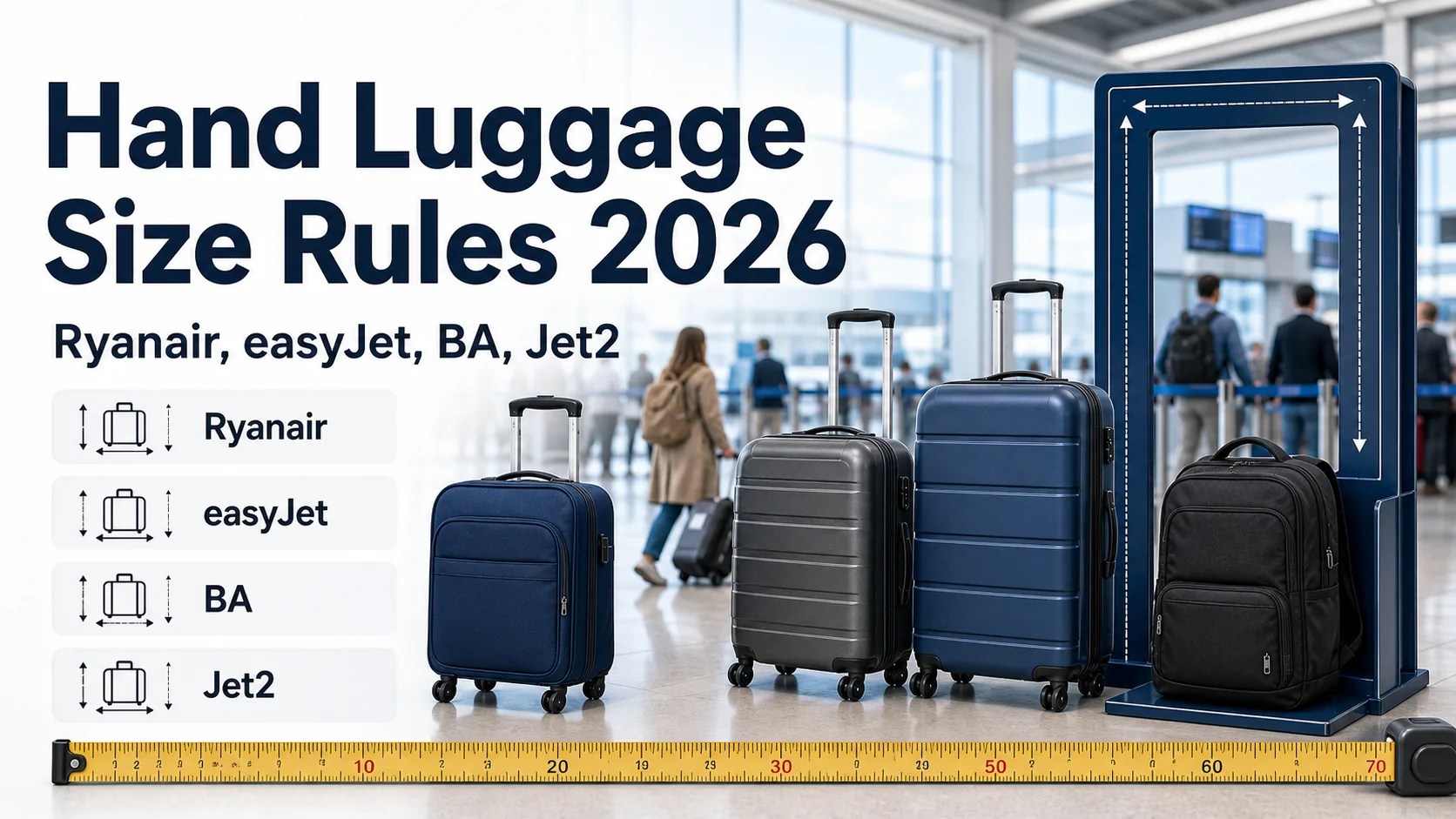
    Cabin bags of different sizes beside an airline gate baggage sizer, showing 2026 hand luggage size rules for Ryanair, easyJet, BA and Jet2

    Cabin bag fees and gate-side surprises are one of the most stressful parts of flying budget airlines. The good news for 2026: a new EU standard is tidying up the rules. This guide breaks down the hand luggage size rules for 2026 across Ryanair, easyJet, British Airways and Jet2 — exact dimensions, weights, what is free, and how to avoid a fee at the gate.

    Quick answer

    • Ryanair: free under-seat bag 40 x 30 x 20 cm; add Priority for a 10 kg, 55 x 40 x 20 cm cabin bag.
    • easyJet: the most generous free bag — 45 x 36 x 20 cm (up to 15 kg) under the seat.
    • British Airways: two bags free — 40 x 30 x 15 cm plus a 56 x 45 x 25 cm cabin bag, up to 23 kg each.
    • Jet2: a 10 kg cabin bag up to 56 x 45 x 25 cm, plus a small under-seat bag.
    • Universal safe size: a bag no bigger than 40 x 30 x 15 cm fits the free allowance on all four.

    Hand luggage size rules 2026: airline comparison

    AirlineFree under-seat bagLarger cabin bagWeight
    Ryanair40 x 30 x 20 cm55 x 40 x 20 cm (Priority only)10 kg (large bag)
    easyJet45 x 36 x 20 cm56 x 45 x 25 cm (with a plan/seat)Up to 15 kg
    British Airways40 x 30 x 15 cm56 x 45 x 25 cm (free)Up to 23 kg each
    Jet240 x 30 x 20 cm56 x 45 x 25 cm (free)10 kg (cabin bag)

    Dimensions include handles and wheels. Allowances are the current 2026 rules and can change — always check your airline before you fly.

    Ryanair hand luggage size

    Ryanair hand luggage starts with one free small bag that must fit under the seat in front of you, sized up to 40 x 30 x 20 cm — recently enlarged from 40 x 25 x 20 cm to meet the new EU standard. To bring a second, larger bag you need Priority & 2 Cabin Bags, which adds a 10 kg bag up to 55 x 40 x 20 cm in the overhead locker. Without Priority, an oversized bag at the gate means a fee, so measure carefully. For the full breakdown, see our dedicated Ryanair cabin bag size guide.

    easyJet hand luggage size

    easyJet hand luggage is the most generous of the budget airlines for the free bag: every passenger can bring one under-seat bag up to 45 x 36 x 20 cm, weighing up to 15 kg. For a bigger 56 x 45 x 25 cm cabin bag in the locker, you need an Up Front, Extra Legroom or FLEXI fare, or a Plus membership. For the full breakdown, see our dedicated easyJet hand luggage size guide.

    British Airways hand luggage size

    British Airways hand luggage is the best value on this list: even on the cheapest fares you get two bags free — a small under-seat bag up to 40 x 30 x 15 cm plus a larger cabin bag up to 56 x 45 x 25 cm, each up to 23 kg. On very busy flights BA may ask you to check the larger bag into the hold for free if the lockers fill up.

    Jet2 hand luggage size

    Jet2 hand luggage includes a 10 kg cabin bag up to 56 x 45 x 25 cm as standard — no separate “priority” purchase needed — plus one small under-seat bag (handbag, laptop bag or airport purchase) up to 40 x 30 x 20 cm. That makes Jet2 one of the simpler airlines for hand luggage. For the full breakdown, see our dedicated Jet2 hand luggage & baggage allowance guide.

    The new EU cabin bag standard

    From 2024 into 2026, the EU has been standardising cabin baggage to end the confusion between airlines. The agreed reference sizes are a main cabin bag up to 55 x 40 x 20 cm and a personal/under-seat item up to 40 x 30 x 15 cm. The change also pushes low-cost carriers to include a basic carry-on and a personal item in the fare, which is why Ryanair increased its free bag size. Rules are still settling, so the exact allowance can vary by airline for now.

    How to avoid hand luggage fees

    • Measure with wheels and handles. Airlines measure the bag’s largest points, and gate staff use a sizer that does too.
    • Buy to the smallest airline you use. A 40 x 30 x 15 cm bag fits the free allowance on all four airlines here.
    • Weigh it at home. Weight limits (10–23 kg) are enforced as strictly as size on many airlines.
    • Pack a packing list, not extra “just in case” items — our Packing List Generator helps you pack light enough to stay within the free bag.
    • Add Priority before the airport. Buying an extra bag at the gate costs far more than online.

    Gate fees are steep. An oversized bag charged at the gate can cost £45 or more — usually more than the price of adding the allowance when you book.

    Frequently asked questions

    What size is Ryanair’s free hand luggage in 2026?

    One small bag up to 40 x 30 x 20 cm that fits under the seat. A larger 10 kg, 55 x 40 x 20 cm cabin bag requires Priority & 2 Cabin Bags.

    What size is easyJet’s free cabin bag?

    easyJet allows a free under-seat bag up to 45 x 36 x 20 cm and 15 kg — the most generous free allowance of the budget airlines.

    What is British Airways’ hand luggage allowance?

    BA includes two bags free on most fares: a 40 x 30 x 15 cm under-seat bag and a 56 x 45 x 25 cm cabin bag, each up to 23 kg.

    What is Jet2’s hand luggage allowance?

    Jet2 gives you a 10 kg cabin bag up to 56 x 45 x 25 cm as standard, plus a small under-seat bag up to 40 x 30 x 20 cm.

    What is the new EU standard cabin bag size?

    A main cabin bag up to 55 x 40 x 20 cm and a personal item up to 40 x 30 x 15 cm. The EU is also pushing airlines to include a basic carry-on and personal item in the fare.

    What is the biggest free hand luggage of these airlines?

    easyJet’s free 45 x 36 x 20 cm under-seat bag is the largest single free bag, while BA gives you the most overall by including two free bags.

    What size bag fits all four airlines for free?

    A bag no larger than 40 x 30 x 15 cm fits the free under-seat allowance on Ryanair, easyJet, British Airways and Jet2.

    Do I have to pay for hand luggage?

    All four airlines include at least one free bag. A second, larger cabin bag is free on BA and Jet2 but costs extra on Ryanair (Priority) and easyJet (certain fares or Plus).

    Is hand luggage measured with wheels and handles included?

    Yes. Stated dimensions include wheels and handles, and gate sizers are built to those exact measurements.

    How much does an oversized bag cost at the gate?

    Gate fees vary but can be £45 or more, typically far higher than adding the allowance when you book online.

    Does my free bag have a weight limit?

    Often yes. easyJet’s free bag allows up to 15 kg, BA up to 23 kg, and Jet2’s cabin bag is 10 kg. Ryanair focuses on size for the free small bag.

    Will hand luggage rules change again in 2026?

    Possibly. The EU standard is still being adopted, so allowances may shift. Always confirm your airline’s current rules before you travel.

    Sources

    Based on the airlines’ published 2026 hand luggage policies and EU cabin baggage guidance, including Your Europe (European Union). Checked June 2026 — allowances change, so confirm with your airline before booking.

  • Summer 2026 Flight Delays: Worst UK Airports & How to Protect Your Trip

    Summer 2026 Flight Delays: Worst UK Airports & How to Protect Your Trip

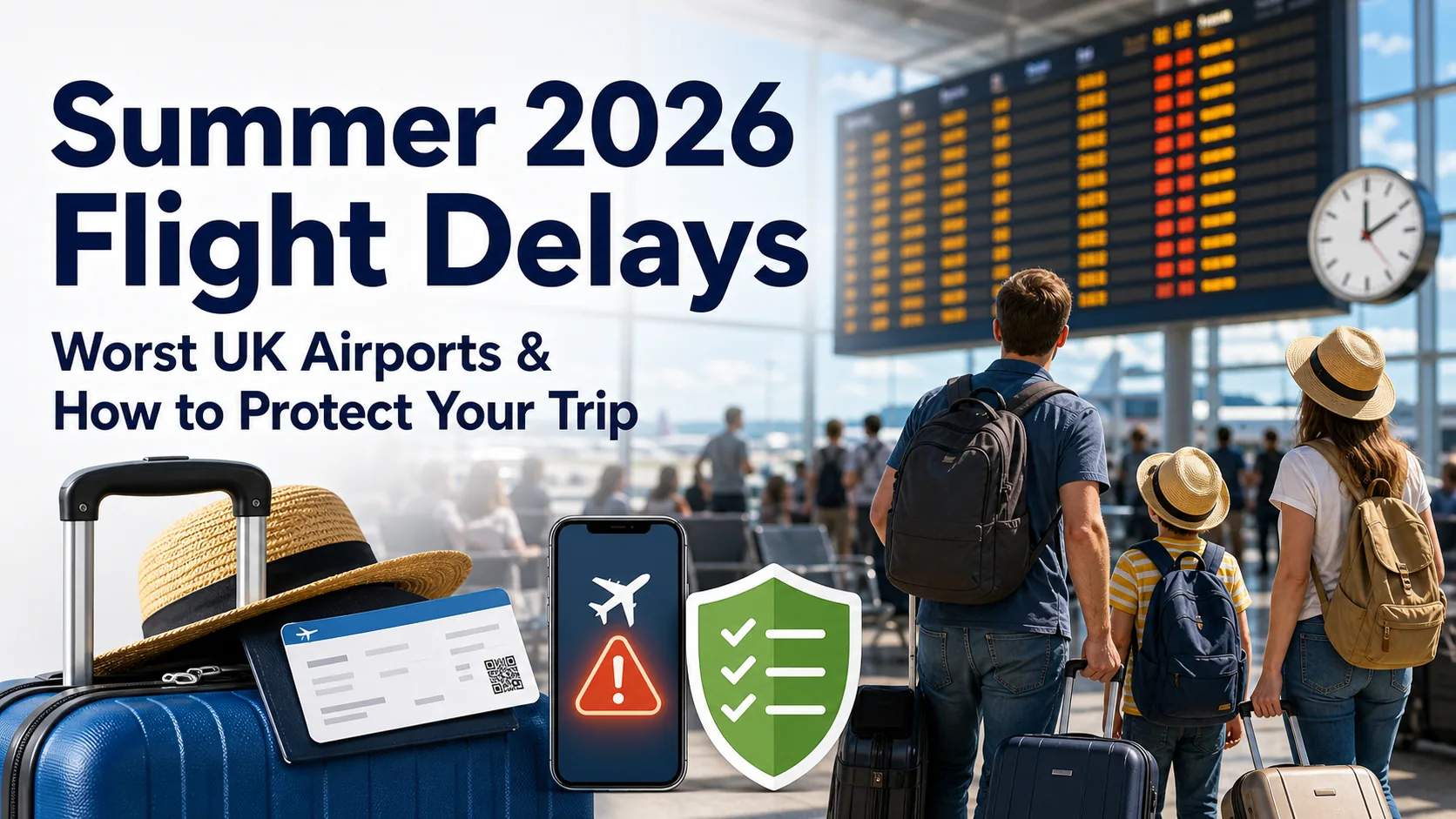
    A UK airport departures board showing delayed summer 2026 flights with travellers waiting

    Summer is the busiest — and most disrupted — time to fly from the UK. With record passenger numbers, new EU border checks and the usual strike and weather risks, flight delays in summer 2026 are a real planning concern. This guide shows the worst UK airports for delays using official CAA data, why this summer could be tougher, and exactly how to protect your trip — including how to claim up to £520 in compensation.

    Quick answer

    • Worst UK airports for delays (2025 CAA data): Manchester, Birmingham and Stansted had the lowest on-time rates; the UK average was 77% on time.
    • Compensation: if your flight arrives 3+ hours late and it is the airline’s fault, you can claim £220–£520 under UK261.
    • Strikes and weather usually count as “extraordinary circumstances” — no compensation, but the airline must still feed and house you.
    • Protect your trip: book early-morning flights, build buffer time, take out travel insurance and know your rights.

    Worst UK airports for delays in 2026

    The Civil Aviation Authority (CAA) measures punctuality as the share of flights arriving or departing within 15 minutes of schedule. Based on the most recent 2025 figures, these were the worst UK airports for flight delays by on-time rate — the lower the percentage, the more delays:

    AirportOn-time rate (2025)Vs UK average
    Manchester71.5%Worst major airport
    Birmingham72.5%Below average
    Stansted73.5%Below average
    Bristol74.5%Below average
    Gatwick75.5%Below average
    Edinburgh76.5%Around average
    UK average77%
    Luton78%Above average

    Source: CAA punctuality data, 2025. On-time means within 15 minutes of the scheduled time. Figures vary by month and airline.

    Why summer 2026 could be worse

    Several factors are stacking up for the 2026 summer season:

    • New EU border checks. The EU’s Entry/Exit System (EES) is rolling out in 2026, adding biometric checks at the border that can lengthen queues at peak times. See our guide to EES delays for UK travellers.
    • Air traffic control strikes. Summer strikes — especially French ATC action — routinely delay flights across European airspace, even ones that do not land in the striking country.
    • Record passenger numbers. Airports are handling more passengers than ever, which leaves less slack when something goes wrong.
    • Weather. Summer thunderstorms can close runways and back up schedules for hours.

    Flight delay compensation: your UK261 rights

    If your flight is delayed, you may be owed flight delay compensation under UK261 — the UK’s version of EU261. It applies to flights departing any UK airport, and to flights arriving in the UK on a UK or EU airline. You qualify if you arrive at your destination 3 or more hours late and the delay was the airline’s responsibility.

    Flight distanceDelay at arrivalCompensation
    Up to 1,500 km (short-haul)3+ hours£220
    1,500–3,500 km (medium)3+ hours£350
    Over 3,500 km (long-haul)3–4 hours£260
    Over 3,500 km (long-haul)4+ hours£520

    Compensation is not paid automatically — you claim it directly from the airline, and you generally have up to six years to do so. If the airline refuses unfairly, you can escalate to an alternative dispute resolution (ADR) body or the CAA.

    Work out what you are owed: use our Flight Delay Compensation Calculator to check your exact entitlement, then follow the step-by-step process (with a copy-and-paste claim template) in how to claim delayed flight compensation in the UK.

    When you can’t claim — but still get care

    You are not owed compensation if the delay was caused by “extraordinary circumstances” outside the airline’s control — such as bad weather, ATC strikes, security alerts or political unrest. However, the airline must still look after you regardless of the cause once the delay passes a couple of hours:

    • Food and drink (usually vouchers) appropriate to the wait
    • A means to communicate (phone calls)
    • Accommodation and transfers if you are delayed overnight

    Keep every receipt. If the airline fails to provide care, pay for reasonable essentials yourself and claim the cost back later.

    How to protect your trip

    • Fly early. The first flights of the day are the most punctual — delays cascade as the day goes on.
    • Build buffer time into connections and onward plans. Use our Layover Calculator to check your connection is realistic.
    • Plan your airport arrival sensibly with the Airport Arrival Time Calculator so a delay does not turn into a missed flight.
    • Take out travel insurance with delay and missed-connection cover, especially for self-transfers.
    • Prefer direct flights where possible — fewer connections means fewer points of failure.
    • Track your flight status the day before and on the day, and know your UK261 rights before you travel.

    Frequently asked questions

    What is the worst UK airport for delays?

    Based on 2025 CAA punctuality data, Manchester had the lowest on-time rate of any major UK airport at 71.5%, followed by Birmingham and Stansted. The UK average was 77% on time.

    How much compensation can I get for a delayed flight?

    Under UK261 you can claim £220 for short-haul (up to 1,500 km), £350 for medium-haul (1,500–3,500 km) and £520 for long-haul (over 3,500 km), if you arrive 3 or more hours late and the delay was the airline’s fault.

    Does the 3-hour rule apply to departure or arrival?

    Arrival. Compensation is based on how late you reach your final destination, not your departure time, so a flight that leaves late but makes up time may not qualify.

    Can I claim compensation if my flight was delayed by a strike?

    Usually not. Air traffic control and airport strikes are treated as extraordinary circumstances, so compensation does not apply — but the airline must still provide food, drink and accommodation if needed.

    What about delays caused by bad weather?

    Weather is an extraordinary circumstance, so no compensation is due. You are still entitled to care and assistance during the delay.

    How do I claim flight delay compensation?

    Claim directly from your airline first, with your booking reference and flight details. If they reject a valid claim, escalate to an ADR scheme or the CAA. You generally have up to six years to claim.

    Does UK261 cover flights from the EU back to the UK?

    Yes, if you fly into the UK on a UK or EU airline, or depart from any UK airport. Flights into the UK on a non-UK, non-EU airline may not be covered.

    Will the EES border checks cause more delays in 2026?

    The new Entry/Exit System adds biometric checks at EU borders, which can lengthen queues at busy times. See our EES delays guide for how much extra time to allow.

    What if I miss a connection because of a delay?

    If your flights are on one booking, the airline must re-route you, and compensation is based on your arrival delay at the final destination. Separate tickets (self-transfers) are riskier — the second airline is not obliged to help.

    Are early-morning flights really less likely to be delayed?

    Yes. The first departures of the day start with aircraft and crew already in position, so they avoid the knock-on delays that build up through the day.

    Does travel insurance cover flight delays?

    Many policies include delay cover and missed-connection cover, but limits and waiting times vary. Check the policy wording, especially if you are connecting on separate tickets.

    How long does a delay have to be before the airline must feed me?

    Care and assistance typically kick in after about two hours for short-haul and longer for long-haul, regardless of the cause of the delay.

    Sources

    Punctuality figures from the UK Civil Aviation Authority; passenger rights from the CAA delays guidance. Checked June 2026 — figures vary by month and airline; confirm your rights for your specific flight.

  • UK Airport Liquid Rules 2026: 100ml vs 2 Litres, Airport by Airport

    UK Airport Liquid Rules 2026: 100ml vs 2 Litres, Airport by Airport

    Airport security tray with toiletry bottles and a liquids bag, illustrating UK airport liquid rules in 2026

    If you are flying from the UK this year, the airport liquid rules are more confusing than ever — because they now depend on which airport you fly from. Some airports have scrapped the old 100ml limit and let you carry up to 2 litres; others still enforce 100ml. Here is the up-to-date, airport-by-airport breakdown for 2026, including the catch that trips travellers up on the way home.

    Quick answer

    • 2-litre airports: Heathrow, Gatwick, Edinburgh and Birmingham (plus Bristol and the Belfast airports) — their new CT scanners let you carry liquids up to 2 litres.
    • Still 100ml: Manchester, Luton, Stansted, Liverpool and Glasgow.
    • Everywhere: at major UK airports you can now leave liquids in your bag — no clear plastic bag needed.
    • The catch: a 500ml bottle allowed leaving Heathrow can be refused on your return or transfer through a 100ml airport.
    • Vacuum flasks and metal bottles must still be emptied, even at 2-litre airports.

    UK airport liquid rules 2026 at a glance

    AirportLiquid limitRemove from bag?VerifiedSource
    Heathrow2 litresNoJul 2026Heathrow
    Gatwick2 litresNoJul 2026Which?
    Edinburgh2 litresNoJul 2026Which?
    Birmingham2 litresNoJul 2026Which?
    Bristol & Belfast2 litresNoJul 2026Which?
    Manchester100mlNo (keep in bag)Jul 2026Which?
    Luton100mlNo (keep in bag)Jul 2026Which?
    Stansted100mlNo (keep in bag)Jul 2026Stansted
    Liverpool & Glasgow100mlNo (keep in bag)Jul 2026Liverpool

    Every row was individually re-checked on 14 July 2026 against the airport’s official security guidance and the Which? scanner tracker. The rollout is ongoing, so an airport on the 100ml list may move to 2 litres at short notice — always check your specific airport before you fly.

    Heathrow liquid rules

    Heathrow has scrapped the 100ml limit. After a major investment in 3D CT scanners across its terminals, Heathrow liquid rules now allow containers up to 2 litres in your hand luggage, and you no longer need to take liquids or electronics out of your bag at security. That means a full-size sun cream, a 1-litre water bottle or larger toiletries are fine when flying from Heathrow.

    Manchester Airport liquid rules

    Manchester is the big exception travellers ask about. As of 2026, Manchester Airport liquid rules still enforce the 100ml per-container limit — its CT scanner rollout has not yet passed the checks needed to lift the cap. The one bit of good news: you no longer have to remove your liquids from your cabin bag or place them in a clear plastic pouch. So pack within 100ml per container at Manchester, but you can leave them in your bag.

    Which UK airports allow 2 litres of liquid?

    The airports that have completed their CT scanner upgrades and passed government checks now allow up to 2 litres per container: Heathrow, Gatwick, Edinburgh and Birmingham, with Bristol and the Belfast airports among others that have also lifted the limit. At these airports, liquids and laptops stay in your bag.

    Which UK airports still use the 100ml rule?

    Several major airports still enforce 100ml: Manchester, Luton, Stansted, Liverpool and Glasgow. At all of these you can keep liquids inside your cabin bag without a plastic bag, but each container must hold no more than 100ml.

    The catch: your return or transfer airport

    This is the part that catches people out. The rules apply to the airport you are leaving from, not your whole trip. A 500ml bottle you happily carried through Heathrow can be confiscated at your destination or transfer airport if it still uses the 100ml rule. So if your return or connecting airport is on the 100ml list, pack as if the 100ml limit applies to avoid losing items.

    Rule of thumb: if any airport on your trip still uses 100ml, play it safe and keep liquids to 100ml containers for the whole journey.

    Other things worth knowing

    • Vacuum flasks must be emptied — the scanners cannot see through the double insulation, even at 2-litre airports.
    • Metal water bottles should be emptied before security too.
    • Baby milk, formula and medication are allowed in larger quantities at all UK airports — declare them at security.
    • Airline cabin-bag limits still apply to the size and weight of your bag, separately from the security liquid rules.
    • Allow time for security regardless — queues vary — and plan your arrival with our Airport Arrival Time Calculator.

    Frequently asked questions

    What are the liquid rules at Heathrow Airport?

    Heathrow now allows liquid containers up to 2 litres in hand luggage, and you do not need to remove liquids or electronics from your bag, thanks to its new 3D CT scanners.

    What are the liquid rules at Manchester Airport?

    Manchester Airport still enforces the 100ml per-container limit in 2026. You can keep liquids in your cabin bag without a plastic pouch, but each container must be 100ml or less.

    Which UK airports allow 2 litres of liquid?

    Heathrow, Gatwick, Edinburgh and Birmingham, plus Bristol and the Belfast airports, among others that have finished their CT scanner rollouts.

    Which UK airports still use the 100ml rule?

    Manchester, Luton, Stansted, Liverpool and Glasgow still apply the 100ml limit, although you can keep liquids in your bag.

    Do I still need a clear plastic bag for liquids?

    No. At major UK airports you no longer need to put liquids in a transparent plastic bag, whether the airport uses the 100ml or 2-litre rule.

    Can I leave liquids in my cabin bag now?

    Yes. At all major UK airports you can leave liquids (and laptops) inside your cabin bag at security, because the new scanners produce a 3D image.

    Has the 100ml rule been scrapped at every UK airport?

    No. Only airports that have completed and passed their CT scanner checks have lifted it. Others, including Manchester and Luton, still use 100ml.

    What happens on my return or transfer flight?

    The rules apply to the airport you depart from. A larger bottle allowed from a 2-litre airport like Heathrow may be refused at a return or transfer airport that still uses 100ml, so pack to the strictest airport on your trip.

    Can I take a vacuum flask through security?

    You can take the flask, but it must be empty. The scanners cannot see through the double-walled insulation, so a filled flask will be refused even at a 2-litre airport.

    What about baby milk and medication?

    Baby milk, formula and essential medication are allowed in larger quantities at all UK airports. Declare them to security staff, who may screen them separately.

    Why do different UK airports have different liquid rules?

    The difference comes down to the rollout of new 3D CT scanners. Airports that have installed them and passed government checks can lift the 100ml limit; others have not finished yet.

    Do airlines have their own liquid limits?

    Airlines set the size and weight of your cabin bag, but the liquid limit at security is set by the airport. Both apply, so check your airline’s hand-luggage allowance separately.

    Will the UK liquid rules change again in 2026?

    Likely yes. More airports are expected to lift the 100ml limit as their scanner upgrades pass checks, so confirm your airport’s current rule shortly before you travel.

    Sources

    Every airport’s status in the table above was re-verified on 14 July 2026 against official airport security guidance and independent consumer reporting, including Which?, Heathrow, Stansted and Liverpool. The 100ml-to-2-litre rollout is signed off airport by airport by the Department for Transport, so rules can change at short notice — confirm your specific airport shortly before you travel.

  • EES Delays in 2026: What UK Travellers Need to Know

    EES Delays in 2026: What UK Travellers Need to Know

    UK travellers at an EU airport passport-control border, illustrating EES delays in 2026

    If you have a European trip booked this year, you have probably heard about EES delays — and the warnings are real. Since the EU’s new Entry/Exit System (EES) rolled out fully in April 2026, UK travellers have faced border queues of several hours at peak times. Here is what the EES actually is, why it is slowing things down, when ETIAS joins it, and — most usefully — how much extra time you should build into your trip.

    Quick answer

    • EES is the EU’s biometric border system. Since 10 April 2026, UK travellers have their fingerprints and photo taken on first entry to the Schengen area.
    • It is free and there is no advance registration — it happens at the border.
    • Checks now take about 90 seconds per person versus ~25 before, causing queues of 2–4 hours (up to 6 at peak).
    • ETIAS is separate: a €20 travel authorisation you apply for online, expected to launch in late 2026.
    • Build in extra buffer — especially on the return leg and at Eurostar/Dover, where EES is done before you leave the UK.

    What is the EES, and why the delays?

    The EU Entry/Exit System is a digital border system that records non-EU visitors entering and leaving the Schengen area. It started on 12 October 2025 and reached full rollout on 10 April 2026. Instead of a quick passport stamp, UK travellers now register biometric data — fingerprints and a facial photo — the first time they enter.

    That extra step is exactly why you are seeing EES delays. A routine passport check that used to take around 20 to 25 seconds now takes roughly 90 seconds under EES. Multiplied across a full flight, that has driven queues of two to four hours at major European airports, with warnings of up to six hours at the busiest summer peaks. The good news: there is no fee and no advance registration — it all happens at the border on arrival.

    Where and when does the EES affect you?

    This is the part travellers get wrong. The EES check happens when you enter the Schengen area, so for a flight it is done on arrival in Europe, not at your UK departure airport. Your check-in and security timing in the UK are unchanged — but expect a longer wait at passport control when you land, and again on your return into the EU if your trip involves one.

    If you travel by Eurostar, the Eurotunnel or the ferry at Dover, it is different: French border officers operate “juxtaposed controls” on the UK side before you leave, so the EES queue is added to your departure in Britain. For those routes especially, give yourself plenty of extra time.

    Good news: once you have registered your biometrics, re-entry is much faster — usually a quick facial check rather than the full process.

    How much extra time should you allow?

    For flights, your UK departure buffer doesn’t change — use the normal arrival times and our Airport Arrival Time Calculator to plan it. What changes is the arrival end: allow extra time after you land for the EES queue, and don’t book a tight onward connection (train, transfer or domestic flight) immediately after a Schengen arrival during the first weeks of a busy season.

    For Eurostar, Eurotunnel or Dover, add a meaningful buffer to your UK departure — many operators are advising travellers to arrive earlier than usual while the system beds in. If you are connecting onward in the UK first, our Leave-Time Calculator helps you back-time the whole journey.

    EES vs ETIAS: what’s the difference?

    They are often confused, but they are two separate things — and only one of them exists yet. For the full picture on ETIAS — the cost, timing and how to apply — see our dedicated ETIAS for UK travellers guide.

    EES (Entry/Exit System)ETIAS (travel authorisation)
    What it isA biometric border system that records your entry and exitA pre-travel authorisation you apply for online
    WhenLive now (full rollout 10 April 2026)Expected to launch in late 2026
    CostFree€20 (free for under-18s and over-70s)
    Where you do itAt the border, on arrivalOnline, before you travel
    ValidityPer trip3 years, or until your passport expires

    ETIAS is not a visa — it is a quick online authorisation, similar to the US ESTA, that most UK travellers will need for short stays in around 30 European countries once it launches. Until then, you do not need an ETIAS; you only need to allow for the EES at the border.

    And if your journey also touches the UK, that has its own separate requirement — the UK ETA — which is not the same as the EES or ETIAS. Our UK ETA 2026 guide explains who needs it and the airside-transit exemption.

    How to beat the EES queues

    • Allow extra time, especially on the return leg and on Eurostar/Dover routes.
    • Travel off-peak where you can — mid-week and outside school holidays see shorter queues.
    • Have your passport ready and know that the first registration takes longest; later trips are quicker.
    • Don’t book a tight onward connection straight after a Schengen arrival in the first weeks of peak season.
    • Watch for the ETIAS launch date — the EU will confirm it at least six months ahead, so you’ll have time to apply.

    Frequently asked questions

    What is the EES (EU Entry/Exit System)?

    It is a digital EU border system that records non-EU visitors entering and leaving the Schengen area, taking your fingerprints and a facial photo. It reached full rollout on 10 April 2026.

    Do UK travellers need to do the EES?

    Yes. As a non-EU passport holder, you register your biometrics the first time you enter the Schengen area for a short stay. There is nothing to do in advance — it happens at the border.

    Is there a fee for the EES?

    No. The EES itself is free. The €20 fee you may have read about is for ETIAS, which is a separate scheme launching later.

    Why is the EES causing delays?

    Registering biometrics takes longer than a passport stamp — about 90 seconds per person versus around 25 before. Across a full flight that has produced queues of two to four hours, and up to six at peak times.

    How long are EES border queues?

    Reports since the April 2026 rollout describe two to four hours at major airports, with warnings of up to six hours at the busiest summer peaks. Re-entry after your first registration is much quicker.

    Does the EES affect my UK departure or only my EU arrival?

    For flights, the EES check is done when you arrive in the Schengen area, so your UK departure timing is unchanged. For Eurostar, Eurotunnel and Dover, it is done on the UK side before you leave, so it adds to your departure there.

    Does the EES apply at Eurostar and Dover?

    Yes. Because French border control operates on the UK side at St Pancras, Folkestone and Dover, the EES process is completed before you depart, so allow extra time on those routes.

    Do I need to register for the EES in advance?

    No. There is no online pre-registration for the EES. You complete it in person at the border the first time you cross.

    Is the EES the same as a visa?

    No. The EES is a border record system, not a visa or an authorisation. UK travellers can still visit the Schengen area for up to 90 days in any 180 without a visa.

    What is ETIAS?

    ETIAS is a travel authorisation, similar to the US ESTA, that most UK travellers will need to apply for online before short stays in around 30 European countries. It is not a visa.

    Do I need ETIAS now?

    Not yet. ETIAS is expected to launch in late 2026, and the EU will confirm the exact date at least six months ahead. Until then you only need to allow for the EES at the border.

    How much does ETIAS cost?

    The fee is €20. Travellers under 18 or over 70 are exempt, and an approved ETIAS is valid for three years or until your passport expires.

    When does ETIAS start?

    It is expected in the last quarter of 2026, with a transition period before it becomes mandatory. The official start date will be announced at least six months in advance.

    How much extra time should I allow because of the EES?

    For flights, plan your UK departure as normal but expect a longer wait at passport control on arrival in Europe. For Eurostar and Dover, add a generous buffer on the UK side. Use the TripBuffer Airport Arrival Time Calculator to plan your timing.

    Is re-entry faster after my first EES registration?

    Yes. Once your biometrics are on file, later entries are usually a quick facial check rather than the full fingerprint-and-photo process, so the long queues mainly affect first-time registrations.

    Sources

    Official guidance: GOV.UK — EU Entry/Exit System, European Union — About ETIAS, and consumer reporting from Which?. Checked June 2026 — EES and ETIAS rules are changing, so confirm the latest official guidance before you travel.

  • How Early to Get to Heathrow, Gatwick & Manchester (2026)

    How Early to Get to Heathrow, Gatwick & Manchester (2026)

    Travellers with suitcases walking through an airport departures hall under a large DEPARTURES sign

    Wondering how early to get to Heathrow, Gatwick or Manchester for your flight in 2026? The honest answer is “a bit earlier than you think” — UK airports are busy, security queues are unpredictable, and the cost of getting it wrong is a missed flight. This guide gives you each airport’s official recommendation, what realistically affects your timing, and a simple way to work out exactly when to leave home.

    Quick answer

    • Heathrow: arrive 2 hours before short-haul (UK & Europe), 3 hours before long-haul.
    • Gatwick: 2 hours before short-haul, 3 hours before long-haul.
    • Manchester: at least 90 minutes for Europe, but 2–3 hours is safer, especially for long-haul.
    • Add 30–60 minutes at peak times (early mornings, school holidays, summer).

    How early to get to Heathrow, Gatwick & Manchester at a glance (2026)

    AirportShort-haul (UK / Europe)Long-haul (international)Worth knowing
    Heathrow (LHR)2 hours3 hoursThe UK’s busiest hub; allow extra at peak times and check your terminal.
    Gatwick (LGW)2 hours3 hoursCheck-in opens 4h (long-haul), 3h (Europe), 2h (UK/Ireland) before departure.
    Manchester (MAN)~2 hours (min 90 min Europe)2–3 hoursSecurity and immigration can be slow — lean towards 3 hours for long-haul.

    How early should you get to Heathrow?

    Heathrow officially recommends arriving at check-in and bag drop three hours before a long-haul departure, and two hours before a UK or European flight. As the busiest airport in the UK, Heathrow handles huge passenger volumes, and security queues at the larger terminals (especially Terminals 2 and 5) can build quickly at peak times.

    If you’re asking how early to arrive at Heathrow on a tight schedule, the safe rule is: don’t cut the official times fine. Bag drop typically closes around 60 minutes before departure (sometimes earlier for long-haul), and gates usually close 20–35 minutes before. With hand luggage only and online check-in done, you have more flexibility — but you still need to clear security, which is the unpredictable part.

    Tip: flying long-haul from Terminal 5 or 2 in the early-morning bank (06:00–09:00)? Treat 3 hours as the minimum, not the maximum.

    How early should you arrive at Gatwick Airport?

    Gatwick recommends arriving two hours before a short-haul flight and three hours before long-haul. Check-in desks open four hours before long-haul flights, three hours before European flights, and two hours before UK and Ireland flights, so there’s no benefit to turning up earlier than that. Gatwick is split across North and South Terminals connected by a shuttle, so double-check which terminal your airline uses before you travel.

    How early should you get to Manchester Airport?

    Manchester advises a minimum of 90 minutes for European flights, but in practice 2–3 hours is wiser — security screening and immigration processing can take time, and Manchester has had well-publicised busy spells. For long-haul departures, give yourself the full 3 hours. Manchester has three terminals, so allow time to find the right one if you’re being dropped off.

    What changes how early you should arrive

    • Peak times. Early-morning departures, Friday evenings, school holidays and summer all mean longer security queues — add 30–60 minutes.
    • Bags vs hand luggage only. No checked bag and checked in online? You can shave time. Checking a bag means beating the bag-drop deadline (usually ~60 minutes before).
    • Fast Track security. Many UK airports sell a Fast Track lane — useful insurance on a tight morning, but never a substitute for arriving on time.
    • Your journey to the airport. Traffic, train delays and parking shuttles all eat into your buffer — plan the ground leg as carefully as the flight.

    Work out exactly when to leave home

    The numbers above are the time you should be at the airport. To avoid a stressful morning, work backwards from your flight: arrival buffer + check-in/security + the journey to the airport.

    Example: a 09:00 long-haul flight from Heathrow means being there by 06:00. If your drive is 75 minutes and you want a 15-minute cushion, you’re leaving home around 04:30.

    And don’t forget the journey itself — compare the cheapest ways to get to Heathrow or estimate costs with our Airport Transfer Cost Calculator.

    Frequently asked questions

    How early should I get to Heathrow?

    Arrive two hours before a UK or European flight and three hours before a long-haul departure, as Heathrow recommends. Add 30–60 minutes at peak times such as early mornings and school holidays.

    How early should I arrive at Gatwick Airport?

    Two hours before a short-haul flight and three hours before long-haul. Gatwick check-in opens four hours (long-haul), three hours (Europe) or two hours (UK/Ireland) before departure.

    How early should I get to Manchester Airport?

    Manchester recommends at least 90 minutes for European flights, but 2–3 hours is safer because security and immigration can be busy. For long-haul departures, allow the full three hours.

    How long before a flight should I arrive in the UK?

    As a general 2026 rule: two hours for domestic and short-haul European flights, and three hours for long-haul international flights. Lean towards the longer end at busy airports and peak times.

    Is two hours enough for an international flight?

    Two hours is usually enough for a short-haul European flight, but for long-haul international travel three hours is the recommended minimum to allow for check-in, bag drop, security and the walk to a distant gate.

    How early should I arrive for a domestic flight in the UK?

    Around two hours is typical for a UK domestic flight, though some airlines and smaller airports allow less. Check your airline’s advice, and still leave time for security, which is the same regardless of flight length.

    How early should I get to the airport for an early morning flight?

    Early-morning flights (roughly 06:00–09:00) are among the busiest for security, so stick to the full recommended time or add 30 minutes. Bag drop and security desks often have their longest queues first thing.

    Can I arrive at the airport too early?

    You can, because check-in and bag drop only open a few hours before departure — typically four hours for long-haul, three for Europe and two for UK flights. Arriving much earlier means waiting before you can drop a bag.

    How early should I arrive if I only have hand luggage?

    With hand luggage only and online check-in done, you can arrive a little later because you skip bag drop. Even so, allow enough time to clear security comfortably — around 90 minutes to two hours is sensible for short-haul.

    What time does bag drop close at UK airports?

    Bag drop typically closes around 60 minutes before departure, and sometimes earlier for long-haul flights. Always check your airline’s specific deadline, as it can be stricter.

    What happens if I miss the bag drop deadline?

    If you miss bag drop you usually cannot check a bag and may be refused boarding, even if the plane has not left. This is why arriving in time for bag drop, not just the gate, really matters.

    When does the boarding gate close?

    Gates usually close 20–35 minutes before departure, and once closed they will not reopen. Allow time to reach the gate, which can be a long walk at large terminals like Heathrow.

    How long does security take at UK airports?

    Security can take anywhere from a few minutes to over an hour depending on the time of day and the airport. Treat it as the most unpredictable part of your journey and never rely on a quick pass.

    Is Fast Track security worth it?

    Fast Track can be worth buying on a tight schedule or at peak times, as it shortens the security queue. It is useful insurance, but not a reason to arrive later than recommended.

    How early should I arrive at peak times or during school holidays?

    During school holidays, summer and busy weekends, add 30–60 minutes to the standard times. Queues for bag drop and security are at their longest in these periods.

    Do I need to arrive earlier for a connecting flight?

    A connection depends on the airport’s minimum connection time, plus any terminal change or re-clearing of security. Use our Layover Calculator to check whether your connection time is realistic.

    Sources

    Official arrival guidance: Heathrow Airport, London Gatwick, Manchester Airport. Checked for the 2026 travel season. Always confirm your airline’s specific check-in and bag-drop deadlines before you travel.

  • East vs. West: Why Jet Lag is Worse in One Direction

    East vs. West: Why Jet Lag is Worse in One Direction

    Map-style illustration of east and west flight directions showing why jet lag is worse travelling one way

    It’s a well-known feeling among frequent flyers: flying London to New York feels manageable, but flying New York back to London wrecks your sleep for days. There’s actual science behind why eastbound jet lag hits so much harder — and a small set of practical tools that genuinely help. Here’s a friendly walk-through.

    The science of your circadian rhythm

    Your body operates on a roughly 24-hour internal clock called the circadian rhythm. This clock controls when you feel alert, when your body releases melatonin to make you sleepy, when your core body temperature dips overnight, and when your digestive system expects meals.

    The interesting bit: human circadian rhythms are naturally slightly longer than 24 hours — closer to 24.2 hours on average. Because of this, it’s biologically easier for your body to delay sleep (stay up later) than to advance it (force sleep earlier). That single fact explains most of what’s coming next.

    Flying west: chasing the sun (delaying the clock)

    When you fly west — say, Europe to North America — you’re moving “backwards” through time zones. Your day gets longer.

    If you land in New York at 6 PM, your body thinks it’s 11 PM UK time. You might feel tired early in the evening, but you just need to stay awake a few more hours before going to bed. Because your body naturally finds it easier to stay up later, adjusting to a westbound time zone is comparatively gentle. The rule of thumb is roughly one day of adjustment per time zone crossed.

    Flying east: losing time (advancing the clock)

    Eastbound is the harder direction. You’re moving “forward” through time zones, and your day gets shorter.

    A typical New York to London red-eye leaves at 8 PM and lands at 8 AM local time. But your body thinks it’s 3 AM. You’re being asked to start a new day when your biological clock is screaming at you to be in deep sleep. Worse, when it’s bedtime in London (say, 10 PM), your body thinks it’s only 5 PM — not nearly tired enough to fall asleep.

    Forcing your body to sleep earlier and wake earlier means advancing your circadian rhythm, which is biologically the hard direction. The rule of thumb here is roughly 1.5 days of adjustment per time zone crossed — about 50% slower than westbound recovery.

    Light: the most powerful lever you have

    Of all the tools available for shifting your body clock, daylight exposure is by far the strongest. Your circadian rhythm takes more information from light than from anything else — not from meals, not from melatonin pills, not from caffeine. Bright morning light tells your brain “this is morning”; the absence of light at night tells it “this is night.” Using light deliberately is the most reliable way to shift faster.

    For eastbound travel: when you land in the morning, get outside in daylight as soon as you can. Even on a grey day, outdoor light is many times brighter than indoor lighting and it’s enough to shift your clock. In the evening, dim indoor lights and avoid bright screens for the last hour before bed.

    For westbound travel: do the opposite. Try to stay awake in the local evening with bright light, then sleep through the night.

    Meal timing as a secondary signal

    Your gut also has a circadian rhythm, and eating at local meal times helps reset it. It’s a weaker signal than light, but free and easy to apply: when you arrive, eat breakfast, lunch and dinner at local times even if you aren’t hungry. Avoid late-night meals on day one in the new time zone, as a heavy meal close to bedtime makes it harder to fall asleep.

    What about melatonin and sleeping aids?

    Melatonin is the most-studied supplement for jet lag, and the evidence supports it for eastbound travel of 5+ time zones. A small dose (0.5–3 mg) taken about 30 minutes before your target bedtime in the new time zone can help you fall asleep at the right local time. Larger doses aren’t more effective and can make morning grogginess worse.

    Prescription sleeping pills can knock you out for a flight, but they don’t shift your circadian rhythm — you’ll wake up feeling rested for that one sleep but still jet-lagged. If you’re considering anything stronger than melatonin, talk to a doctor first.

    Caffeine: use it like a tool

    Coffee can be the right call or the wrong call, depending on timing. On a westbound arrival, a strong coffee at 4 PM local time can help you stay awake until a normal bedtime. On an eastbound arrival, coffee after lunch can make it harder to fall asleep at night and slow your adjustment. Treat caffeine like a stimulant on a schedule: use it to push through to bedtime, not after.

    How to beat eastbound jet lag

    • Start shifting early. Begin going to bed 30–60 minutes earlier than usual for a few days before your trip. Even a small head start makes a big difference.
    • Sleep on the plane if you can. A red-eye flight is your chance to get a few hours of sleep on local schedule. Use an eye mask, earplugs and skip the in-flight wine.
    • Get bright light on arrival morning. Outside, ideally. This is the single most effective thing you can do.
    • Eat at local meal times. Three regular meals on local time, no big late-night snacks.
    • Skip the long nap. If you must nap after a red-eye, keep it under 90 minutes and finish by mid-afternoon. Any longer and you’ll struggle to sleep that night.
    • Consider melatonin. A small dose before your target bedtime can help for the first 2–3 nights.

    A worked example: London → New York → London

    Suppose you fly Heathrow to JFK on Friday morning and back to Heathrow on Sunday evening. Here’s what the typical traveller experiences:

    • Westbound (LHR → JFK). Land at JFK around 3 PM local (8 PM UK). Stay up until 10 PM local (3 AM UK), sleep, wake up around 7 AM. Within 1–2 days you’re on local time. Most people barely notice the shift.
    • Eastbound (JFK → LHR). Red-eye lands at LHR Monday at 8 AM (3 AM body time). You’ve slept maybe 4 hours on the plane. You push through Monday on caffeine, fall asleep way too early Monday evening, wake up at 3 AM Tuesday. It takes most of the week to feel normal.

    That’s exactly the pattern the circadian science predicts — and exactly why a small head start, good light exposure and well-timed melatonin can shave days off recovery.

    Plan your sleep shift

    Don’t guess when to start shifting your sleep. Use our jet lag planner to generate a personalised pre-trip schedule that gradually shifts your body clock before you even step on the plane. For long-haul flights specifically, the long-haul jet lag planner guide goes deeper on light timing and meal scheduling for trips of 6+ time zones. And if you’ve got an overnight flight ahead of you, the red-eye flight survival guide covers what to do on the plane and the morning after.

    Frequently asked questions

    Is jet lag worse going east or west?

    For most people, jet lag is worse travelling east. Around 75% of travellers find eastward trips harder because your body clock has to advance (sleep earlier), which is more difficult than delaying it.

    Why is jet lag worse when you fly east?

    Your internal body clock naturally runs slightly longer than 24 hours (about 24.2 hours), so it adapts more easily to longer days. Flying west lengthens your day, which feels natural; flying east shortens it, forcing your clock to advance against its natural drift.

    Why is it easier to recover flying west?

    Westward travel delays your body clock, effectively staying up later, which matches your natural tendency to drift later. That makes adapting faster and recovery easier than advancing your clock for eastward travel.

    How long does jet lag last?

    It depends on direction and time zones crossed. After a long eastward flight, recovery can take 5 to 9 days; going west, most people recover in 2 to 5 days. Eastward trips take roughly 50% longer to recover from.

    How many days does it take to recover per time zone?

    A common rule of thumb is about one day of recovery for each time zone crossed. Recovery tends to be faster going west and slower going east.

    How many time zones do you need to cross to get jet lag?

    Jet lag usually starts when you cross about three or more time zones. The more zones you cross, the stronger and longer the jet lag tends to be.

    Do you get jet lag flying north or south?

    No. Jet lag is caused by crossing time zones (east-west travel), not distance. A long north-south flight that stays in the same time zone will not cause jet lag, though you may still feel travel fatigue.

    What are the symptoms of jet lag?

    Common symptoms include difficulty sleeping, daytime tiredness, trouble concentrating, irritability, headaches and digestive upset. They usually appear a day or two after crossing several time zones.

    How can I reduce jet lag when flying east?

    Shift your schedule earlier a few days before you travel, seek bright light in the morning and avoid bright light in the evening at your destination, and consider melatonin at your destination bedtime.

    How can I reduce jet lag when flying west?

    Shift your schedule later before you travel, get bright light in the evening and avoid it early in the morning at your destination, and stay active in the late afternoon to help delay your body clock.

    Does melatonin help with jet lag?

    Yes, for many people. A small dose (around 0.5 to 3 mg) taken at your destination bedtime can reduce adjustment time by a day or two, and it is most useful for eastward travel where you need to advance your clock. Check with a pharmacist or doctor first.

    How does light exposure affect jet lag?

    Light is the strongest signal for your body clock. For eastbound travel, get morning light and avoid evening light; for westbound travel, get evening light and avoid early-morning light. Timed correctly, light can cut recovery time significantly.

    Should I adjust my sleep schedule before I fly?

    Yes, if you can. Shifting your bedtime earlier (for eastward travel) or later (for westward travel) by 30 to 60 minutes a day for a few days before departure gives your body a head start.

    Does jet lag get worse with age?

    It often does. Older travellers tend to find their body clocks adjust more slowly, so jet lag can feel stronger and last a little longer than it did when they were younger.

    Does staying hydrated and moving on the plane help?

    It helps how you feel. Dehydration, sitting still and disrupted sleep all worsen the symptoms, so drink water, move regularly and try to sleep when it is night at your destination, but the main driver of jet lag is still the number of time zones and the direction.

    Guidance based on sleep-science sources including the CDC and Cleveland Clinic. Speak to a pharmacist or doctor before using melatonin or sleep aids.