
Last updated: September 2, 2026
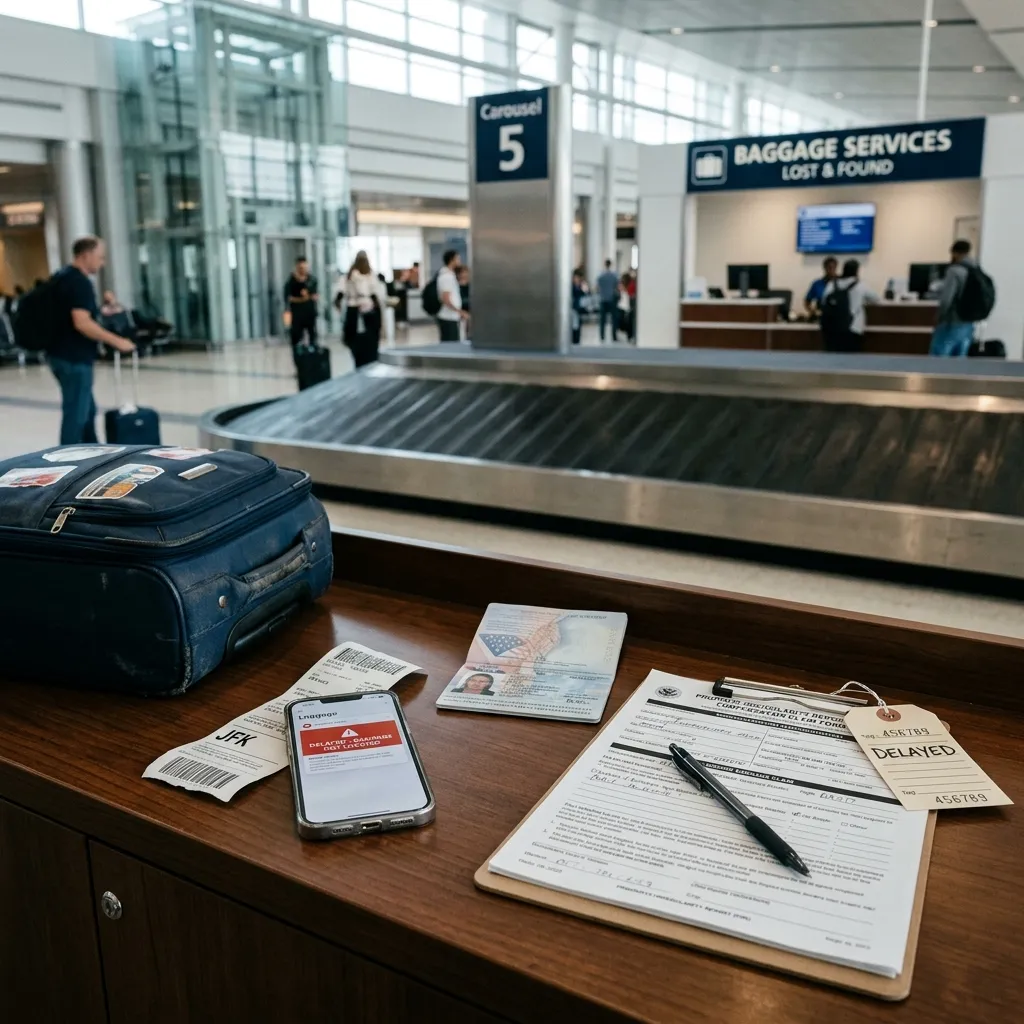
If an airline delays, loses or damages your checked bag, you can claim compensation under the Montreal Convention — up to 1,519 SDR per passenger (about £1,500 / $2,000). But it isn’t a fixed payout: you claim your actual proven costs up to that cap, the clock starts ticking the moment you land, and one form at the airport can make or break your claim. Here’s exactly how delayed baggage compensation works in 2026, and how to claim for a lost or damaged bag too.
Quick answer: baggage compensation
- File a PIR (Property Irregularity Report) at the airport before you leave — this is the step people skip and regret.
- Delayed bag: claim reasonable essential expenses (toiletries, clothes) — keep every receipt.
- Lost bag: generally treated as lost after 21 days; claim the value of the contents.
- The cap is 1,519 SDR (~£1,500 / $2,000) per passenger for delay, loss and damage combined — it’s your actual loss, not an automatic sum.
- Deadlines: damaged → 7 days; delayed → 21 days; legal action → 2 years.
First, before you leave the airport: file a PIR
Report the problem at the airline’s baggage desk and get a Property Irregularity Report (PIR) before you leave the baggage hall.
The Property Irregularity Report is the single most important step, and it’s easy to miss when you’re tired and just want to get home. Go to the airline’s Lost & Found / baggage services desk in the arrivals hall and report that your bag didn’t arrive or was damaged. They’ll create a PIR with a reference number — that’s your proof that you reported the problem in time, and most airlines won’t process a claim without it. Take a photo of the report and the reference before you leave.
Delayed baggage compensation
If your bag is delayed, you can claim the reasonable cost of essentials you had to buy while you waited for it.
A delayed bag is the most common problem, and the airline is liable for the necessary expenses you run up because you don’t have your things — toiletries, underwear, a change of clothes, phone charger and similar essentials. The rules to remember:
- Keep every receipt — you claim actual costs, so no receipt usually means no reimbursement.
- Buy reasonably. Replacing a toothbrush and a few basics is fine; a designer wardrobe is not, and will be refused.
- Report in writing within 21 days of finally receiving the bag.
- If you’re away from home, your need for essentials is greater than at your home airport, and airlines know this.
Submit the delayed baggage claim to the airline with your PIR reference, receipts and boarding pass. The compensation comes out of the same 1,519 SDR cap that covers loss and damage.
Lost luggage compensation
If your bag never turns up, you claim the value of its contents, up to the 1,519 SDR limit.
There’s no single global rule for when a delayed bag officially becomes “lost”, but most airlines treat it as lost after 21 days. At that point your claim shifts from expenses to the value of what was inside. To give your lost luggage claim the best chance:
- Itemise everything in the bag, with approximate values and dates of purchase.
- Provide proof of value where you can — receipts, bank statements, photos of expensive items.
- Include the value of the suitcase itself, not just the contents.
- Remember the cap is per passenger, so a couple who each checked a bag have a combined limit.
Don’t pack valuables in checked luggage. Airlines routinely exclude or limit liability for cash, jewellery, electronics, important documents and fragile items. If it’s valuable or irreplaceable, it belongs in your hand luggage.
Damaged luggage compensation
Report damage within 7 days and the airline should repair or reimburse the bag.
If your case arrives cracked, torn or with wheels or handles broken, the airline is liable — but the deadline is tight. You must report damaged baggage in writing within 7 days of collecting it. Photograph the damage before you leave the airport if you can, and keep the bag; the airline may want to inspect it or arrange a repair. Normal wear and tear, and minor scuffs, are usually excluded.
How much can you claim?
All three — delay, loss and damage — share a single ceiling under the Montreal Convention:
| What happened | What you claim | Maximum |
|---|---|---|
| Delayed baggage | Reasonable essential expenses while you wait | 1,519 SDR per passenger — about £1,500 / $2,000 — for delay, loss and damage combined |
| Lost baggage | The value of the bag and its contents | |
| Damaged baggage | Repair, or the value of the bag |
The limit rose from 1,288 SDR to 1,519 SDR on 28 December 2024, so ignore older guides still quoting the lower figure. SDR is an international currency unit that converts at the daily exchange rate, which is why the pound and dollar equivalents shift slightly. Crucially, this is a maximum for proven loss — not a guaranteed payout — so the quality of your evidence decides what you actually receive.
The deadlines that make or break a claim
| Action | Deadline |
|---|---|
| Report the problem at the airport (PIR) | Before you leave the baggage hall |
| Written claim for damaged baggage | Within 7 days of receiving it |
| Written claim for delayed baggage | Within 21 days of receiving it |
| Baggage treated as lost | Generally after 21 days missing |
| Take legal action if the airline refuses | Within 2 years of arrival |
US flights: a higher limit for domestic trips
The Montreal Convention covers international flights. For US domestic flights it doesn’t apply — instead the Department of Transportation sets a higher minimum liability, currently $4,700 per passenger. So a domestic US baggage claim can actually be worth more than an international one, though the same principle applies: you claim actual, proven loss, and you must report promptly.
How to claim, step by step
- File the PIR at the airport before you leave — get the reference number.
- Keep everything — receipts for essentials, the damaged bag, boarding passes.
- Submit a written claim to the airline within the deadline (7 days damaged, 21 days delayed), quoting the PIR reference.
- Itemise and evidence your losses — the better the proof, the higher the payout.
- Escalate if refused — to the airline’s dispute resolution scheme, the CAA in the UK, or the courts within 2 years.
Airline claim vs travel insurance
You can claim from the airline under the Montreal Convention and from your travel insurance — but you can’t be paid twice for the same loss. In practice, travel insurance is often faster, may cover more (including items the airline excludes), and usually has its own delayed-baggage benefit that pays out after a set number of hours. A common approach is to claim essentials from insurance quickly, and pursue the airline for the larger loss. Check both policies’ limits and deadlines.
Worked example
Your bag is delayed for four days on a trip to Spain. You file a PIR on arrival, then spend £180 on essentials — toiletries, a couple of outfits, swimwear — keeping every receipt. When the bag arrives, you submit a written claim within 21 days with the PIR reference and receipts. The airline reimburses the reasonable essentials, well within the 1,519 SDR cap. Had you thrown the receipts away, or skipped the PIR, the claim would have been far harder to win.
Related guides and tools
- Delayed Flight Compensation UK — separate rules for the flight itself
- Flight Cancellation Compensation
- Missed Connecting Flight Compensation
- Hand Luggage Size Rules — what to keep with you, not in the hold
FAQs
How much compensation for delayed baggage?
You can claim your reasonable essential expenses while you wait, up to the Montreal Convention cap of 1,519 SDR (about £1,500 / $2,000) per passenger, which covers delay, loss and damage combined. It’s actual proven cost, not a fixed sum, so keep your receipts.
How much compensation for lost luggage?
The value of your bag and its contents, up to 1,519 SDR (about £1,500 / $2,000) per passenger. Itemise everything and provide proof of value to get the highest payout.
What is a Property Irregularity Report (PIR)?
It’s the form the airline creates when you report a delayed, lost or damaged bag at the airport. It records your claim and gives you a reference number — most airlines won’t process compensation without one, so file it before you leave the baggage hall.
How long before luggage is considered lost?
There’s no single rule, but most airlines treat a delayed bag as lost after about 21 days. At that point your claim moves from essential expenses to the value of the contents.
What are the deadlines to claim?
Report at the airport before you leave (PIR); a written claim within 7 days for damaged baggage and 21 days for delayed baggage; and any legal action within 2 years of arrival.
Do I need receipts to claim for delayed baggage?
Yes. Delayed-baggage compensation reimburses actual costs, so keep receipts for every essential you buy. Without them, the airline can refuse or reduce your claim.
Can I claim from both the airline and my travel insurance?
You can claim from both, but not be paid twice for the same loss. Insurance is often faster and may cover items the airline excludes, so many people use insurance for essentials and the airline for larger losses.
Is baggage compensation different in the US?
Yes. International flights follow the Montreal Convention (1,519 SDR). US domestic flights follow DOT rules, with a higher minimum liability of $4,700 per passenger.
Sources
Based on the Montreal Convention 1999 baggage liability limits (revised to 1,519 SDR effective 28 December 2024) as reported by ICAO, UK Civil Aviation Authority guidance on baggage, and the US Department of Transportation for domestic limits. SDR values convert at the daily exchange rate. Verified 14 July 2026 — this is general guidance, not legal advice; confirm your position with the airline, the CAA or your insurer.

Reviewed by Muhammad Umar Khan
Founder and editor of TripBuffer. Reviewed against official airport, airline and transport-provider information. For our research standards, see the Editorial Policy.