
Last updated: September 2, 2026
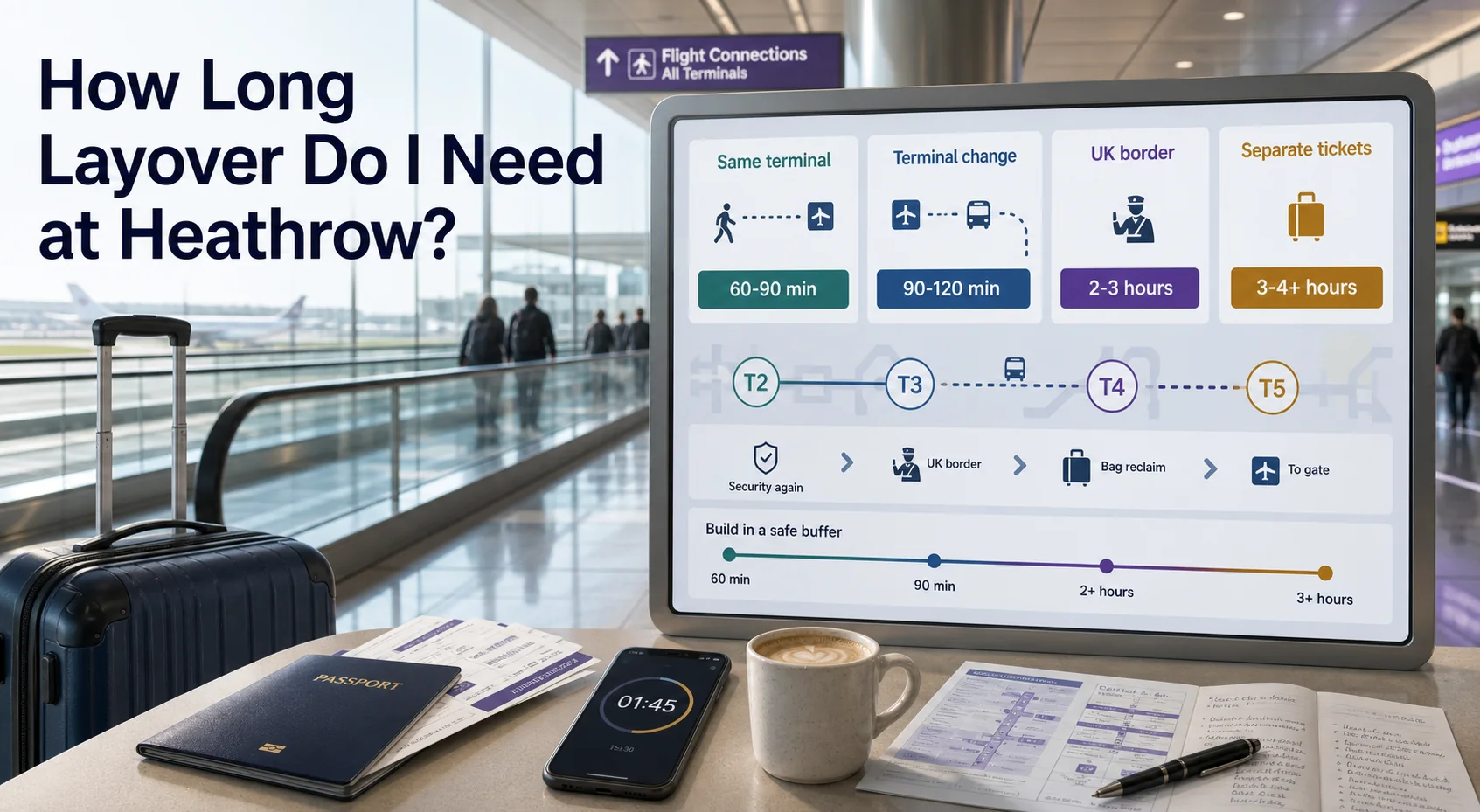
How long a Heathrow layover you need depends on your airline and ticket, whether you change terminals, and whether you cross the UK border — Heathrow itself says there is no single answer. This guide sets out the airline-specific minimums and the safer TripBuffer planning buffers for each scenario, so you can choose a connection with confidence.
This page helps you choose the total connection buffer. For the physical terminal route, use the Heathrow terminal-transfer guide; for separate tickets, the self-transfer guide; for leaving the airport, the Can I leave Heathrow? guide.
Reviewed and updated: 14 August 2026, by Muhammad Umar Khan, TripBuffer editor. Operational information was checked on that date; live immigration and security waits were not measured, and the buffers below are TripBuffer planning ranges rather than airline minimum connection times.
How Heathrow layover time gets used
The process flow behind most connection buffers at Heathrow.
Arrival
Land and orient
Immigration
Border control if needed
Terminal transfer
Move between gates or terminals
Security
Re-clear before the onward flight
Boarding buffer
Aim to reach the gate early
- you are self-transferring
- you have checked bags
- you need to clear immigration
- you must change terminals
Quick answer: how long should a Heathrow layover be?
There is no single Heathrow minimum connection time — the valid minimum is set by your airline and itinerary, and Heathrow tells passengers to confirm it with their airline. British Airways, for example, says its connection times vary by itinerary and are shown in Manage My Booking, and recommends at least four hours when flights are booked on separate tickets. Always start from the minimum shown on your ticket, then add a TripBuffer planning margin for the UK border, terminal changes and disruption — and never book a connection shorter than your airline’s accepted minimum.
Heathrow layover planning buffers (TripBuffer)
| Connection type | TripBuffer planning margin (add to your airline minimum) | Why the margin changes |
|---|---|---|
| Same ticket, same terminal | Airline minimum + about 30 minutes | Lowest-friction connection if your inbound is on time. |
| Same ticket, terminal change | Airline minimum + about 30–60 minutes | You take the airside Flight Connections bus and re-clear security at the departure terminal. |
| International to UK domestic (or Ireland) | Airline minimum + about 45–90 minutes | You must pass passport control and a facial biometric check before security. |
| Separate tickets, cabin bag only | Treat as a new departure — allow at least 4 hours | No protected connection; British Airways recommends at least 4 hours for separate tickets. |
| Separate tickets with checked bags or terminal change | Treat as a new departure — 4–5 hours or more, depending on the itinerary | Heathrow is an arrival plus a fresh departure, not a simple connection. |
Swipe horizontally to see all scenarios. These are TripBuffer planning margins to add to the minimum your airline accepts — not a replacement for it. Never book a connection shorter than your airline’s minimum. Check your exact flights with the Layover Calculator.
Will you make your connecting flight? Put your connection into the Minimum Connection Time Calculator to estimate a safer connection buffer for your bags, terminals and ticket type.
Where each fact comes from
| Claim | Source | Evidence type | Checked |
|---|---|---|---|
| Free Flight Connections shuttle bus runs every 10 minutes | Heathrow | Official airport process | 14 Aug 2026 |
| All connecting passengers pass a security check before the onward flight | Heathrow | Official airport process | 14 Aug 2026 |
| International-to-UK-domestic needs passport control + biometric before security | Heathrow | Official airport process | 14 Aug 2026 |
| Connection times vary by itinerary (shown in Manage My Booking); at least 4 hours for separate tickets | British Airways | Airline guidance | 14 Aug 2026 |
| Airside transit vs landside transit; transit-visa/ETA rules | GOV.UK | UK government guidance | 14 Aug 2026 |
| At least 4 hours; 4–5 hours or more with checked bags or a terminal change | TripBuffer | Editorial risk recommendation | 14 Aug 2026 |
Swipe horizontally to see all columns.
Heathrow terminals and airside transfers
Heathrow operates four terminals: 2, 3, 4 and 5 (Terminal 1 is closed). Terminals 2 and 3 sit together in the Central Terminal Area and are a short walk apart landside, but a connecting passenger should not assume they can use that public pedestrian route while staying in the transfer process. To change terminals as a connecting passenger you follow the purple “Flight Connections” signs; Heathrow directs you to the free airside connection bus (which it says runs every 10 minutes) and through a security check at the departure terminal.
| Scenario | Protected (airside) connection | Airline / official guidance | TripBuffer note |
|---|---|---|---|
| Within Terminal 3, or within Terminal 5 | Walk between gates; a satellite gate can add time | Use the minimum on your itinerary | Confirm your airline’s minimum; add margin for a far gate. |
| Terminal 3 ↔ Terminal 5 | Follow Flight Connections signs to the free airside bus (every 10 min), then a security check | Use the minimum on your itinerary | Allow for the bus, waiting, security and walking — not just the ride. |
| Terminals 2 ↔ 3 (Central Terminal Area) | Follow Flight Connections signs; staff may route you by the airside bus rather than the landside walk | Confirm your airline’s MCT | Don’t treat the landside walk as your connection route. |
| Any terminal change | Re-clear security at the departure terminal | — | Build the second security screening into your buffer. |
Swipe horizontally to see all columns. Confirm the connection minimum on your ticket with your airline — British Airways, for example, says its connection times vary by itinerary and are shown in Manage My Booking.
Do you cross the UK border on a Heathrow connection?
This is what makes some Heathrow connections faster than others:
- International to international (transit): you normally stay airside and do not pass UK immigration — only a transfer and a security check before the onward flight. This is why a same-ticket airside connection can work on a shorter buffer.
- International to UK domestic or Republic of Ireland: you must present your passport at Passport Control and have a facial biometric taken before security — add time.
- Leaving the airport, or separate tickets: you clear the UK border, reclaim bags and start again as a departing passenger.
Check your UK transit permission (visa or ETA)
Staying airside does not automatically mean every traveller can transit without documentation. Depending on your nationality and the documents you hold, you may need a Direct Airside Transit visa even if you never pass through UK border control. If you do cross the border — to collect baggage, self-transfer landside, change airports or leave the airport — you may need an Electronic Travel Authorisation (ETA), a Visitor in Transit visa, a Standard Visitor visa or another valid permission (an ETA removes the need for a transit visa). Rules depend on nationality, so check the official GOV.UK checker and confirm with your airline before booking.
What makes Heathrow layovers tighter
- Heathrow requires connecting passengers to go through a security check before their onward flight.
- Separate-ticket travellers face arrival formalities, baggage reclaim, check-in, bag drop and security a second time.
- Terminal changes add airside-bus and walking time even when the transfer is straightforward.
- International-to-domestic journeys add passport control and a biometric check before security.
Worked example: an international arrival connecting to a UK domestic flight
TripBuffer planning example — not a prediction of live queue times. Immigration, buses, security and gate walks can be shorter or considerably longer. Scenario: you land at Terminal 3 from Dubai on one ticket, connecting to a domestic flight from Terminal 5 (for example to Edinburgh).
- Deplane and reach Flight Connections: illustrative 10–25 min
- Passport Control + facial biometric (UK border for a domestic onward): variable — no fixed guarantee
- Airside Flight Connections bus T3 → T5: route- and wait-dependent
- Security screening at T5: variable
- Walk to gate: gate-dependent
This example shows why TripBuffer suggests adding approximately 45–90 minutes to the airline-accepted minimum for an international-to-domestic connection — it does not establish that every T3–T5 domestic connection takes a fixed time. A pure international-to-international transit (no passport control) is usually faster. Always use the minimum on your ticket, and add margin for a late inbound.
When 2 hours at Heathrow feels enough — and when it does not
2 hours can work
One-ticket international-to-international transit, same-terminal journeys and airlines used to Heathrow connections can make 2 hours workable when the inbound flight is on time.
2 hours can feel tight
Terminal changes, late arrivals, long walks, international-to-domestic routing and heavy congestion can turn 2 hours from comfortable into stressful very quickly.
Separate tickets are different
On separate tickets you are not protected like a through passenger. That is why TripBuffer uses much larger buffers for self-transfers at Heathrow.
Can you leave the airport during a Heathrow layover?
Usually only with a genuinely long buffer — Heathrow suggests staying near the airport for layovers of up to about six hours. If you do leave, you must clear the UK border on the way out (check your UK entry permission first), and return like a normal departing passenger: about 3 hours before a long-haul departure and 2 hours before a short-haul flight. Remember a six-hour layover is not six usable hours in London once you subtract immigration on exit, travel each way, possible transport disruption, a different return terminal and your airline’s check-in deadline. If that is your plan, use our dedicated Can I Leave Heathrow During a Layover? guide, and on separate tickets pair it with the Heathrow Self-Transfer Guide. For overnight connections, see How to Plan an Airport Hotel Stopover.
From the driver’s seat: what a long Heathrow layover is really like
I’ve spent years arranging airport transfers around Heathrow, and I’m often the person booked to collect someone on a long layover, run them into London and get them back in time for the next flight. The airside connection minimum is your airline’s to set — the guidance above covers that. What I can add is the honest answer to the question I actually get asked: is it worth leaving the airport, and how much time do you really have?
A six-hour layover is not six hours in London
This is the one people get wrong most. From the moment you land, the clock is already spending time you can’t get back: clearing the UK border, the transfer into town, then the return transfer and being back through security with margin to spare. A six-hour gap on your ticket often leaves only two or three genuinely usable hours in the city. Plan from the usable time, not the number on the boarding pass.
When it’s genuinely worth leaving
With a truly long layover — roughly seven hours or more — in daylight, with straightforward entry and light bags, a quick trip in can beat sitting at the gate, and I’ll happily arrange it. When it isn’t worth it: a shorter gap, a red-eye connection when the city’s shut anyway, or a first visit where you’d spend the whole window anxious about getting back. If leaving would be a rush, it isn’t a trip — it’s a risk.
First, check you’re even allowed to leave
Not everyone can cross the UK border on a layover. Depending on your nationality you may need an ETA or a transit visa simply to step landside, and I’ve seen people plan a whole city trip they legally couldn’t take. Sort your UK entry permission first — the official guidance is linked above — before you plan anything on the other side of passport control.
What happens to your bags
On a single through-ticket, your checked bags are usually tagged all the way through, so you leave with just your hand luggage — easy. On two separate tickets you’ll have every bag with you, which turns a “quick trip into town” into a luggage operation and eats into the time and the fun. Know which one you’re on before you decide to leave.
When I’ll tell you to just stay in the airport
I don’t push everyone out of the terminal — that wouldn’t be honest. A tight gap, a very late or very early connection, bad weather or heavy traffic on the roads, or simply a traveller who’d get more out of a lounge and a shower than a rushed dash: sometimes staying put is the smarter call. Leaving isn’t always the win people imagine it will be.
Give the way back more room than you think
The return leg is where it goes wrong, every time: traffic, a slow security queue, a gate that closes earlier than expected. Aim to be back through security with real margin, not “just in time.” Missing your onward flight costs far more — in money and stress — than a couple of quieter hours in the terminal ever would.
Methodology and official references
The buffers here are TripBuffer planning ranges, not airline minimum connection times. Where a figure comes directly from Heathrow, an airline or GOV.UK it is attributed (for example “Heathrow says the connection bus runs every 10 minutes”). We do not quote fixed per-airline connection minutes, because airlines set them by itinerary — British Airways, for instance, says its connection times vary and are shown in Manage My Booking. Actual immigration and security waits change by the hour and season and were not measured. Operational information checked 14 August 2026. Always confirm the minimum on your ticket with the operating airline, and check UK transit-permission rules on GOV.UK. TripBuffer is independent and not affiliated with Heathrow or any airline.
- Heathrow — connecting flights guide (Flight Connections, bus, security)
- Heathrow — travel between terminals
- British Airways — Heathrow flight connections (airline recommendations)
- GOV.UK — UK transit visa checker
Frequently asked questions
What is the minimum connection time at Heathrow?
There is no single Heathrow minimum connection time — the valid minimum is set by your airline and itinerary. British Airways, for example, says its connection times vary by itinerary (shown in Manage My Booking) and recommends at least four hours for separate-ticket connections. Separate-ticket passengers cannot rely on protected-connection minimums and should allow substantially more time. Always confirm the minimum on your ticket, and never book a connection shorter than your airline accepts.
Is 90 minutes enough for a Heathrow connection?
It can be enough on one ticket if you stay in the same terminal, your inbound is on time and your airline accepts it. It is not a comfortable buffer for a terminal change, an international-to-domestic connection or separate tickets. Confirm your airline’s minimum and don’t book below it.
Is 2 hours enough for an international connection at Heathrow?
Two hours is often workable for an international-to-international transit on one ticket, but it becomes much less comfortable if you change terminals, go from international to UK domestic, or face any disruption. Use the minimum on your ticket and add margin for a late inbound.
How long does it take to transfer between Heathrow terminals?
There is no fixed universal figure. Connecting passengers follow the purple Flight Connections signs to the free airside bus, which Heathrow says runs every 10 minutes, then pass a security check at the departure terminal. Allow for the bus, waiting, security and walking on top of the ride, and confirm the connection minimum shown on your itinerary.
Do I need a UK transit visa or ETA for a Heathrow layover?
It depends on your nationality and whether you cross UK border control. Some travellers need a Direct Airside Transit visa even when staying airside; if you pass the border (to collect bags, self-transfer or leave the airport) you may need an ETA, a Visitor in Transit visa or another permission, and an ETA removes the need for a transit visa. Check the GOV.UK transit-visa checker and confirm with your airline before booking.
How much layover time do I need at Heathrow on separate tickets?
As a conservative planning baseline, allow at least four hours for separate-ticket connections, including cabin-bag-only journeys — British Airways currently recommends a minimum of four hours for separate tickets at Heathrow. Consider additional time (4–5 hours or more) for checked baggage, border formalities, terminal changes, mobility assistance or disruption. On separate tickets there is no protected connection, so airline minimums don’t apply and check-in and bag-drop deadlines can make even these buffers insufficient after a delayed arrival.
Can I leave Heathrow during a layover?
Only with a genuinely long layover, and Heathrow suggests staying near the airport for waits of up to about six hours. You must clear the UK border to leave (check your entry permission first) and return like a normal departing passenger — about 3 hours before long-haul departures and 2 hours before short-haul flights. A six-hour layover is not six usable hours once you account for immigration, travel each way and your check-in deadline.

Reviewed by Muhammad Umar Khan
Founder and editor of TripBuffer. Reviewed against official airport, airline and transport-provider information. For our research standards, see the Editorial Policy.