
Last updated: July 18, 2026
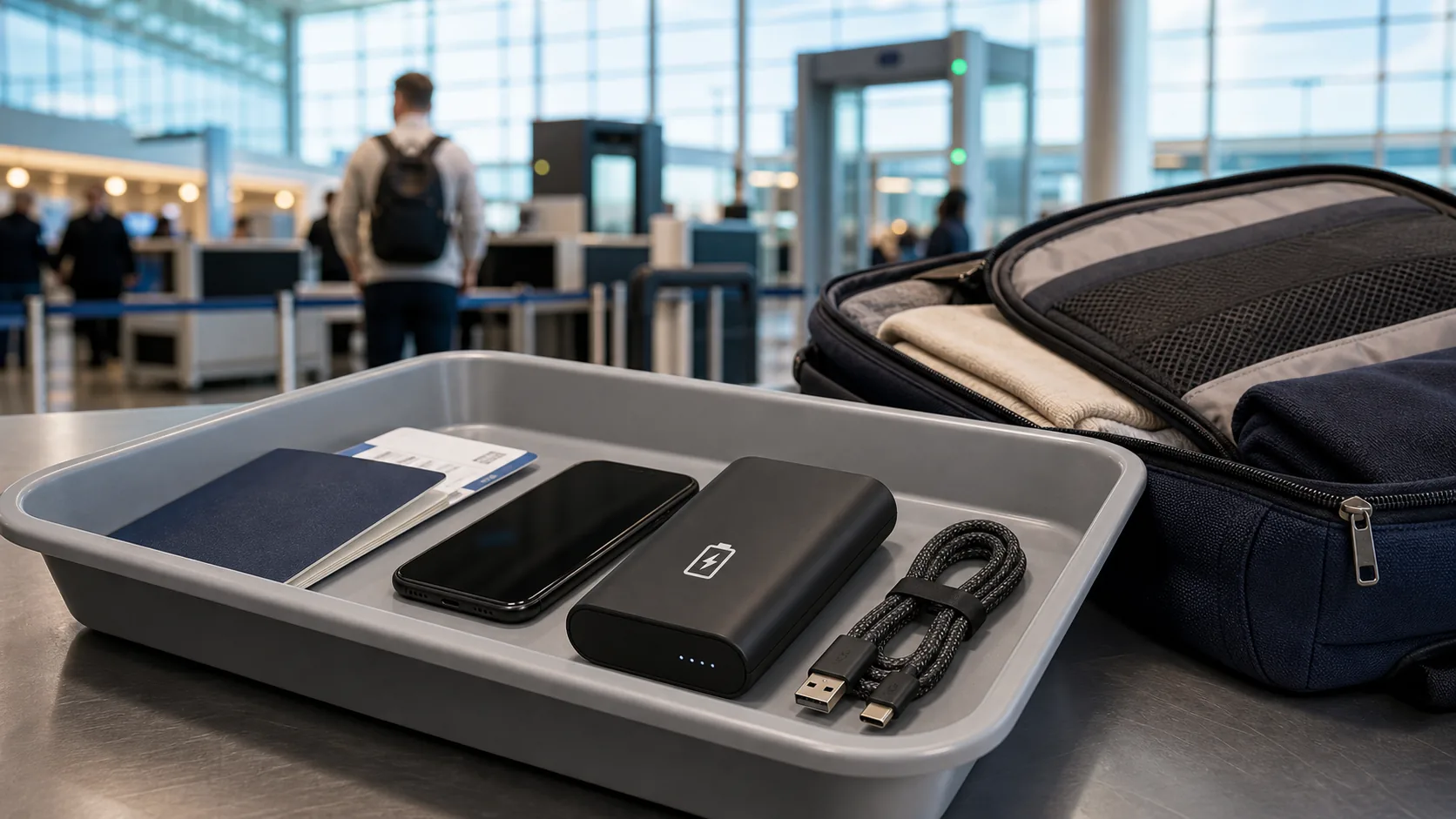
Can you take a power bank on a plane? Yes — but only in your hand luggage, never in checked baggage. Power banks up to 100Wh are allowed without airline approval, those between 100Wh and 160Wh need your airline’s permission, and anything over 160Wh is banned. Under the 2026 rules you can carry a maximum of two per person and must not recharge them in flight. Here is exactly what that means for UK travellers.
Quick answer: are power banks allowed on planes?
- Yes, in hand luggage only — power banks are spare lithium batteries and are banned from checked luggage.
- Up to 100Wh: allowed, no approval needed (covers most power banks, e.g. a 20,000mAh unit).
- 100Wh–160Wh: allowed only with airline approval.
- Over 160Wh: not allowed on passenger aircraft.
- Maximum of two power banks per passenger; do not recharge them on board.
- Airlines can be stricter than the UK baseline — always check yours before you fly.
What changed in the 2026 ICAO/IATA power bank rules?
From 27 March 2026, updated international guidance from ICAO and IATA — reflected by the UK Civil Aviation Authority — tightened how passengers can carry power banks and spare lithium batteries. The headline changes are:
- A clear maximum of two power banks per person.
- Power banks must not be recharged on board the aircraft.
- They should not be used to charge other devices during the flight.
- They must not be stored in the overhead lockers — keep them within reach, in the seat pocket or under the seat in front, so crew can act fast if a battery overheats.
- Each spare battery must be individually protected from short circuits (kept in its case or a bag, terminals covered).
The watt-hour limits (100Wh and 160Wh) themselves are unchanged — what changed in 2026 is the quantity, in-flight use and packaging guidance.
UK power bank flight rules at a glance
Here are the power bank flight rules in a form you can scan in seconds:
| Power bank capacity | Roughly (at 3.7V) | In hand luggage? | Airline approval? | Max number |
|---|---|---|---|---|
| Up to 100Wh | Up to ~27,000mAh | Yes | No | 2 |
| 100Wh – 160Wh | ~27,000–43,000mAh | Yes | Yes — required | 2 |
| Over 160Wh | Over ~43,000mAh | No — banned | — | 0 |
| Any size in checked luggage | — | No — never | — | 0 |
Based on UK CAA / IATA guidance effective 27 March 2026. Approximate mAh figures assume a typical 3.7V lithium-ion cell. Always check your airline before flying.
Quick definitions
- Power bank
- A portable battery pack that stores energy to charge phones, tablets and other devices on the go. Airlines treat it as a spare lithium battery.
- Portable charger
- Another name for a power bank — the rules are identical.
- Watt-hour (Wh)
- The energy capacity of a battery, and the figure airlines use to decide if it is allowed. Calculated as Wh = mAh × V ÷ 1000.
- Spare lithium battery
- Any lithium battery not installed inside a device — including power banks. These must travel in the cabin, never in the hold.
Can you take a power bank on a plane in hand luggage?
Yes. A power bank must go in your hand luggage (cabin baggage) and can be up to 100Wh without approval.
Because a power bank is a spare lithium battery, aviation rules require it to be in the cabin with you, where crew can act quickly in the rare event of a battery fault. Keep it easy to reach for the security tray, and protect the terminals so it cannot short circuit against keys or coins. For everything else that goes in your bag, see our full UK hand luggage rules.
Can you put a power bank in checked luggage?
No. Power banks are banned from checked luggage on UK and international flights.
Spare lithium batteries are not allowed in the hold because a fault there would be much harder to detect and control. If security or check-in staff find a power bank in a checked bag, they will ask you to remove it — and it may be confiscated if you have already dropped the bag. Never pack a power bank, spare phone battery or loose lithium cell in your checked baggage.
Can you take a portable charger on a plane?
Yes — a portable charger is just another name for a power bank, so the same rules apply.
Carry your portable charger on a plane in your hand luggage, keep it under 100Wh (or get airline approval for 100–160Wh), and bring no more than two. There is no separate category for “portable chargers” — security treats them exactly like power banks.
What size power bank is allowed on a plane?
Up to 100Wh with no approval; 100–160Wh with airline approval; over 160Wh is not allowed.
The power bank size limit is measured in watt-hours (Wh), not physical size or mAh alone. Most consumer power banks sit comfortably under 100Wh, so they are fine. The trouble starts with very high-capacity chargers marketed at 30,000mAh and above, which can cross the 100Wh line.
How to check your power bank’s Wh rating
Many power banks print the Wh figure on the casing. If yours only shows mAh, work it out with this formula:
Wh = mAh × V ÷ 1000
Most power banks use a 3.7V lithium-ion cell, so:
- 10,000mAh × 3.7 ÷ 1000 = 37Wh — fine
- 20,000mAh × 3.7 ÷ 1000 = 74Wh — fine
- 27,000mAh × 3.7 ÷ 1000 = 99.9Wh — just under the limit
- 30,000mAh × 3.7 ÷ 1000 = 111Wh — over 100Wh, needs airline approval
As a rule of thumb, anything up to about 27,000mAh at 3.7V stays under 100Wh. Above that, check the Wh rating and your airline’s policy.
Can you use a power bank during a flight?
Under the 2026 rules you should not use a power bank to charge devices during the flight, and many airlines now prohibit it.
The updated CAA guidance says power banks should not be used to charge other portable electronic devices on board. Some airlines allow limited, supervised use; a growing number ban it outright, especially storing a power bank in the overhead locker while it is in use. The safe approach in 2026: charge your devices before you board and keep the power bank switched off in the cabin unless your airline clearly permits use.
Can you charge a power bank on the plane?
No. You must not recharge a power bank on board, for example from a seat-back USB port.
Recharging a power bank in flight is specifically not allowed under the 2026 rules. Seat USB ports are intended for phones and tablets, not for topping up spare batteries. Arrive with your power bank already charged.
How many power banks can you take on a plane?
A maximum of two power banks per passenger.
The 2026 guidance sets a clear ceiling of two power banks per person. If you are travelling as a family, each traveller has their own allowance, but pack sensibly — two well-marked, sub-100Wh power banks cover almost any trip.
What about larger power banks between 100Wh and 160Wh?
Allowed only with your airline’s prior approval, and still limited to two per person.
Power banks in the 100–160Wh band — typically high-capacity units around 30,000–43,000mAh — are permitted only if your airline agrees in advance. Contact the airline before you travel; do not assume approval, as staff can refuse an oversized battery at the gate.
Airline rules can be stricter
The CAA sets the UK baseline, but individual airlines can — and increasingly do — add their own restrictions on using or storing power banks in the cabin. A rule that is fine on one carrier may be tighter on another, and destination countries can differ too. Always check the operating airline’s dangerous-goods or restricted-items page before you fly, especially for connecting or long-haul flights.
Airline power bank rules compared (2026)
Some carriers are now noticeably stricter than the UK baseline — a few allow only one power bank, and the major US airlines have explicitly banned storing them in the overhead lockers. Here is how popular airlines compare in 2026:
| Airline | Max power banks | Wh limit | Use to charge devices in flight? | Overhead locker? |
|---|---|---|---|---|
| British Airways | 2 | Up to 110Wh | Cruise only | No — under the seat in front |
| easyJet | 2 | Up to 160Wh | Cruise only | No — keep with you |
| Ryanair | 2 | Up to 100Wh | Cruise only | No — under seat / on you |
| Jet2 | 2 | Up to 160Wh* | Cruise only | No — keep with you |
| Emirates | 1 | Up to 100Wh | No — in-flight use banned | No |
| American Airlines | 2 | Up to 100Wh | Keep visible; must not recharge the bank | No — banned |
| Delta Air Lines | 2 | Up to 100Wh | Keep visible; must not recharge the bank | No — banned |
| United Airlines | 2 | Up to 160Wh | Carry-on only; must not recharge the bank | No — banned |
| Southwest | 1 | Up to 100Wh | No — use/recharge banned | No — banned |
*Jet2 requires a clearly printed Wh rating and short-circuit protection. Compiled from each airline’s published guidance and reputable 2026 reporting; verified 14 July 2026. Southwest’s one-charger limit applied from 20 April 2026 and the US carriers’ overhead-locker ban from around 1 May 2026. Airlines change these frequently — confirm with your carrier before you fly.
The 2026 headline for every airline: keep power banks in the cabin, don’t recharge them in flight, and don’t stow them in the overhead locker — keep them within reach.
UK airport power bank rules: Heathrow, Gatwick, Manchester and beyond
The power bank rules are set nationally, so they are the same at every UK airport — Heathrow, Gatwick, Manchester, Luton, Stansted, Birmingham, Edinburgh, Glasgow, Bristol and the rest. Security at any UK airport can ask to see your power bank, check its Wh or mAh marking, and refuse it if it is over the limit or unmarked. What varies is not the airport but your airline and your destination, so plan around those.
Power bank rules vs UK liquid rules
Travellers often lump power banks in with the liquids rule, but they work very differently:
| Power banks | Liquids | |
|---|---|---|
| Where they go | Hand luggage only | Hand luggage (hold is fine too) |
| Checked luggage | Banned | Allowed |
| Limit | 100Wh / 160Wh with approval | 100ml or 2 litres, by airport |
| Plastic bag needed | No | No (at most UK airports now) |
In short, liquids can go in the hold but power banks cannot. For the latest security-lane liquid limits, see our guide to the UK airport liquid rules.
Common mistakes that could get your power bank refused
- Packing it in checked luggage — the single most common reason a power bank is pulled or confiscated.
- No visible Wh or mAh marking — if staff cannot confirm the capacity, they can refuse it.
- Assuming a 30,000mAh unit is fine — it is likely over 100Wh and needs approval.
- Bringing three or more — over the two-per-person limit.
- Loose in a bag with keys or coins — a short-circuit risk; keep terminals protected.
- Recharging or using it in flight where the airline prohibits it.
Packing checklist before you fly
✓ Power bank(s) in your hand luggage, never checked
✓ Capacity under 100Wh (or airline approval for 100–160Wh)
✓ No more than two power banks per person
✓ Wh/mAh marking visible on the casing
✓ Fully charged before boarding (you can’t recharge on board)
✓ Terminals protected from short circuits
✓ Checked your airline’s specific policy
FAQs
Can you take a power bank on a plane in the UK?
Yes. A power bank is allowed in hand luggage only. Up to 100Wh needs no approval, 100–160Wh needs airline approval, and over 160Wh is banned. You can carry a maximum of two, and they must never go in checked luggage.
Can I take a portable charger in hand luggage?
Yes. A portable charger is the same as a power bank and must be carried in your hand luggage or cabin bag, up to 100Wh without approval.
Can I put a power bank in checked luggage?
No. Power banks are spare lithium batteries and are banned from checked luggage. They must travel in the cabin with you.
What is the power bank size limit for planes?
100Wh without approval, 100–160Wh with airline approval, and over 160Wh not allowed. The limit is measured in watt-hours, not physical size.
Is a 20,000mAh power bank allowed on a plane?
Yes. At 3.7V a 20,000mAh power bank is about 74Wh, well under the 100Wh limit, so it is allowed in hand luggage without approval.
Is a 30,000mAh power bank allowed on a plane?
Usually only with airline approval. At 3.7V a 30,000mAh power bank is about 111Wh, just over 100Wh, placing it in the 100–160Wh band that requires the airline’s permission.
How many power banks can I take on a plane?
A maximum of two power banks per passenger under the 2026 UK CAA and IATA guidance.
Can I charge my phone with a power bank during a flight?
Under the 2026 rules you should not use a power bank to charge devices on board, and many airlines now prohibit it. Charge your devices before you fly and check your airline’s policy.
Can I recharge my power bank on the plane?
No. Power banks must not be recharged on board, including from a seat-back USB port. Arrive with it already charged.
Can I keep a power bank in the overhead locker?
No. Under the 2026 rules power banks must stay within reach — in the seat pocket or under the seat in front — not in the overhead locker, so crew can act quickly if a battery overheats. US airlines including American, Delta, United and Southwest now ban overhead-bin storage outright.
Do airport security staff check power bank capacity?
They can. Security may inspect the Wh or mAh marking and refuse a power bank that is over the limit or unmarked.
What happens if my power bank has no Wh label?
It may be refused, because staff cannot confirm it is within limits. Keep the original capacity markings visible, or note the Wh rating.
Are power bank rules the same for all airlines?
No. The CAA sets a UK baseline, but airlines can be stricter and destinations can differ. Always check your operating airline before flying.
Final answer
So, can you take a power bank on a plane? Yes — in your hand luggage, up to 100Wh without approval, up to 160Wh with your airline’s permission, never in checked baggage, and no more than two per person. Keep it marked, keep it charged before boarding, don’t recharge or use it in flight where prohibited, and check your specific airline. Do that and your power bank will sail through security at any UK airport in 2026.
Sources
Based on the UK Civil Aviation Authority guidance on lithium batteries and power banks (rules effective 27 March 2026), aligned with ICAO and IATA passenger lithium-battery guidance. The airline comparison table is compiled from each carrier’s published guidance and reputable 2026 reporting. Verified 14 July 2026 — rules and airline policies change frequently, so confirm with your airline before you travel.

Reviewed by Muhammad Umar Khan
Founder and editor of TripBuffer. Reviewed against official airport, airline and transport-provider information. For our research standards, see the Editorial Policy.