
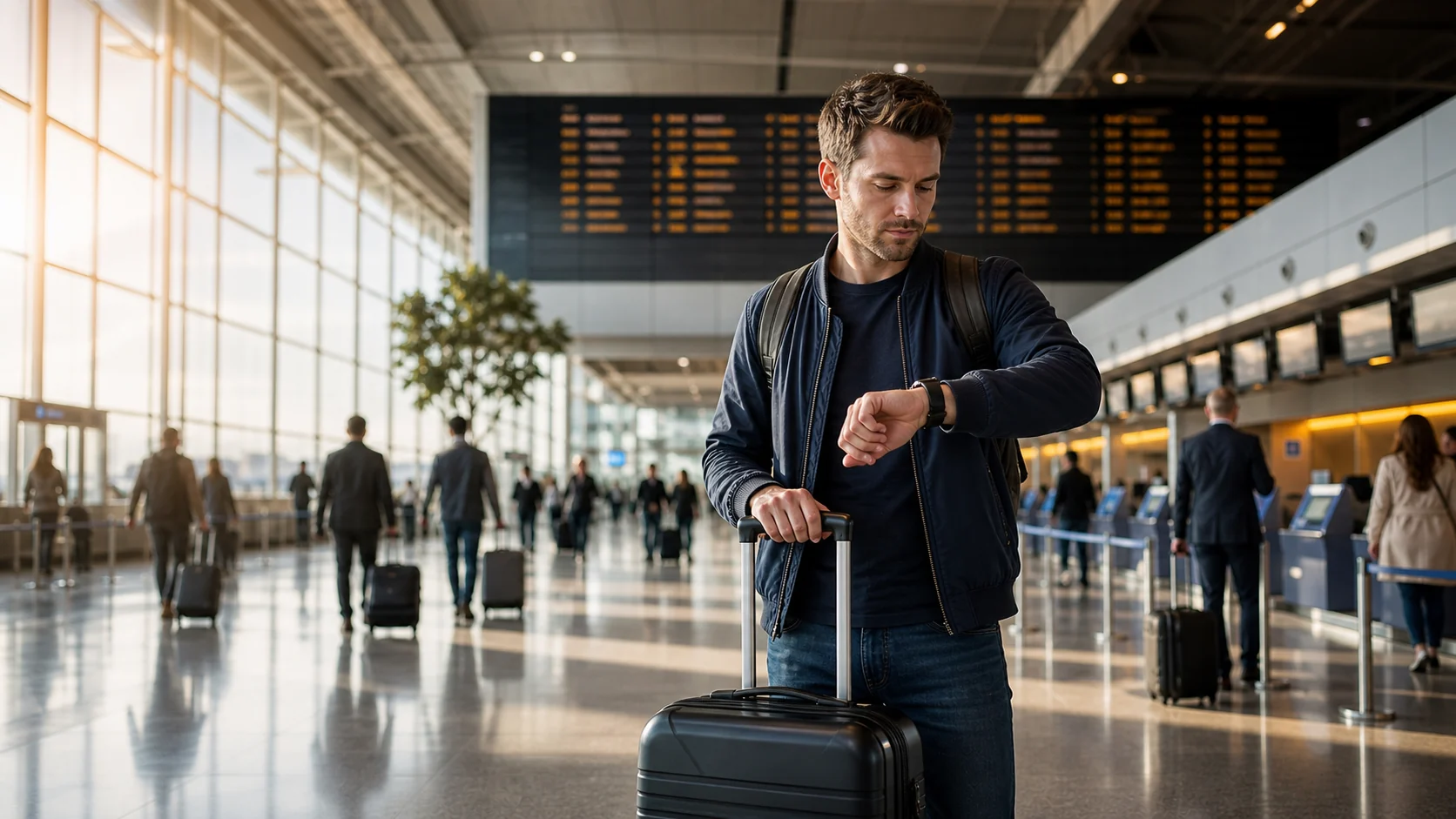
“Get to the airport three hours early.” It’s the oldest piece of travel advice we’ve got, and in 2026 it’s often wrong — sometimes by a lot. Depending on your airline, your bag situation, the airport and the time of day, three hours can be plenty, or barely enough. Here’s a friendlier way to think about it.
Why the “3-hour rule” exists
The three-hour guidance comes from a time when international flights involved long manual document checks at the desk, paper boarding passes and queues that moved slowly. Today, mobile boarding passes, automated passport control and faster bag drop systems have streamlined the whole flow. The three-hour rule sticks around because it’s safe advice for the worst-case scenario, not because it’s the right answer for every flight.
The honest answer is: you can usually arrive later than you think, but with a buffer that protects you on the days something goes wrong. Let’s break down what actually drives the right timing.
The factors that actually determine your arrival time
1. Are you checking a bag?
If you’re travelling carry-on only and you’ve already got your mobile boarding pass, you can skip the check-in desk entirely and head straight to security. This usually saves 30–60 minutes off your arrival target.
If you are checking a bag, you’re bound by the airline’s hard cutoffs. Most international flights close baggage drop 60 minutes before departure. If you arrive 55 minutes before your flight, the system simply won’t let you check in, even if the plane is still at the gate. That hard cutoff is what makes “arrive early” advice exist in the first place.
2. Is it a major hub or a regional airport?
Walking from security to your gate at a busy hub like Heathrow, JFK or DXB can easily take 15–20 minutes. If you need to take an airside transit train to a satellite terminal, add another 10–15. Regional airports are different — you can often be at the gate within 5 minutes of clearing security, which means an extra 30 minutes of buffer at the front end is just extra time at the cafe.
3. International vs domestic
International flights often involve manual visa or passport checks before you reach the security queue. Boarding for large international aircraft usually starts 45–50 minutes before departure, whereas domestic flights might start boarding just 30 minutes prior. That difference adds up.
4. The time of day
Airport queues aren’t uniform across the day. Early-morning long-haul departures (5:00–8:00 AM) often see the longest security queues because most of the airport’s daily flights are leaving at once. Mid-afternoon and late-evening flights usually have lighter security flow. If your flight leaves at 7 AM from a busy hub, give yourself the extra buffer; for an 11 AM regional flight, you can be more relaxed.
5. Time of year
School holidays, summer peak weeks and the days around major holidays push every queue longer. If you’re flying during one of these windows, add 30 minutes to your arrival target. Off-peak weekday mid-mornings are the easiest time to fly through any airport.
When you actually need to arrive
Putting it all together, here’s a friendlier set of guidelines for 2026:
- Carry-on only, domestic: 1.5 hours before departure
- Checked bags, domestic: 2 hours before departure
- Carry-on only, international: 2 to 2.5 hours before departure
- Checked bags, international: 2.5 to 3 hours before departure
- Peak holiday travel, any flight: add 30 minutes to the above
- Major hub early-morning long-haul: add 30 minutes
Airport-specific arrival advice
The above is a starting point. Each big airport has its own quirks worth knowing about:
- Heathrow. Terminal-specific. Terminal 5 has its own train to satellite terminals (B and C) which adds 10–15 minutes; budget for it. More on Heathrow Terminal 5.
- Gatwick. Generally fast at off-peak; the security queue at South Terminal can build during 5–7 AM departures.
- JFK. Heavily terminal-dependent. International airlines at T1, T4 and T7 each have different layouts; arrive 20 minutes earlier than you would for a domestic flight. More on JFK terminals.
- DXB. Big airport, generally efficient flow, but Terminal 2 (low-cost carriers like FlyDubai) feels more like a regional setup. More on DXB terminals.
What’s actually changed in 2026
A few quiet improvements over the last couple of years have shifted the maths:
- Faster security tech. Most major UK airports now use 3D-scan CT systems that let you keep laptops and liquids in your bag. That’s 30–60 seconds saved per passenger, which adds up to meaningfully shorter queues.
- Automated passport control. e-Gates at major UK and EU airports now accept passport holders from more countries, including most US, Canadian and Australian travellers.
- Biometric boarding pilots. A handful of airlines and airports are trialling face-recognition boarding that skips boarding-pass scans entirely. It’s not universal yet, but it’s spreading.
Net effect: the same flight that needed three hours of buffer in 2018 can often be done in 2 to 2.5 hours today, especially with carry-on only.
What if you arrive too early?
Arriving early isn’t wasted time if you plan for it. The big hubs have decent food, lounges (paid day-passes from £25–£40), shopping, decent wi-fi and quiet seating. If you’ve got a 3-hour buffer and you cleared security in 20 minutes, that’s two and a half hours of low-stress time. The traveller who arrived 90 minutes before departure and ran into an unusually long queue is the one who paid for that buffer in stress.
Calculate your exact leave-home time
“Arrive 2.5 hours early” isn’t useful if you don’t factor in the drive, the parking shuttle, dropping the car off and the walk to the terminal. Use our airport arrival time calculator to work backwards from your flight time, factoring in your bag situation, the airport and the time of day, and get a realistic target for when you should actually leave the house. For getting to the airport, the best time to leave for airport calculator handles the travel-to-airport side of the same question.
Popular airport transfer guides
Frequently asked questions
How early should you get to the airport in 2026?
It depends on your bag and flight type. A realistic 2026 guide: carry-on only domestic about 1.5 hours; checked bag domestic about 2 hours; carry-on international 2 to 2.5 hours; checked-bag international 2.5 to 3 hours. Add 30 minutes for peak holidays or an early-morning long-haul from a busy hub.
Is the old 3-hour rule still necessary?
Not always. The 3-hour rule dates from an era of manual document checks and paper boarding passes. With mobile boarding passes, e-gates and faster CT scanners, many flights that needed three hours in 2018 can be done in 2 to 2.5 hours today, especially carry-on only. It remains safe advice for the worst case.
How early should I arrive for a domestic flight?
Around 1.5 hours if you are carry-on only with a mobile boarding pass, and about 2 hours if you are checking a bag. Add time at busy hubs or during peak periods.
How early should I arrive for an international flight?
About 2 to 2.5 hours carry-on only, and 2.5 to 3 hours if you are checking a bag, because international flights often add passport or visa checks and earlier boarding.
Can I arrive 90 minutes before a flight?
For a domestic flight, carry-on only, with online check-in done, 90 minutes is usually workable at most airports. It is riskier with a checked bag or at a busy hub during peak hours.
How much earlier should I arrive if I am checking a bag?
Allow roughly 30 to 60 minutes more than carry-on only, because you are bound by the airline’s bag-drop cutoff rather than just the security queue.
What time does baggage drop close?
Most international flights close bag drop around 60 minutes before departure. If you arrive after the cutoff the system will not let you check in, even if the plane is still at the gate, so beat the deadline.
Does travelling carry-on only let me arrive later?
Yes. With carry-on only and a mobile boarding pass you can skip the check-in desk and go straight to security, typically saving 30 to 60 minutes off your arrival target.
How early should I arrive at a big hub versus a regional airport?
Big hubs like Heathrow, JFK or DXB can mean a 15 to 20 minute walk to the gate, plus an airside train to satellite terminals, so build in extra time. At a regional airport you can often reach the gate within 5 minutes of clearing security. For UK airports specifically, see our Heathrow, Gatwick and Manchester arrival guide.
How early should I arrive for an early-morning flight?
Early-morning departures (around 5 to 8 AM) often have the longest security queues because much of the airport leaves at once. Add about 30 minutes to your usual target for an early flight from a busy hub.
Should I arrive earlier during school holidays or peak season?
Yes. School holidays, summer peak weeks and the days around major holidays push every queue longer, so add about 30 minutes to your arrival target during these windows.
What time does the boarding gate close?
Boarding usually starts 45 to 50 minutes before a large international flight and about 30 minutes before a domestic one. Gates then close around 20 to 30 minutes before departure and will not reopen, so leave time for a long walk to the gate.
Has airport security got faster in 2026?
In many places, yes. Most major UK airports now use 3D CT scanners that let you keep laptops and liquids in your bag, and e-gates accept passport holders from more countries. These shave time off queues, which is why arrival times have eased slightly.
How early should I arrive for a connecting flight?
A connection depends on the airport’s minimum connection time, plus any terminal change or re-clearing of security. Allow more than the published minimum, and use the TripBuffer Layover Calculator to check whether your connection is realistic.
What happens if I arrive too late at the airport?
If you miss the bag-drop or boarding cutoff you can be refused travel even if the plane has not left, and you may have to rebook. The buffer exists to protect you on the day a queue runs unusually long.