
Last updated: September 2, 2026
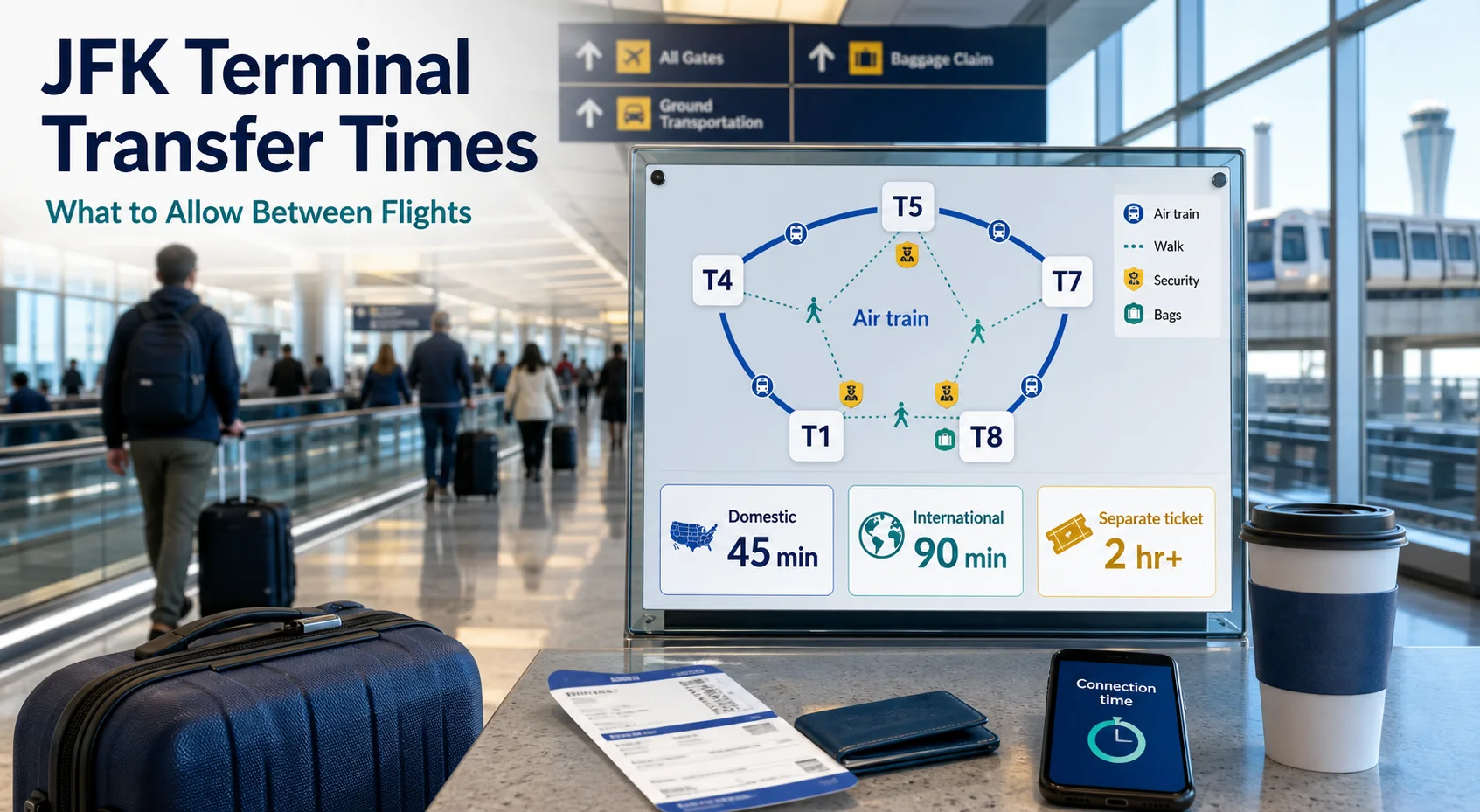
This guide sets out how terminal transfers work at New York JFK — why most terminal changes mean clearing security again, the important exception for international arrivals, and how much time to plan — so a tight layover does not catch you out. The terminal-move times here are editorial planning ranges, not airline minimum connection times.
Reviewed and updated: 13 August 2026.
JFK construction notice — checked 13 August 2026: JFK is being redeveloped, and the airport warns that getting to, from and around the airport may take longer than usual. Allow significantly more time and check live JFK advisories before you travel.
Quick answer
- JFK has five working terminals — Terminals 1, 4, 5, 7 and 8 — with no airside (secure) link between any of them. To change terminals you leave security, ride the free AirTrain JFK, and clear TSA again at the next terminal.
- A domestic or US-precleared connection in the same terminal can often stay airside and just walk to the next gate.
- A non-precleared international arrival must clear US immigration (CBP), collect its checked bags, recheck them and pass TSA again — even if the onward flight leaves from the same terminal.
- On separate tickets, treat any terminal change as a self-transfer and allow a large buffer.
Which connection are you making?
The single most important question at JFK is not the distance between terminals — it’s whether you have to enter the US and reclaim baggage. This changes the process completely, even within one terminal.
| Connection type | Process at JFK |
|---|---|
| Domestic or US-precleared arrival, same terminal | Normally stay airside and walk to your next gate — no AirTrain, no baggage reclaim. |
| Non-precleared international arrival, same terminal | Clear CBP immigration, collect your checked bags (even if tagged to your final destination), recheck them where required, and pass TSA security again. |
| Different terminal (any arrival) | Leave the secure area, take AirTrain, and pass TSA again at the departure terminal — plus CBP and baggage first if you’re a non-precleared international arrival. |
Swipe horizontally to see all columns.
Source: JFK’s official Connections Guide, which confirms that international arrivals must go through immigration, collect their baggage, recheck it and pass security again.
JFK terminal transfer times at a glance
The ranges below are TripBuffer planning buffers, not airline minimum connection times. They combine JFK’s published process with allowances for deplaning, walking, AirTrain waiting and screening — always use the connection shown in your confirmed booking, and check separate-ticket timing with the operating airline.
| Type of move | TripBuffer planning range (not an airline minimum) | What is involved |
|---|---|---|
| Same terminal — domestic or US-precleared | Often under an hour | Stay airside and walk to the next gate. No AirTrain, no second security check. |
| Same terminal — non-precleared international arrival | Treat as a full entry-and-departure | CBP immigration, baggage reclaim, recheck and TSA again — even for the same terminal. |
| Different terminal, single (through) ticket | 90 minutes or more | AirTrain (under 10 minutes) plus leaving security, walking, and re-clearing TSA at the new terminal. |
| Different terminal, separate tickets | A large self-transfer buffer | Reclaim checked bags, ride AirTrain, check in again, and pass security — check the operating airline’s bag-drop deadline. |
| International arrival then a terminal change | The largest buffer of all | Add CBP immigration and baggage reclaim before the terminal move; times vary widely. |
Swipe horizontally to see all columns. Planning ranges — not airline minimum connection times.
How JFK’s terminals are connected
AirTrain JFK links every terminal and runs 24 hours a day. JFK says the ride between passenger terminals takes under 10 minutes, with trains every 5–15 minutes — but service intervals and routes can change, so check the monitors in the AirTrain station. Travel between terminals inside the airport loop is free.
The catch is that JFK has no secure connector between terminals. Unlike a single-building airport, you cannot walk airside from Terminal 4 to Terminal 5. Every terminal change means leaving the secure area, taking AirTrain, and clearing TSA again — and that security queue, not the train, is usually what eats your time.
Airlines are grouped by terminal — broadly, Delta around Terminal 4, JetBlue in Terminal 5, American in Terminal 8, and a mix of international carriers in Terminals 1 and 7. Terminal and airline assignments change during JFK’s redevelopment, though, so confirm the operating carrier and terminal in your airline app or JFK’s terminals overview before you travel. Assignments were checked on 13 August 2026.
Minimum connection time at JFK
On a single, through-checked ticket the airline sets the minimum connection time it will accept; if a protected connection fails, reaccommodation depends on the ticket, the cause of the delay and the carrier’s conditions. Use the connection shown in your booking rather than a universal number.
If your flights are on separate tickets, none of that protection applies: you must reclaim your bags, move terminals, check in again and re-clear security. Airline bag-drop deadlines vary, so check the operating airline. Treat this as a self-transfer and leave a generous buffer — more again if you’re arriving internationally and clearing CBP first. For how much total layover to book, see our JFK layover guide; this page focuses on how the terminal move itself works.
Will you make your connecting flight? Put your connection into the Minimum Connection Time Calculator to estimate a safer connection buffer for your bags, terminals and ticket type.
Worked example
Illustrative example, not a prediction — JetBlue (T5) to a separate American ticket (T8), domestic: assume your inbound lands early afternoon. Allowing roughly 30 minutes to deplane and collect baggage, then about 10–25 minutes to reach and wait for AirTrain and ride to Terminal 8, then the check-in/bag-drop queue and TSA line, you could easily be looking at two to three hours before you’re at the departure gate — and longer at busy times or during construction disruption. A same-afternoon departure a couple of hours later would be tight; a later one gives real margin. Your own timing depends on queues, baggage and the day, so use the ranges above as planning buffers, not guarantees.
How we estimate these times
TripBuffer’s planning ranges are editorial buffers, not official minimum connection times. They combine JFK’s published process with allowances for deplaning, walking, AirTrain waiting and screening, and they do not guarantee that an airline will accept an itinerary. Where a figure comes from JFK directly — AirTrain under 10 minutes, trains every 5–15 minutes, free inter-terminal travel — it is attributed to the airport. Immigration (CBP), security and baggage times vary widely by day and cannot be promised. Always use the connection in your confirmed booking and check separate-ticket deadlines directly with the operating airline. TripBuffer is independent and not affiliated with JFK or any airline; if you spot a changed route or process, please tell us via the contact page.
Related JFK pages
- How Long Layover Do I Need at JFK? — the total connection buffer to book
- JFK Self-Transfer Guide — separate tickets, baggage and missed-flight risk
- Can I Leave JFK During a Layover?
- JFK to Manhattan: taxi vs train vs rideshare
- Layover Calculator
Official sources
- JFK Airport: Connections Guide (immigration, baggage and security for connections)
- JFK Airport: AirTrain JFK (times, frequency, construction notice)
- JFK Airport: Terminals overview
- MTA: Getting to and around JFK Airport
FAQs
Do I have to clear security again to change terminals at JFK?
Yes. JFK has no airside connection between terminals, so any terminal change means leaving the secure area, taking AirTrain, and clearing TSA security again at the new terminal.
Do international arrivals re-clear immigration and security even in the same terminal?
Usually, yes. JFK’s Connections Guide says a non-precleared international arrival must pass US immigration (CBP), collect its checked bags even if they are tagged onward, recheck them and pass TSA security again — even if the onward flight departs from the same terminal. Passengers who cleared US preclearance before departure are the main exception.
How long does AirTrain take between JFK terminals?
JFK says AirTrain travel between passenger terminals takes under 10 minutes, with trains every 5–15 minutes, 24 hours a day — but check the station monitors for service changes. The real time cost of a connection is the walking, exiting and re-screening around the ride, not the train itself.
Is AirTrain free between JFK terminals?
Yes. Travelling between terminals inside the airport is free. AirTrain only charges when you ride out to the Jamaica or Howard Beach subway and rail stations.
How much time should I allow to change terminals at JFK on separate tickets?
Treat it as a self-transfer and allow a generous buffer, because you must reclaim bags, ride AirTrain, check in again and pass security — and airline bag-drop deadlines vary, so check the operating airline. Add more time if you’re arriving internationally and clearing CBP immigration first. Use your confirmed booking’s connection time as the baseline, not a universal figure.

Reviewed by Muhammad Umar Khan
Founder and editor of TripBuffer. Reviewed against official airport, airline and transport-provider information. For our research standards, see the Editorial Policy.