Category: Uncategorized

  • Delayed Flight Compensation UK: How to Claim What You’re Owed (2026)

    Delayed Flight Compensation UK: How to Claim What You’re Owed (2026)

    Passengers waiting at an airport departure board showing a delayed flight, illustrating UK261 delay compensation claims
    Published 14 July 2026 · verified July 2026

    If your flight arrived three or more hours late, you may be owed £220 to £520 per passenger under UK261 — and you can claim it yourself, free, without giving a third of it to a claims company. This guide covers delayed flight compensation UK rules in plain English: whether you qualify, exactly how to claim, a copy-and-paste template you can send today, and how to push back when the airline says no.

    Quick answer

    • You qualify if you arrived at your final destination 3+ hours late and the cause was within the airline’s control.
    • How much: £220 (under 1,500 km), £350 (1,500–3,500 km), £260 or £520 (over 3,500 km) — per passenger.
    • Claim direct with the airline — it’s free and you keep 100%. Claims firms take 25–36%.
    • Even with no compensation (e.g. bad weather) you still get food, drink and a hotel if needed.
    • You generally have 6 years to claim in England and Wales (5 in Scotland).

    Am I entitled to flight delay compensation?

    You are entitled if you arrived 3+ hours late at your final destination, on a covered flight, and the delay was the airline’s responsibility.

    Three conditions have to be met. First, the route must be covered: UK261 applies to any flight departing a UK airport (on any airline) and to flights arriving in the UK on a UK or EU airline. EU261 works identically for EU airports. Second, you must have arrived at your final destination at least three hours behind schedule. Third, the cause must have been within the airline’s control — a technical fault, crew shortage or knock-on delay counts; a hurricane does not.

    Two things that do not matter, despite what people assume: how much you paid (a £39 fare attracts the same compensation as a £400 one) and whether you booked a package. Compensation is a statutory entitlement, not a goodwill gesture.

    How much compensation for a delayed flight?

    The amount is fixed by distance and delay length, and it is paid per passenger — so a family of four can be owed four times these figures:

    Flight distanceArrival delayUK261EU261
    Under 1,500 km3+ hours£220€250
    1,500–3,500 km3+ hours£350€400
    Over 3,500 km3–4 hours£260€300
    Over 3,500 kmOver 4 hours£520€600

    Notice the long-haul split: a flight over 3,500 km that lands 3 hours 45 minutes late pays £260, but at 4 hours 5 minutes it pays £520. Those twenty minutes are worth £260 per person, which is exactly why you should record your actual arrival time. Not sure which band you’re in? Run it through the flight delay compensation calculator.

    The 3-hour rule: arrival, not departure

    The clock is measured by when you reached your final destination — not when your flight left.

    This is the single most misunderstood part of the rules, and airlines rarely correct you. A flight that pushes back two hours late but makes up time in the air may arrive only 90 minutes late — no compensation. Conversely, a modest departure delay that causes you to miss a connection and reach your destination six hours late is a six-hour delay, and the full compensation applies.

    “Arrival” has a specific legal meaning too: it is when the aircraft doors open, not when the wheels touch down. If you are close to a threshold, note the time the doors actually opened.

    What you get even when compensation isn’t due

    Airlines lean on “extraordinary circumstances” to refuse compensation — but that defence does not remove your right to care. Once your delay passes these thresholds, the airline must look after you regardless of the cause:

    Flight distanceCare starts afterWhat you’re owed
    Under 1,500 km2 hoursFood and drink, means to communicate, plus hotel and transfers if you’re delayed overnight
    1,500–3,500 km3 hours
    Over 3,500 km4 hours

    If the airline doesn’t provide it, buy what’s reasonable and keep the receipts — you can claim the cost back afterwards. And if the delay reaches five hours, you can abandon the trip entirely and claim a full refund instead.

    How to claim flight delay compensation (step by step)

    Claim directly with the airline first — it’s free, and you keep the entire amount.

    1. Gather your evidence

    • Booking reference and passenger names
    • Boarding passes or e-tickets
    • Scheduled vs actual arrival times (a photo of the departure board or arrivals screen is ideal)
    • Whatever reason the airline announced or texted you
    • Receipts for food, drink or a hotel you paid for yourself

    2. Work out exactly what you’re owed

    Check your distance band and delay length so you can state a specific figure. Vague claims are easier to fob off than “I am claiming £520 per passenger for four passengers, totalling £2,080.”

    3. Send the claim in writing

    Use the airline’s online claim form if it has one; otherwise email customer relations. Put it in writing either way so you have a record and a timestamp.

    4. Give them time, then chase

    UK airlines have eight weeks to respond. If they miss it, or refuse, you escalate.

    5. Escalate if refused

    Take it to the airline’s alternative dispute resolution (ADR) scheme, or to the Civil Aviation Authority if the airline isn’t in one. Both are free to use. Small claims court remains an option for persistent refusals.

    Copy-and-paste claim template

    Send this to the airline’s customer relations team, filling in the bracketed details:

    Subject: UK261 flight delay compensation claim – [flight number], [date], booking [reference]

    Dear [Airline] Customer Relations,

    I am writing to claim compensation under UK Regulation (EC) No. 261/2004 for a delay to flight [flight number] from [departure airport] to [arrival airport] on [date], booking reference [reference].

    The flight was scheduled to arrive at [scheduled time] but I arrived at my final destination at [actual time] — a delay of [X hours Y minutes]. The flight distance falls in the [under 1,500 km / 1,500–3,500 km / over 3,500 km] band.

    On that basis I am claiming £[amount] per passenger for [number] passengers, totalling £[total]. The passengers are: [names].

    [If you paid for meals or a hotel:] I am also claiming £[amount] in expenses incurred because assistance was not provided. Receipts are attached.

    Please confirm payment within eight weeks. If you consider this delay to have been caused by extraordinary circumstances, please provide the specific reason and supporting evidence, as required.

    Yours faithfully,
    [Your name]
    [Contact details]

    Why that last line matters: asking the airline to evidence its extraordinary-circumstances claim up front tends to produce either a payout or a specific reason you can then challenge — rather than a vague brush-off.

    Common airline excuses — and how to challenge them

    What they sayDoes it excuse compensation?Your response
    “Technical fault”Usually notRoutine technical problems are part of running an airline. Challenge it and ask for evidence.
    “Crew shortage / crew out of hours”Usually notStaffing is within the airline’s control. Push back.
    “The inbound aircraft arrived late”Usually notKnock-on delays from the aircraft’s own earlier rotation generally don’t qualify.
    “Severe weather”Yes, if genuineCheck whether other flights operated normally that day. You still keep right to care.
    “Air traffic control strike / restrictions”YesOutside the airline’s control — but right to care still applies.
    “Bird strike” or security incidentYesGenuinely extraordinary. Right to care still applies.

    Don’t accept vouchers as a substitute. Airlines sometimes offer travel credit worth less than your legal entitlement. You are entitled to cash — accepting a voucher can end your claim.

    Should you use a flight compensation claim company?

    You don’t need one. Claim-management firms typically keep 25–36% of your payout — on a £520 claim that’s up to about £190 gone, for filling in a form you could complete in fifteen minutes. Airlines are legally obliged to deal with you directly, and using a firm doesn’t make a valid claim more likely to succeed.

    They’re worth considering only if the airline has already refused, you’ve exhausted ADR, and you’d rather not pursue it yourself.

    How long do you have to claim?

    In England and Wales you generally have six years from the date of the flight; in Scotland it’s five. That means old delays are often still claimable — it’s well worth checking past boarding passes and booking emails before you assume it’s too late.

    Worked example

    London to New York, delayed on arrival by 4 hours 20 minutes, blamed on a technical fault, two passengers: the route is over 3,500 km and the delay exceeds four hours, so the rate is £520 per passenger = £1,040. A technical fault is not normally an extraordinary circumstance, so a refusal on that basis should be challenged. The passengers also waited over four hours, so any meals they bought are claimable on top with receipts.

    Related guides and tools

    FAQs

    How much is delayed flight compensation in the UK?

    £220 for flights under 1,500 km, £350 for 1,500–3,500 km, and £520 for flights over 3,500 km — reduced to £260 if a long-haul flight arrives between three and four hours late. It is paid per passenger and doesn’t depend on your ticket price.

    Am I entitled to flight delay compensation?

    Yes, if you arrived at your final destination three or more hours late, your flight departed a UK airport (or arrived in the UK on a UK/EU airline), and the cause was within the airline’s control.

    How do I claim flight delay compensation?

    Claim directly with the airline in writing, quoting your flight number, booking reference, actual arrival delay and the amount you’re claiming. It’s free and you keep 100%. If refused, escalate to the airline’s ADR scheme or the CAA.

    Is the 3 hours from departure or arrival?

    Arrival at your final destination. A late departure that still lands on time doesn’t qualify, while a small departure delay that makes you miss a connection and arrive six hours late does.

    Can I claim if the delay was caused by weather?

    No compensation is payable for genuine extraordinary circumstances such as severe weather or ATC strikes. However, you keep your right to care — food, drink and accommodation — and can claim a refund if the delay reaches five hours.

    Does a technical fault count as an extraordinary circumstance?

    Usually not. Routine technical problems are considered part of normal airline operations, so a refusal on those grounds is well worth challenging.

    How far back can I claim for a delayed flight?

    Generally six years in England and Wales, and five years in Scotland, so past flights are often still claimable.

    Do I have to use a claims company?

    No. Claiming yourself is free and takes about fifteen minutes. Claims firms typically keep 25–36% of your compensation.

    What if the airline ignores my claim?

    Airlines have eight weeks to respond. After that you can escalate free of charge to their alternative dispute resolution scheme, or to the Civil Aviation Authority if they aren’t a member of one.

    Sources

    Based on UK Civil Aviation Authority guidance on flight delays and cancellations (compensation bands, the three-hour arrival threshold, the long-haul reduction, right-to-care thresholds and the eight-week response period), with EU261 amounts from the equivalent EU regulation. Verified 14 July 2026. This is general guidance, not legal advice — confirm your position with the airline or the CAA.
  • Can You Bring Alcohol on a Plane? 2026 TSA & UK Rules

    Can You Bring Alcohol on a Plane? 2026 TSA & UK Rules

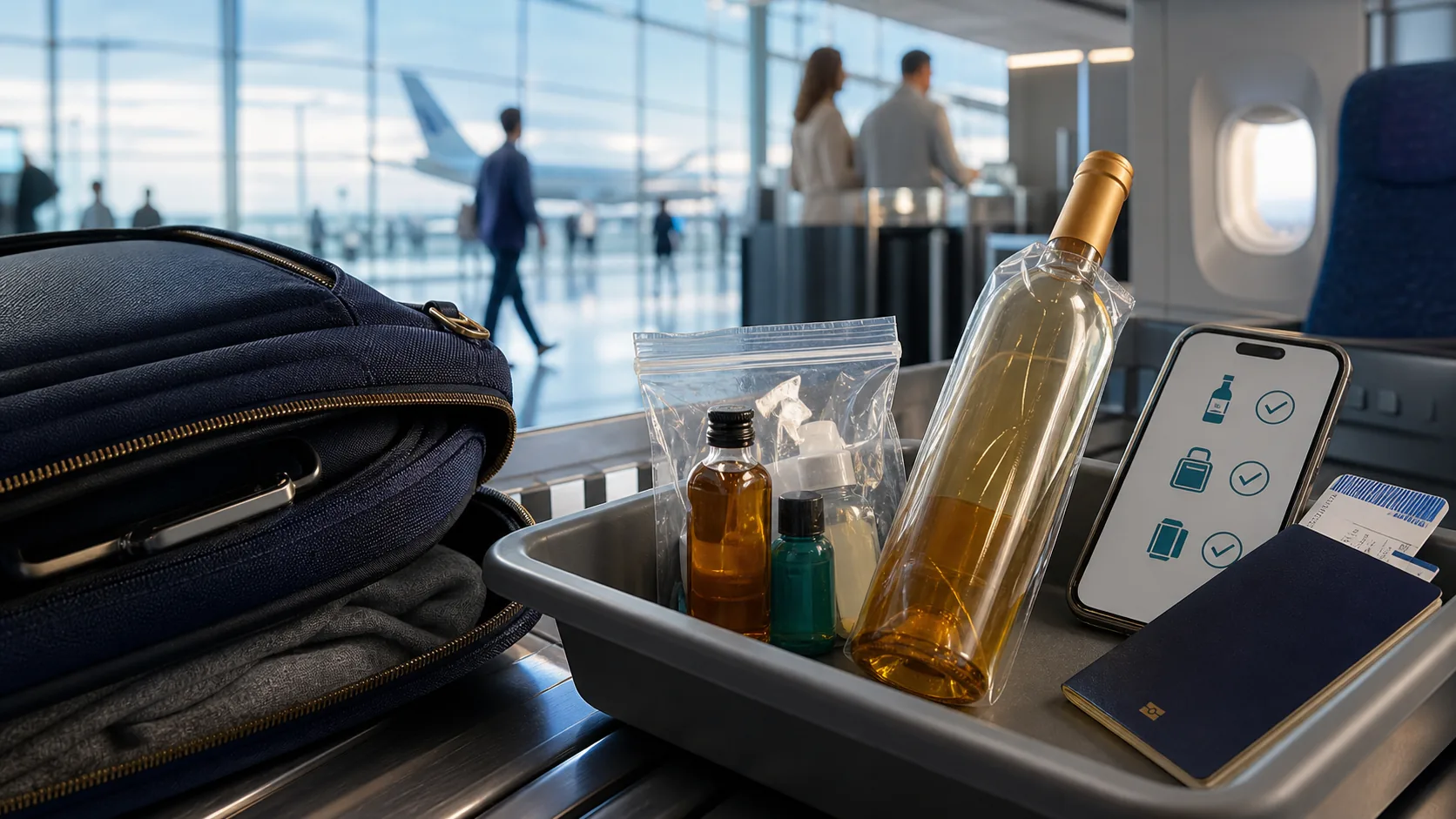
    Duty-free alcohol bottles and luggage at an airport, illustrating 2026 rules for bringing alcohol on a plane
    Published 14 July 2026 · verified July 2026

    Can you bring alcohol on a plane? Yes — but the rules split three ways. In hand luggage alcohol is just a liquid, so only miniatures up to 100ml get through security. In checked luggage you can pack up to 5 litres of spirits (24–70% ABV), while beer and wine under 24% have no set limit — and anything over 70% ABV is banned outright. Duty-free is the exception that lets you carry full-size bottles, but only if the sealed bag stays sealed. Here’s how it all works in 2026.

    Quick answer: taking alcohol on a plane

    • Hand luggage: only containers of 100ml (3.4oz) or less, in your clear liquids bag — so miniatures only.
    • Checked luggage: under 24% ABV (beer, most wine) has no set limit; 24–70% ABV is capped at 5 litres per passenger in unopened retail packaging.
    • Over 70% ABV (140 proof) is banned in both hand and checked luggage.
    • You cannot drink your own alcohol on board — only drinks served by the crew.
    • Duty-free can exceed 100ml in hand luggage if it stays sealed in the tamper-evident bag with the receipt inside.

    Can you take alcohol in hand luggage?

    Only in containers of 100ml (3.4oz) or less, inside your clear liquids bag — in practice, miniatures.

    Security treats alcohol like any other liquid, so the standard limit applies. A 50ml or 100ml miniature is fine; a 700ml bottle of gin bought on the high street is not, and will be taken off you at the checkpoint. The one big exception is duty-free bought airside, covered below. Remember that even if you carry miniatures through, you’re not allowed to drink them on the plane.

    Can you put alcohol in checked luggage?

    Yes — and this is where you can pack full-size bottles, subject to strength limits.

    Checked baggage is the right place for real quantities of alcohol. The rules are based on alcohol by volume (ABV):

    Alcohol strengthExamplesChecked luggageHand luggage
    Under 24% ABVBeer, cider, most wineNo set quantity limit (airline weight limits still apply)100ml containers only
    24% – 70% ABVMost spirits: gin, vodka, whisky, rumMax 5 litres per passenger, in unopened retail packaging100ml containers only
    Over 70% ABV (140 proof)Grain alcohol, 151-proof rumBannedBanned

    Note the “unopened retail packaging” wording for spirits — a half-drunk bottle doesn’t qualify. Wrap bottles well; airlines aren’t liable for breakages, and a burst bottle can ruin everything else in the bag.

    How much alcohol can you bring on a plane?

    Up to 5 litres of 24–70% ABV spirits in checked luggage; beer and wine under 24% have no set limit.

    That’s the safety limit set by aviation rules. There’s a second, separate limit to think about: customs. Every country sets its own duty-free allowance for how much alcohol you can bring in without paying duty, and it’s usually far less than 5 litres. Exceed it and you owe tax, even if the airline was happy to fly it. Always check the official customs allowance for your destination before you stock up.

    TSA alcohol rules (US flights)

    For flights within or from the United States, the TSA alcohol rules mirror the above:

    • Carry-on: alcohol follows the 3-1-1 rule — 3.4oz (100ml) containers in a quart-size bag.
    • Checked: 5 litres per passenger for 24–70% ABV in unopened retail packaging; under 24% ABV is unrestricted by the FAA.
    • Over 70% ABV is prohibited in both carry-on and checked baggage.
    • FAA rules prohibit passengers from drinking their own alcohol on board.

    UK hand luggage alcohol rules

    The UK works the same way: alcohol in hand luggage is bound by the 100ml liquid limit (some UK airports now allow larger liquids with new scanners — see our UK airport liquid rules), while full-size bottles belong in the hold. Duty-free bought airside can travel in the cabin in its sealed security bag. And as everywhere, you can only drink what the cabin crew serve you.

    Can you drink your own alcohol on a plane?

    No. You may only drink alcohol served to you by the cabin crew.

    This surprises a lot of travellers who assume duty-free or a miniature from their bag is fair game. It isn’t — aviation rules require that alcohol consumed on board is served by the airline, so crew can manage how much passengers drink. Opening your own bottle can get you warned, refused further service, or in serious cases met by police on arrival. If you want a drink in the air, buy it from the trolley.

    Duty-free alcohol and the sealed bag rule

    Duty-free liquids can exceed 100ml in hand luggage — but only sealed in a tamper-evident bag with the receipt inside.

    When you buy alcohol airside, the shop seals it in a Security Tamper-Evident Bag (STEB) — a clear, sealed bag with your receipt visible inside. That seal is what lets a 1-litre bottle through a security check that would otherwise refuse it. The rules are strict:

    • Do not open the bag until you reach your final destination.
    • The receipt must stay inside and be visible.
    • The bag must show no signs of tampering.
    • Travelling to the US on a connection, the purchase generally must have been made within 48 hours.

    Open the bag early and you lose the bottle. If you break the seal before your final airport — even just to repack — it becomes a normal oversized liquid and will be confiscated at the next screening.

    Duty-free on connecting flights: the trap

    This is where travellers most often lose their duty-free. If you buy a bottle at your first airport and then transfer somewhere that re-screens your hand luggage, the STEB is supposed to be accepted — but in practice it often isn’t, particularly on transfers through EU/non-Schengen checkpoints when the bottle was bought outside the EU. A classic example is Dubai → a European hub → onward: the bag gets pulled at the transfer checkpoint.

    The safe rule: buy duty-free at your final departure airport — the last one before your destination — not the first. If you must buy earlier, keep the seal and receipt intact and accept there’s some risk at the transfer point.

    If your trip involves a tight transfer, also make sure you have time to clear the extra screening — our Layover Calculator helps you check whether the connection is realistic in the first place.

    Can you bring beer or wine on a plane?

    Beer and wine are almost always under 24% ABV, so in checked luggage there’s no set quantity limit from a safety standpoint — the practical limits are your baggage weight allowance and your destination’s customs allowance. In hand luggage they’re still liquids, so a can of beer or bottle of wine won’t pass security unless it’s duty-free in a sealed bag. Pack bottles in the middle of your case, wrapped in clothing, ideally in a padded sleeve.

    ✓ Full-size bottles → checked luggage, wrapped well
    ✓ Spirits (24–70% ABV) → max 5 litres, unopened retail packaging
    ✓ Over 70% ABV → leave it at home, it’s banned
    ✓ Hand luggage → 100ml miniatures only
    ✓ Duty-free → keep the sealed bag and receipt intact until you land
    ✓ Connecting? Buy at your final departure airport
    Don’t drink your own on board

    FAQs

    Can you bring alcohol on a plane?

    Yes. In hand luggage only in 100ml (3.4oz) containers, so miniatures. In checked luggage you can pack up to 5 litres of 24–70% ABV spirits, and beer or wine under 24% ABV has no set limit. Over 70% ABV is banned.

    Can you take alcohol in hand luggage?

    Only in containers of 100ml or less inside your clear liquids bag. The exception is duty-free bought airside, which can be larger if it stays sealed in its tamper-evident bag with the receipt.

    How much alcohol can you put in checked luggage?

    Up to 5 litres per passenger for drinks between 24% and 70% ABV, in unopened retail packaging. Below 24% ABV there’s no set safety limit, though airline weight limits and customs allowances still apply.

    Is any alcohol banned from planes?

    Yes. Anything over 70% ABV (140 proof), such as grain alcohol or 151-proof rum, is prohibited in both hand and checked luggage.

    Can you drink your own alcohol on a plane?

    No. You may only drink alcohol served by the cabin crew. Drinking your own, including duty-free, is not permitted and can lead to being refused service or met by police.

    Can you take duty-free alcohol in hand luggage?

    Yes, even over 100ml, as long as it stays sealed in the tamper-evident bag with the receipt inside and shows no signs of tampering. Don’t open it until your final destination.

    Can you take duty-free through a connecting flight?

    Usually yes if the sealed bag and receipt are intact, but transfers that re-screen hand luggage sometimes confiscate duty-free bought outside the region. The safest approach is to buy at your final departure airport.

    Can you bring beer or wine on a plane?

    In checked luggage yes, with no set safety limit as they’re under 24% ABV. In hand luggage they’re treated as liquids, so only 100ml containers or sealed duty-free.

    Does the 5 litre limit include duty-free?

    The 5 litre allowance applies to 24–70% ABV alcohol carried in checked baggage. Sealed duty-free carried in the cabin is handled under the tamper-evident bag rules, and customs allowances are separate again.

    How much alcohol can I bring into the country?

    That’s set by customs, not the airline, and it’s usually far less than the 5 litre baggage limit. Check your destination’s duty-free allowance before buying, or you may owe duty on arrival.

    Sources

    Based on FAA PackSafe guidance on alcoholic beverages (ABV limits and the 5 litre allowance), TSA liquids and duty-free/tamper-evident bag rules, and UK/EU airport security guidance on liquids purchased airside. Verified 14 July 2026 — airline, security and customs rules change, so confirm with your airline and destination customs before you travel.

  • Can You Bring Food on a Plane? TSA & Airport Security Rules (2026)

    Can You Bring Food on a Plane? TSA & Airport Security Rules (2026)

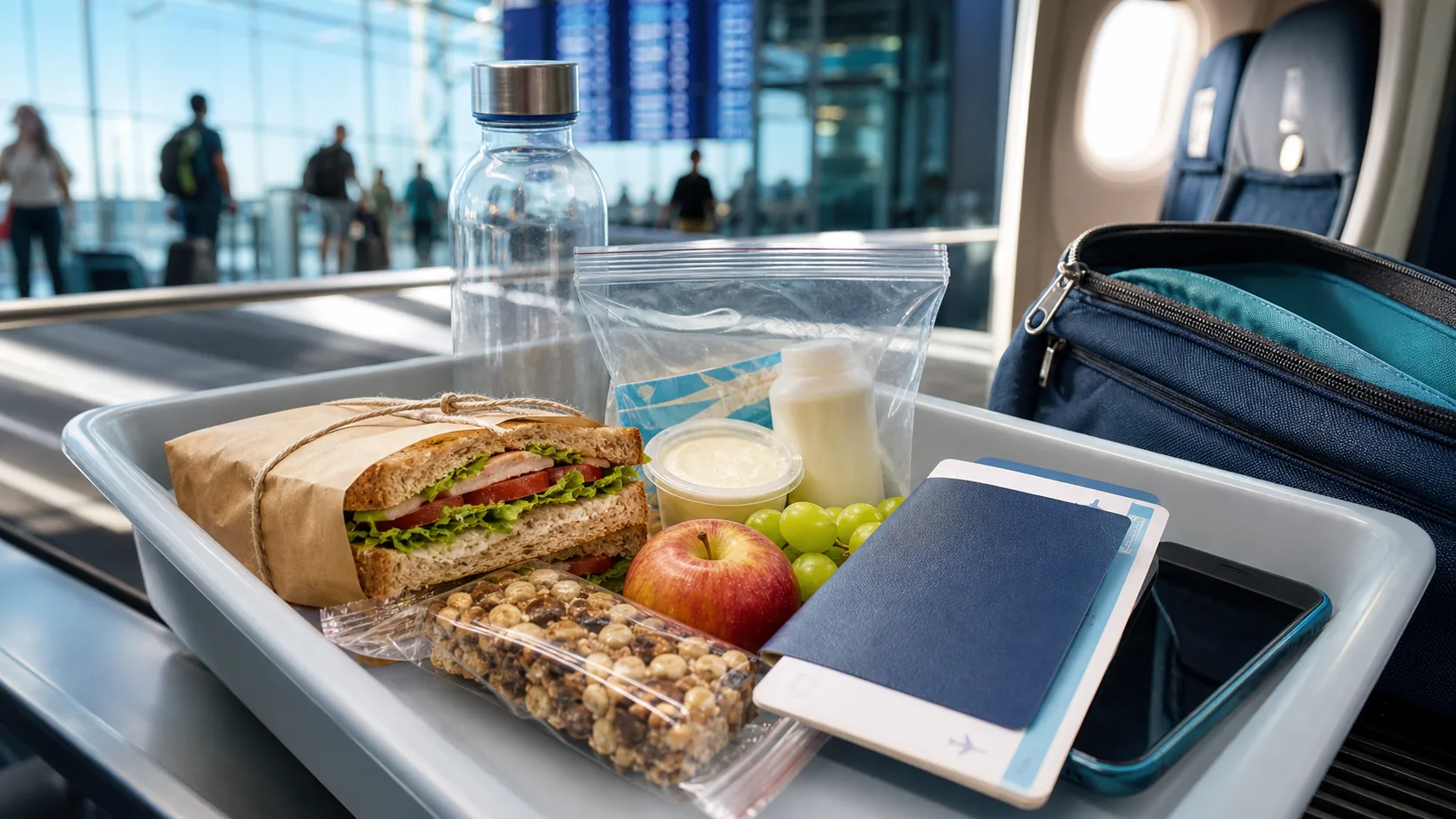
    Food and snacks in a carry-on bag at airport security, illustrating 2026 rules for bringing food on a plane
    Published 14 July 2026 · verified July 2026

    Can you bring food on a plane? Yes — solid food is allowed through airport security in unlimited quantities in your carry-on. The catch is liquid, gel and spreadable food: things like peanut butter, yogurt, honey and soup count as liquids, so they must follow the 100ml (3.4oz) rule. Baby food and formula are exempt, food is fine in checked luggage too — but if you’re flying internationally, customs rules on meat, dairy and fresh produce matter far more than security. Here’s exactly what you can bring, in the US and the UK.

    Quick answer: can you take food through airport security?

    • Solid food — yes, no limit in carry-on (sandwiches, snacks, chocolate, cake, whole fruit, hard cheese).
    • Liquid/spreadable food — 100ml (3.4oz) rule applies (peanut butter, yogurt, honey, jam, hummus, soup).
    • Baby food, formula and breast milk are exempt — larger amounts allowed; just declare them.
    • Food in checked luggage is generally fine for domestic trips.
    • Flying abroad? Customs limits on meat, dairy and fresh produce are strict — declare, or leave them at home.

    The key rule: solid food vs liquid food

    Airport security doesn’t really care about “food” as a category — it cares whether something is a solid or a liquid/gel. Solid food has no quantity limit in your carry-on. But anything you could pour, spread, spray or spoon is treated as a liquid and must go in a container of 100ml (3.4oz) or less, inside your clear liquids bag. That’s why a sandwich sails through but a tub of hummus doesn’t.

    Which foods can you bring in carry-on?

    Use this table to check before you pack. “Liquid” items are still allowed — just in 100ml containers within your clear bag (or packed in checked luggage instead):

    FoodCounts asCarry-on rule
    Sandwiches, wraps, rollsSolidAllowed, no limit
    Crisps/chips, crackers, biscuits/cookiesSolidAllowed, no limit
    Chocolate, sweets/candy, cake, bread, pastriesSolidAllowed, no limit
    Whole fruit, nuts, dried fruit, protein barsSolidAllowed, no limit
    Hard cheese, cooked meat, boiled eggsSolidAllowed (check customs if flying abroad)
    Peanut butter, Nutella and other spreadsLiquid100ml (3.4oz) max
    Yogurt, soft/cream cheese, dipsLiquid100ml (3.4oz) max
    Honey, jam, syrupLiquid100ml (3.4oz) max
    Hummus, salsa, guacamole, sauces, gravyLiquid100ml (3.4oz) max
    SoupLiquid100ml (3.4oz) max
    Baby food, formula, breast milk, pureesExemptLarger amounts allowed — declare

    Tip: a peanut-butter sandwich is a solid and is fine — it’s a jar of peanut butter that’s treated as a liquid. When in doubt, pack spreadable or runny foods in your checked bag.

    Can you bring food through TSA?

    Yes. Solid food has no limit in carry-on through TSA; liquid or gel foods follow the 3-1-1 rule.

    For US flights, the TSA food rules are simple once you know the solid/liquid split. Solid foods can go through the checkpoint in any quantity. Liquid and gel foods — peanut butter, yogurt, hummus, salsa, soup, syrup — must be 3.4oz (100ml) or less and fit in your quart-size bag. Powders are allowed, though large amounts (over about 12oz) may get extra screening. You usually don’t need to take food out of your bag, but an officer can ask you to for a closer look.

    Can you bring food through UK airport security?

    The UK works the same way: solid food in hand luggage is unlimited, while liquid and spreadable foods must be in 100ml containers in your clear bag. Some UK airports now allow larger liquids thanks to new scanners — check our UK airport liquid rules for which airports still enforce 100ml. Either way, solid snacks and sandwiches are always fine to bring from home.

    Can you bring snacks on a plane?

    Yes — solid snacks are allowed in unlimited quantities, and bringing your own is cheaper than buying airside.

    Snacks are one of the easiest things to bring. Anything dry and solid is unrestricted through security. Good options to pack:

    • Crisps/chips, crackers, popcorn, pretzels
    • Nuts, trail mix, dried fruit, granola/protein bars
    • Chocolate, sweets, biscuits/cookies
    • Whole fruit, hard cheese, a sandwich or wrap

    Avoid packing yogurts, dips or anything runny in your hand luggage unless it’s under 100ml — those get pulled at security.

    Protein powder, coffee and other powders

    Powders like protein powder, ground coffee, spices and flour are solids, not liquids, so they don’t count toward your liquids bag. They’re allowed in carry-on. In the US, a powder-like substance over 12oz (about 350g) may require additional screening, and officers can ask you to open the container — if you’re carrying a large tub, allow a little extra time or pack it in checked luggage.

    Baby food, formula and breast milk

    These are exempt from the 100ml rule — you can bring reasonable quantities in carry-on.

    Baby food, formula, toddler drinks, purees and breast milk are allowed over 100ml and do not need to fit in your clear bag. Tell the security officer you have them and separate them out for screening. You do not need to be travelling with the baby to carry breast milk. The same exemption applies at UK and US airports.

    Frozen food, ice packs and coolers

    Frozen food is allowed, and a cooler bag can be your carry-on or go in checked luggage. The thing to watch is ice packs: a gel or ice pack must be frozen solid when it goes through security — if it’s slushy or melted, it’s treated as a liquid. Dry ice is allowed only in limited quantities with airline approval and vented packaging. For anything perishable, freeze it solid and keep the journey short.

    Can you put food in checked luggage?

    Yes — most food is fine in checked luggage, and it’s the easy answer for larger liquids like a full jar of honey or a big tub of protein powder. Wrap anything that could leak, and remember that strong smells and spillage are the main risks. The bigger issue with checked food is not the airline — it’s customs at your destination.

    Bringing food into another country (customs)

    Getting food through security is easy; getting it through customs abroad is where trips go wrong.

    Security screens for safety; customs screens for biosecurity — and their rules on meat, dairy and fresh produce are strict. As of 2026:

    DestinationMeat & dairyFruit, veg & other
    United StatesMost restricted or banned — declare everythingFresh fruit, veg, plants and seeds are restricted; undeclared items mean confiscation and a possible fine.
    United KingdomMeat and dairy from outside the EU are banned (personal imports) — even a sandwich fillingLimited fish (up to 20kg) and some other items allowed.
    European UnionNo meat or dairy from non-EU countriesLimited fruit, vegetables, eggs, honey and fish allowed.

    Golden rule: if in doubt, declare it. Declared items are simply surrendered; undeclared restricted food can mean confiscation, fines or prosecution. When flying internationally, it’s often simplest to eat or bin fresh food before you land.

    Can you eat your own food on a plane?

    Yes — almost every airline lets you eat your own cold food that you brought through security or bought airside. You generally can’t ask crew to heat it, and it’s polite to avoid strong-smelling foods in a packed cabin. Buying a meal deal airside and taking it on board is one of the cheapest ways to eat well on a budget flight.

    Solid food — pack freely in carry-on
    Spreadable/runny food — 100ml in the clear bag, or put it in checked luggage
    Baby food/formula — bring what you need and declare it
    Ice packs — frozen solid, or they count as liquid
    Flying abroad? Check customs on meat, dairy and fresh produce — declare or leave behind

    FAQs

    Can you bring food on a plane?

    Yes. Solid food is allowed through security in unlimited quantities in your carry-on. Liquid, gel and spreadable foods must follow the 100ml (3.4oz) rule.

    Can you bring food through TSA?

    Yes. Solid foods have no limit in carry-on; liquid or gel foods like peanut butter, yogurt and soup must be 3.4oz (100ml) or less in your quart bag. Baby food and formula are exempt.

    Does food count as a liquid at airport security?

    Only if it’s a liquid, gel or spreadable — peanut butter, yogurt, honey, jam, hummus, soup and sauces all count as liquids and follow the 100ml rule. Solid food does not.

    Can you bring snacks on a plane?

    Yes, in unlimited quantities as long as they’re solid — crisps, nuts, chocolate, biscuits, bars, sandwiches and whole fruit are all fine.

    Can you bring peanut butter or yogurt on a plane?

    Only up to 100ml (3.4oz) in your carry-on, because TSA and UK security treat them as liquids. Larger amounts should go in checked luggage.

    Can you bring baby food and formula on a plane?

    Yes. Baby food, formula, toddler drinks and breast milk are exempt from the 100ml limit. Bring reasonable quantities and declare them at security.

    Can you bring protein powder on a plane?

    Yes. Powders are solids, not liquids, so they’re allowed in carry-on. In the US, amounts over about 12oz may get extra screening.

    Can you put food in checked luggage?

    Yes, most food is fine in checked luggage, which is the easy place for larger liquids. Wrap anything that could leak, and check customs rules for international trips.

    Can you bring food into another country?

    Sometimes, but customs rules are strict. The US requires you to declare all agricultural items; the UK and EU ban personal imports of meat and dairy from outside the EU. Declare, or don’t bring it.

    Can you eat your own food on a plane?

    Yes. Airlines let you eat cold food you brought yourself, though you usually can’t have it heated, and it’s best to avoid strong-smelling foods in the cabin.

    Sources

    Based on TSA guidance on food and the liquids (3-1-1) rule, UK airport security liquid guidance, and customs rules from US CBP, GOV.UK and the European Union. Verified 14 July 2026 — security and customs rules change, so confirm with the relevant authority before you travel.

  • Can You Bring a Vape on a Plane? 2026 Rules (Carry-On, TSA & Airlines)

    Can You Bring a Vape on a Plane? 2026 Rules (Carry-On, TSA & Airlines)

    Vape and e-cigarette in a carry-on bag, illustrating 2026 rules for flying with a vape
    Published 14 July 2026 · verified July 2026

    Can you bring a vape on a plane? Yes — but only in your carry-on or hand luggage, never in checked baggage. Vapes, e-cigarettes and their batteries are banned from the hold because of the fire risk, you cannot vape or charge them in flight, and your e-liquid must follow the 100ml liquid rule. One more thing that catches travelers out: vapes are completely illegal in some countries, including Thailand, Singapore and India. Here is exactly how to fly with a vape in 2026 — in the US, the UK and abroad.

    Quick answer: can you take a vape on a plane?

    • Yes, in your carry-on / hand luggage only — vapes and e-cigarettes are banned from checked/hold luggage.
    • No vaping and no charging on board — it’s prohibited on every flight.
    • E-liquid follows the liquid rule: containers of 100ml (3.4oz) or less in your clear bag.
    • Pack a reasonable personal quantity; protect devices from switching on by accident.
    • Check your destination. Vapes are illegal in Thailand, Singapore, India and others — with fines or jail.

    Can you bring a vape in carry-on or checked luggage?

    Carry-on only. Vapes, e-cigarettes and spare batteries must travel in the cabin and are banned from checked luggage.

    This is the single most important rule, and it’s the same in the US, the UK and internationally: because a vape contains a lithium battery, it must be in the cabin with you, where crew can act quickly if a battery overheats. A fault in the hold would be far harder to detect. If a vape is found in a checked bag, you’ll be asked to remove it — and it may be confiscated if the bag is already checked.

    ItemCarry-on / hand luggageChecked / hold luggage
    Vape / e-cigarette deviceYesNo — banned
    Disposable vape (Elf Bar, Geek Bar, etc.)YesNo — banned
    Spare vape batteriesYes (terminals protected)No — banned
    E-liquid up to 100ml per containerYes (in your clear liquids bag)Yes (larger bottles can go here)

    TSA vape rules (US flights)

    Flying within or from the United States, the TSA vape rules are straightforward:

    • Vapes and e-cigarettes go in carry-on only — never in checked bags.
    • E-liquid must follow the 3-1-1 rule: containers of 3.4oz (100ml) or less, in one quart-size clear bag. Larger e-liquid bottles can go in checked luggage (the liquid, not the device).
    • You don’t have to take your vape out of your bag for screening, unlike a laptop — though an officer can ask to inspect it.
    • Lithium batteries must be 100Wh or less, and you must prevent the device from switching on by accident.
    • The FAA prohibits charging e-cigarettes or their batteries on board.

    UK hand luggage vape rules

    From UK airports the rules mirror the US: vapes and e-cigarettes must go in your hand luggage, never in the hold, and you must not use or charge them on board. E-liquid follows the security liquid limit — containers of 100ml or less at airports still on the 100ml rule (many UK airports now allow up to 2 litres with new scanners; see our UK airport liquid rules). Keep devices and spare batteries protected against short circuits.

    Can you vape on a plane or at the airport?

    No. Vaping is banned on every flight, and you can’t charge a vape on board either.

    Every airline prohibits vaping in the cabin and in the toilets — smoke detectors will trigger, and tampering with a lavatory smoke detector is a serious offense. At the airport, vaping indoors is banned at virtually all UK and US terminals. Some airports have designated smoking/vaping areas, often after security in a limited spot or only landside, but many have none at all — so don’t rely on being able to vape during a layover. Check your specific airport before you travel.

    How much e-liquid or vape juice can you take?

    In carry-on, e-liquid must be in containers of 100ml (3.4oz) or less, inside your clear liquids bag.

    Vape juice counts as a liquid, so it’s bound by the same security rule as any other liquid. Bottles over 100ml won’t be allowed through in your hand luggage — but you can pack larger e-liquid bottles in your checked bag (only the liquid; the device and batteries still can’t go in the hold). Bring enough for your trip in travel-size bottles, especially if your destination restricts vape sales.

    How many vapes can you bring on a plane?

    There’s no fixed number for personal use, but pack a reasonable personal quantity and keep spare batteries protected.

    Neither the TSA nor the UK sets a hard limit on the number of vapes for personal use, so a few devices for a trip is fine. The real limits come from two places: airlines can cap spare lithium batteries, and destination countries may restrict how many you can import (or ban them entirely). If you’re carrying several disposables, keep them in your hand luggage, switched off, and be ready to explain they’re for personal use.

    Disposable vapes (Elf Bar, Geek Bar and similar)

    Disposable vapes follow exactly the same rules as refillable devices: carry-on only, never checked, no use or charging in flight. Because the battery is sealed inside, a disposable still counts as a lithium-battery device and cannot go in the hold. Keep them switched off and protected in your bag. Note that many places — including the UK — have tightened rules on single-use vapes, so also check the sale/possession rules at your destination.

    Airline vape rules: what’s the same everywhere

    Whichever airline you fly, the core rules are consistent — vapes in the cabin only, and no vaping or charging in flight. This applies across the major UK and US carriers:

    AirlineVape in cabin?Vaping / charging in flight?
    Ryanair, easyJet, Jet2, TUICarry-on onlyBanned
    British AirwaysCarry-on onlyBanned
    American, Delta, United, Southwest, AlaskaCarry-on onlyBanned
    Emirates, Qatar Airways, EtihadCarry-on onlyBanned

    The differences between airlines are minor — the universal rules above are what matter. Always keep your vape switched off and out of the overhead locker where possible.

    Taking a vape abroad: where vapes are banned

    Vapes are illegal in several popular destinations — bringing one can mean confiscation, heavy fines or jail.

    This is the part travelers most often get wrong. Even if your airline lets you carry a vape, your destination’s laws decide what happens on arrival. As of 2026:

    CountryStatusWhat to know
    ThailandBannedImport and possession illegal since 2014; confiscation, fines, and reportedly up to 10 years in prison. Do not bring one.
    SingaporeBannedImport, sale and possession illegal; fines and possible jail; authorities screen mail and arrivals.
    IndiaBannedNationwide ban since 2019; first offense up to 6 months’ jail and/or a fine.
    AustraliaPrescription onlyNicotine vapes are pharmacy/prescription only; importing without a permit is illegal and heavily penalized.
    Dubai / UAEAllowed, with limitsYou may bring and use a vape, but not in malls or on public transport; e-liquid nicotine is capped at 20mg.

    Always check before you fly: around 46 countries ban e-cigarette sales, and laws change often. When in doubt, leave the vape at home — a banned device isn’t worth a fine or a night in a foreign police station.

    How to pack a vape for a flight

    ✓ Vape and batteries in your carry-on / hand luggage, never checked
    ✓ Device switched off and protected from turning on by accident
    ✓ E-liquid in 100ml (3.4oz) or smaller bottles, in your clear bag
    ✓ Spare batteries with terminals covered (case or bag)
    Don’t vape or charge on the plane
    ✓ Check your destination’s laws — some countries ban vapes entirely

    FAQs

    Can you bring a vape on a plane?

    Yes, in your carry-on or hand luggage only. Vapes, e-cigarettes and their batteries are banned from checked/hold luggage because of the lithium-battery fire risk.

    Can you put a vape in checked luggage?

    No. Vapes and their batteries must travel in the cabin. They are prohibited in checked baggage on US, UK and international flights.

    Can you vape on a plane?

    No. Vaping is banned on every flight, including in the toilets, where it will trigger the smoke detector. You also cannot charge a vape on board.

    How much e-liquid can I take in hand luggage?

    E-liquid follows the liquid rule: containers of 100ml (3.4oz) or less in your clear bag. Larger bottles of e-liquid can go in checked luggage, but the device and batteries cannot.

    How many vapes can I bring on a plane?

    There is no fixed number for personal use, but pack a reasonable personal quantity in your carry-on. Airlines may limit spare batteries, and some countries limit or ban imports.

    Can you take disposable vapes on a plane?

    Yes, in carry-on only, switched off and protected. Disposables have a sealed lithium battery, so like any vape they are banned from checked luggage.

    Do you have to take a vape out at airport security?

    Usually no — unlike a laptop, a vape can stay in your bag. However, a security officer can still ask to inspect it, so keep it accessible.

    Can I take a vape to Thailand, Singapore or India?

    No. Vapes are illegal in Thailand, Singapore and India, with penalties ranging from heavy fines to jail. Do not bring one to these countries.

    Can you charge a vape on a plane?

    No. The FAA and airlines prohibit charging e-cigarettes or their batteries on board. Charge before you fly.

    Are vape rules the same for all airlines?

    The core rules are the same everywhere — carry-on only and no vaping or charging in flight. Always confirm with your airline and, crucially, check your destination’s laws.

    Sources

    Based on TSA and FAA guidance on electronic cigarettes and vaping devices, UK CAA and IATA lithium-battery guidance, and 2026 reporting on national vaping laws. Verified 14 July 2026 — airline and country rules change frequently, so confirm with your airline and your destination’s official guidance before you travel.

  • UK ETA 2026: Who Needs It, Cost, Transit Rules & How to Apply

    UK ETA 2026: Who Needs It, Cost, Transit Rules & How to Apply

    UK ETA 2026 electronic travel authorisation for visiting and transiting the UK
    Published 14 July 2026 · verified July 2026

    A UK ETA (Electronic Travel Authorisation) is a digital permission to travel to the UK, and since 25 February 2026 airlines must check you have one before they let you board — no ETA, no boarding. It costs £20, covers visa-exempt visitors from the US, EU, Australia, Canada and around 84 other countries, and lasts two years. But if you are only connecting airside through Heathrow or Manchester, you generally do not need one at all. Here is exactly who needs a UK ETA in 2026, what it costs, and how transit works.

    Quick answer: do I need a UK ETA?

    • Yes, if you’re a visa-exempt visitor (US, EU, Australia, Canada and ~84 other nationalities) entering the UK for up to 6 months.
    • It costs £20 and is valid for 2 years (or until your passport expires), for multiple trips.
    • Enforced since 25 February 2026 — airlines will deny boarding without a valid ETA.
    • Airside transit is exempt: a genuine international-to-international connection at Heathrow or Manchester, without passing UK border control, generally does not need an ETA.
    • Not needed by British/Irish citizens or anyone with a UK visa, eVisa or settled status.
    • An ETA is not the same as the EU’s ETIAS or EES — see the comparison below.

    What is a UK ETA?

    A UK ETA is an Electronic Travel Authorisation — a digital pre-travel permission linked to your passport, similar to the US ESTA. It is not a visa. It lets nationals of visa-exempt countries travel to the UK, Jersey, Guernsey or the Isle of Man for stays of up to 6 months for tourism, visiting family, business, or short study. You apply online before you travel, and approval is tied to the passport you applied with.

    Do you need a UK ETA? Who needs one

    You need a UK ETA if you are a visa-exempt national visiting or passing through UK border control, and you don’t already have a UK visa or status.

    You need an ETA if…You do NOT need an ETA if…
    You’re a visa-exempt national (US, EU, Australia, Canada, etc.) visiting the UK for up to 6 monthsYou’re a British or Irish citizen
    You’re travelling for tourism, family, business or short studyYou already hold a UK visa, eVisa or BRP
    You’ll pass through UK border control, even in transitYou have EU Settlement Scheme settled or pre-settled status
    You’re transiting landside (through immigration) at a UK airportYou’re making a genuine airside connection without passing border control

    UK ETA for US citizens

    Yes — US citizens need a UK ETA to visit the UK, costing £20 and valid for two years.

    If you hold a US passport and you’re travelling to the UK for holidays, visiting friends or family, business meetings or a short course, you need a UK ETA. There is no exemption for Americans as visitors. Apply online before you fly, link it to the passport you’ll travel on, and you’re covered for multiple trips over two years. The only time a US citizen can skip it is a true airside transit at Heathrow or Manchester (explained below) — and even then, confirm with your airline, because the exemption is under review.

    UK ETA and transit: the airside exemption

    You generally do not need a UK ETA for a genuine airside connection that never passes UK border control — available only at Heathrow and Manchester.

    This is the part that matters most for connecting passengers. The rule turns on whether you cross UK border control:

    Type of transitETA needed?Why
    Airside international-to-international connection (Heathrow or Manchester)No (currently)You stay in the secure transit zone and never pass UK passport control.
    Landside transit — you clear immigration, collect bags or change to a domestic/terminal that needs border controlYesPassing UK border control triggers the ETA requirement.
    Connecting at any other UK airportYesOnly Heathrow and Manchester offer international-to-international airside connections.

    To rely on the airside exemption you normally need a single or connected booking, bags checked through to your final destination, and no need to change to a terminal that forces you through immigration. If in doubt, plan the connection carefully — our Heathrow terminal transfer guide shows which moves stay airside, and the Layover Calculator helps you leave enough time.

    Important: the Home Office has described the airside transit exemption as temporary and subject to review, so always confirm with your airline before you fly. If there is any chance you’ll pass border control, get the ETA to be safe.

    How much does a UK ETA cost?

    A UK ETA costs £20.

    The fee rose to £20 on 8 April 2026 (it was £16 before that, and £10 at launch). You pay once when you apply, and the ETA then covers multiple trips for two years or until your passport expires, whichever comes first — so it works out to a small cost per visit if you travel to the UK regularly.

    How to apply for a UK ETA

    You apply through the official UK ETA app or on GOV.UK. You’ll need:

    • The passport you’ll travel on (the ETA is linked to it digitally)
    • A photo of yourself and of the passport
    • A payment method for the £20 fee
    • Answers to a few short eligibility questions

    Most decisions come back within minutes, but GOV.UK advises allowing up to three working days, so don’t leave it to the airport. If you get a new passport, you must apply for a new ETA. Beware of copycat sites that charge extra — only apply through the official app or GOV.UK.

    UK ETA vs visa: what’s the difference?

    An ETA is a lightweight authorisation for people who don’t need a visa. If your nationality requires a Standard Visitor visa, an ETA does not apply to you — you apply for the visa instead. For visa-exempt nationals, the ETA replaces the old “just show up with your passport” arrangement with a quick online step before travel.

    UK ETA vs ETIAS vs EES

    These three are constantly confused because they all arrived around the same time — but they are completely separate systems for different destinations:

    UK ETAEU ETIASEU EES
    What it isAuthorisation to enter the UKAuthorisation to enter the Schengen areaBiometric entry/exit border system for Schengen
    Status (July 2026)Live & enforcedNot live yet (expected late 2026)Live (rolled out 2026)
    Do you apply?Yes, online/app before travelYes, online before travel (once live)No — done at the border (fingerprints + photo)
    Cost£20~€20 (proposed, not confirmed)Free
    Applies toVisa-exempt visitors to the UKVisa-exempt visitors to SchengenAll non-EU visitors to Schengen

    In short: the UK ETA is for the UK, while ETIAS and EES are for the EU/Schengen. If your trip includes both, you may need more than one. See our guides to ETIAS for UK travellers and EES delays in 2026.

    What happens if you fly without a UK ETA?

    Since 25 February 2026 you will be denied boarding if you need an ETA and don’t have one.

    Airlines, ferry and train operators are now legally required to check for a valid ETA before boarding. If you’re required to have one and don’t, you won’t be allowed to travel — there is no way to buy it at the gate that guarantees boarding. Because approval can take up to three working days, apply well before you leave.

    Worked example

    A US traveller connecting New York → London Heathrow → Rome, all on one ticket with bags checked through: if you stay airside at Heathrow and never pass UK border control, you generally do not need a UK ETA — but you will eventually need EU entry (and ETIAS once it launches) for Rome. If instead you had to collect bags and re-check at Heathrow, you’d pass border control and would need the £20 ETA. When in doubt, apply for the ETA — it’s valid two years and removes the risk.

    ✓ Visiting the UK and visa-exempt? Apply for the £20 ETA before you fly
    ✓ Allow up to 3 working days — most come back in minutes
    ✓ Only skip it for a true airside connection at Heathrow or Manchester — confirm with your airline
    ✓ Apply only on the official UK ETA app or GOV.UK
    ✓ Heading to the EU too? Check ETIAS and EES separately

    FAQs

    Do I need a UK ETA in 2026?

    If you’re a visa-exempt national (US, EU, Australia, Canada and about 84 others) visiting or passing through UK border control for up to 6 months, yes. It has been enforced since 25 February 2026, and airlines will deny boarding without one.

    How much does a UK ETA cost?

    £20. The fee rose from £16 to £20 on 8 April 2026. One ETA covers multiple trips for two years or until your passport expires.

    Do US citizens need a UK ETA?

    Yes. US passport holders need a UK ETA to visit the UK. The only exception is a genuine airside connection at Heathrow or Manchester that never passes UK border control.

    Do I need a UK ETA for airside transit?

    Generally no, if you make a true international-to-international airside connection at Heathrow or Manchester without passing UK border control. The exemption is temporary and under review, so confirm with your airline.

    Do I need a UK ETA if I leave the airport during a layover?

    Yes. Leaving the airport means passing UK border control, which requires an ETA. Only staying airside can qualify for the exemption.

    How long is a UK ETA valid?

    Two years, or until your passport expires, whichever is first. It allows multiple trips, each up to 6 months.

    How do I apply for a UK ETA?

    Through the official UK ETA app or GOV.UK, using your passport, a photo and the £20 fee. Most decisions arrive within minutes, but allow up to three working days.

    Is a UK ETA the same as ETIAS?

    No. The UK ETA is for entering the UK; ETIAS is a separate authorisation for the EU/Schengen area and is not yet live. If your trip covers both, you may need each.

    What happens if I travel without a UK ETA?

    Since 25 February 2026, carriers must check for a valid ETA and will deny boarding if you need one and don’t have it. Apply before you travel.

    Sources

    Based on the UK Government’s Electronic Travel Authorisation (ETA) guidance on GOV.UK, including the £20 fee and eligibility, and Home Office guidance on airside transit and carrier checks (enforced 25 February 2026). Verified 14 July 2026 — rules and fees can change, so confirm on GOV.UK before you travel.

  • Can I Fly Without a REAL ID? 2026 Rules, the $45 Fee & ID Alternatives

    Can I Fly Without a REAL ID? 2026 Rules, the $45 Fee & ID Alternatives

    Airport ID checkpoint illustrating REAL ID rules and the $45 TSA fee for flying without a REAL ID in 2026
    Published 14 July 2026 · verified July 2026

    Can you fly without a REAL ID in 2026? Yes — you can still fly domestically in the United States without a REAL ID, but since full enforcement began on 1 February 2026 it now means a $45 TSA fee, extra identity screening, and possible delays of 30 minutes or more. Any clearance you get is valid for just 10 days, and if TSA cannot verify your identity you may be turned away. Here is exactly how it works, and the accepted IDs that let you skip all of that.

    Quick answer: can I fly without a REAL ID?

    • Yes, but it is not free or guaranteed. REAL ID has been enforced for domestic flights since 1 February 2026.
    • Without a compliant ID you enter TSA’s ConfirmID process: a $45 fee plus identity verification.
    • Expect 30+ minutes of extra time, and any clearance lasts only 10 days.
    • The fee is non-refundable — if your identity can’t be verified, you won’t fly and won’t get the $45 back.
    • A U.S. passport, passport card, Global Entry, military ID or other accepted ID lets you skip the fee entirely.
    • About 98% of travelers already show a REAL ID or acceptable alternative.

    What is a REAL ID?

    A REAL ID is a driver’s license or state ID that meets the federal security standards set by the REAL ID Act of 2005. You can recognize one by the star marking in the top corner — usually a gold or black star, a star inside a circle, or (in California) a star inside a golden bear. If your license has no star, it is not REAL ID compliant and cannot, on its own, be used to board a domestic flight without extra screening.

    To get one, you apply in person at your state’s DMV with documents proving your identity, Social Security number and two proofs of address. States have issued REAL IDs for years, so many travelers already hold one without realizing it — check for the star before you assume you need to do anything.

    Can you fly without a REAL ID in 2026?

    Yes, but you will go through TSA’s ConfirmID process, pay a $45 fee, and face extra screening and delays.

    Full enforcement began on 1 February 2026. If you arrive at the checkpoint without a REAL ID or another acceptable ID, TSA does not simply turn you away — instead you are routed into the ConfirmID identity-verification program. Here is what that involves:

    StepWhat happens
    $45 feeA non-refundable fee is charged before TSA will attempt to verify your identity.
    Identity verificationTSA confirms your identity using a biometric or biographic check (name, address and other personal details).
    Extra timeExpect delays of 30 minutes or more; the exact process varies by airport.
    10-day clearanceIf you pass, your clearance is valid for only 10 days — it is not a permanent fix.
    If you failYou will not be allowed to fly, and the $45 fee is not refunded.

    Bottom line: flying without a REAL ID is possible but slow, costs $45 each time, and is never guaranteed. If you fly more than once, getting a compliant ID or using a passport is far cheaper and less stressful.

    Accepted IDs if you don’t have a REAL ID

    You do not need a REAL ID at all if you carry one of TSA’s other accepted forms of identification. Any of these lets you skip the $45 fee and the ConfirmID process entirely:

    Accepted IDNotes
    U.S. passportThe simplest alternative; works for domestic and international travel.
    U.S. passport cardWallet-sized; valid for domestic flights and land/sea travel to Canada, Mexico and the Caribbean.
    Global Entry / NEXUS / SENTRI / FASTDHS trusted traveler cards are all accepted.
    U.S. military IDDepartment of Defense common access card (active duty and dependents).
    Permanent resident cardGreen card (Form I-551).
    Enhanced Driver’s License (EDL)Issued by WA, MI, MN, NY and VT — accepted in place of a REAL ID.
    Tribal photo IDFederally recognized tribal-issued ID / Enhanced Tribal Card.
    Foreign government passportAccepted for travelers using a non-U.S. passport.
    OthersVeteran Health ID Card (VHIC), border crossing card, employment authorization card (I-766), TWIC and HSPD-12 PIV cards.

    See the full, current list on the TSA acceptable identification page before you travel.

    The $45 REAL ID fee explained

    The $45 fee is charged through TSA’s ConfirmID program to travelers who arrive without a compliant ID.

    The TSA REAL ID fee is not a fine or a penalty for a broken rule — it is the charge for the extra identity-verification work TSA has to do when you can’t present an accepted ID. It applies each time you fly without one, the clearance only lasts 10 days, and it is non-refundable even if you are ultimately not cleared to fly. For anyone flying more than a couple of times a year, the fee quickly costs more than simply getting a REAL ID or using a passport.

    REAL ID vs passport: which do you need?

    A common question is whether you still need a REAL ID if you already have a passport. You don’t — a valid U.S. passport or passport card is fully accepted for domestic flights and skips the fee. The differences:

    REAL IDU.S. passport
    Domestic flightsYesYes
    International flightsNoYes
    Where you get itState DMVU.S. Department of State
    CostUsual license/ID feeHigher, but valid 10 years
    Fits in a walletYesPassport card yes; book no

    If you travel internationally at all, a passport covers both needs. If you only fly domestically, a REAL ID is the cheaper, wallet-friendly option.

    Do you need a REAL ID for domestic flights?

    You need a REAL ID or another accepted ID to fly domestically without paying the $45 fee.

    Since 1 February 2026, every adult passenger on a U.S. domestic flight must present a REAL ID-compliant license or an acceptable alternative at the TSA checkpoint. There is no separate rule for short or in-state flights — the requirement is the same whether you’re flying coast to coast or one state over.

    REAL ID deadline and enforcement timeline

    The rollout has run for years, which is part of why there is still confusion. The key dates:

    DateWhat happened
    7 May 2025Original REAL ID enforcement deadline.
    1 February 2026TSA began full enforcement with the ConfirmID process and $45 fee for non-compliant travelers.
    July 2026 (now)Enforcement is active nationwide; about 98% of travelers already comply.

    Who is exempt?

    • Children under 18 do not need ID to fly domestically when traveling with a companion who has acceptable ID.
    • Travelers using a passport or other accepted ID never need a REAL ID.
    • REAL ID is not required for driving, voting, or applying for federal benefits — it only matters for boarding flights and entering certain federal facilities.

    Worked example

    You booked a 7:00am domestic flight and only have a standard (no-star) license: plan to reach the checkpoint even earlier than usual, because ConfirmID can add 30+ minutes. You’ll pay $45, verify your identity, and — if cleared — fly, but that clearance expires in 10 days, so your return flight could mean paying again. Getting a REAL ID or bringing your passport would remove the cost, the delay and the uncertainty.

    ✓ Check your license for the star marking
    ✓ No star? Bring a passport, passport card, Global Entry or military ID instead
    ✓ If you must use ConfirmID, arrive early and budget the $45 fee
    ✓ Remember any clearance lasts only 10 days — plan your return trip
    ✓ Use our Airport Arrival Time Calculator to add the extra buffer

    FAQs

    Can I fly without a REAL ID in 2026?

    Yes, but since 1 February 2026 you must go through TSA’s ConfirmID process, which involves a non-refundable $45 fee, identity verification, and possible delays of 30 minutes or more. Any clearance is valid for only 10 days.

    How much is the TSA fee for flying without a REAL ID?

    $45. It is charged through the ConfirmID program each time you fly without an accepted ID, and it is non-refundable even if you are ultimately not cleared to fly.

    What can I use instead of a REAL ID?

    A U.S. passport, U.S. passport card, Global Entry or other DHS trusted traveler card, U.S. military ID, permanent resident card, Enhanced Driver’s License, or a federally recognized tribal ID, among others. Any of these skips the $45 fee.

    Do I need a REAL ID if I have a passport?

    No. A valid U.S. passport or passport card is fully accepted for domestic flights, so you do not also need a REAL ID.

    How do I know if my license is REAL ID compliant?

    Look for a star marking in the top corner — a gold or black star, a star in a circle, or a star in a bear (California). No star means it is not compliant.

    Do children need a REAL ID to fly domestically?

    No. Travelers under 18 do not need ID to fly domestically when accompanied by a companion who has an acceptable form of identification.

    What happens if TSA can’t verify my identity?

    You will not be allowed to fly, and the $45 fee is not refunded. That is why carrying an accepted ID is far safer than relying on ConfirmID.

    Is REAL ID required for international flights?

    No. International travel requires a passport. REAL ID only applies to domestic U.S. flights and entry to certain federal facilities.

    How long does ConfirmID clearance last?

    Only 10 days. If your return flight is later than that, you may have to go through the process and pay the fee again.

    Sources

    Based on the TSA REAL ID and acceptable identification guidance, and 2026 reporting on TSA’s ConfirmID fee including ABC News. Verified 14 July 2026 — TSA rules and fees can change, so confirm on TSA.gov before you travel.