
Last updated: July 26, 2026
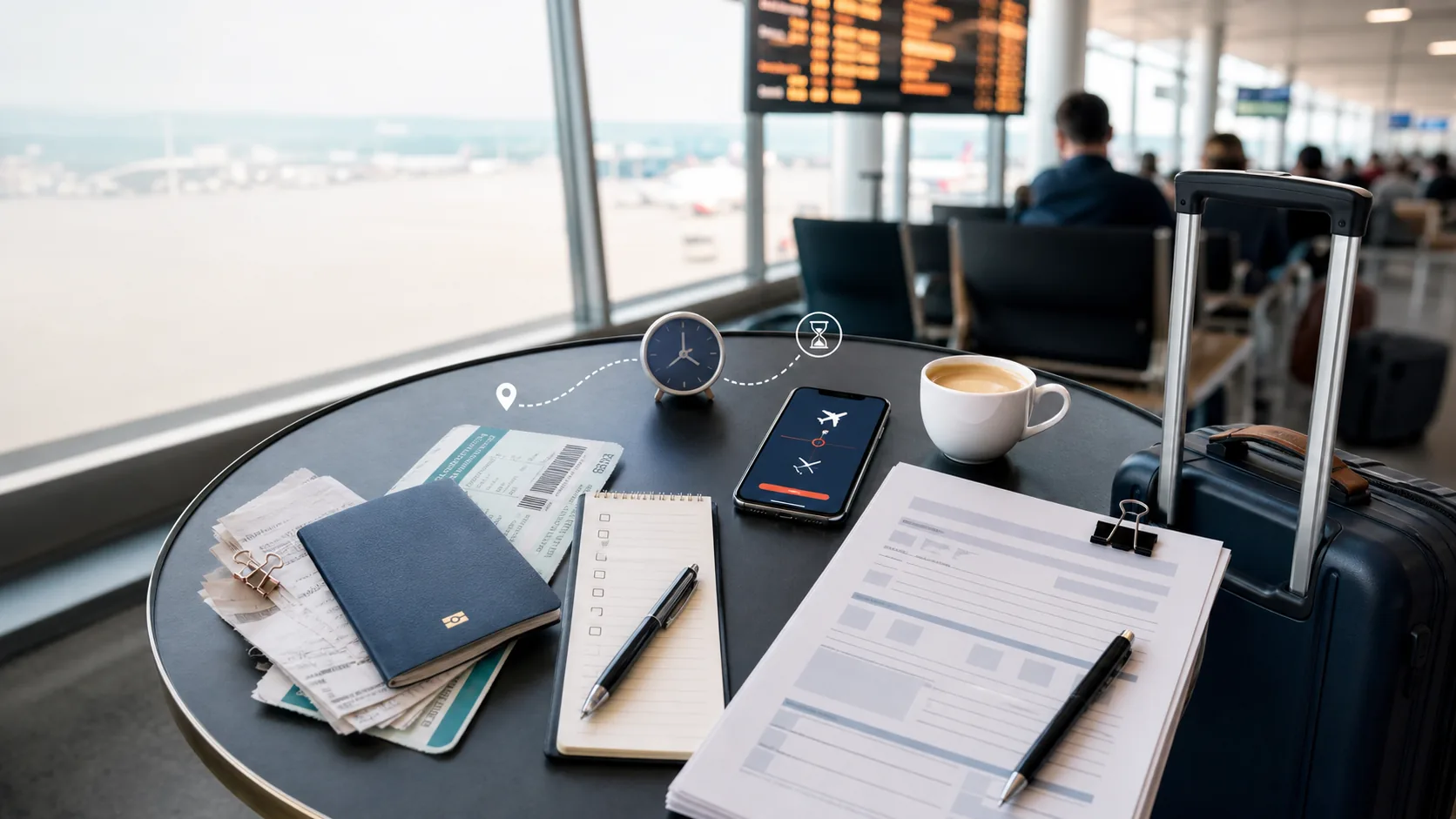
If your flight arrived three or more hours late, you may be owed £220 to £520 per passenger under UK261 — and you can claim it yourself, free, without giving a third of it to a claims company. This guide covers delayed flight compensation UK rules in plain English: whether you qualify, exactly how to claim, a copy-and-paste template you can send today, and how to push back when the airline says no.
Quick answer
- You qualify if you arrived at your final destination 3+ hours late and the cause was within the airline’s control.
- How much: £220 (under 1,500 km), £350 (1,500–3,500 km), £260 or £520 (over 3,500 km) — per passenger.
- Claim direct with the airline — it’s free and you keep 100%. Claims firms take 25–36%.
- Even with no compensation (e.g. bad weather) you still get food, drink and a hotel if needed.
- You generally have 6 years to claim in England and Wales (5 in Scotland).
Am I entitled to flight delay compensation?
You are entitled if you arrived 3+ hours late at your final destination, on a covered flight, and the delay was the airline’s responsibility.
Three conditions have to be met. First, the route must be covered: UK261 applies to any flight departing a UK airport (on any airline) and to flights arriving in the UK on a UK or EU airline. EU261 works identically for EU airports. Second, you must have arrived at your final destination at least three hours behind schedule. Third, the cause must have been within the airline’s control — a technical fault, crew shortage or knock-on delay counts; a hurricane does not.
Two things that do not matter, despite what people assume: how much you paid (a £39 fare attracts the same compensation as a £400 one) and whether you booked a package. Compensation is a statutory entitlement, not a goodwill gesture.
How much compensation for a delayed flight?
The amount is fixed by distance and delay length, and it is paid per passenger — so a family of four can be owed four times these figures:
| Flight distance | Arrival delay | UK261 | EU261 |
|---|---|---|---|
| Under 1,500 km | 3+ hours | £220 | €250 |
| 1,500–3,500 km | 3+ hours | £350 | €400 |
| Over 3,500 km | 3–4 hours | £260 | €300 |
| Over 3,500 km | Over 4 hours | £520 | €600 |
Notice the long-haul split: a flight over 3,500 km that lands 3 hours 45 minutes late pays £260, but at 4 hours 5 minutes it pays £520. Those twenty minutes are worth £260 per person, which is exactly why you should record your actual arrival time. Not sure which band you’re in? Run it through the flight delay compensation calculator.
The 3-hour rule: arrival, not departure
The clock is measured by when you reached your final destination — not when your flight left.
This is the single most misunderstood part of the rules, and airlines rarely correct you. A flight that pushes back two hours late but makes up time in the air may arrive only 90 minutes late — no compensation. Conversely, a modest departure delay that causes you to miss a connection and reach your destination six hours late is a six-hour delay, and the full compensation applies.
“Arrival” has a specific legal meaning too: it is when the aircraft doors open, not when the wheels touch down. If you are close to a threshold, note the time the doors actually opened.
What you get even when compensation isn’t due
Airlines lean on “extraordinary circumstances” to refuse compensation — but that defence does not remove your right to care. Once your delay passes these thresholds, the airline must look after you regardless of the cause:
| Flight distance | Care starts after | What you’re owed |
|---|---|---|
| Under 1,500 km | 2 hours | Food and drink, means to communicate, plus hotel and transfers if you’re delayed overnight |
| 1,500–3,500 km | 3 hours | |
| Over 3,500 km | 4 hours |
If the airline doesn’t provide it, buy what’s reasonable and keep the receipts — you can claim the cost back afterwards. And if the delay reaches five hours, you can abandon the trip entirely and claim a full refund instead.
How to claim flight delay compensation (step by step)
Claim directly with the airline first — it’s free, and you keep the entire amount.
1. Gather your evidence
- Booking reference and passenger names
- Boarding passes or e-tickets
- Scheduled vs actual arrival times (a photo of the departure board or arrivals screen is ideal)
- Whatever reason the airline announced or texted you
- Receipts for food, drink or a hotel you paid for yourself
2. Work out exactly what you’re owed
Check your distance band and delay length so you can state a specific figure. Vague claims are easier to fob off than “I am claiming £520 per passenger for four passengers, totalling £2,080.”
3. Send the claim in writing
Use the airline’s online claim form if it has one; otherwise email customer relations. Put it in writing either way so you have a record and a timestamp.
4. Give them time, then chase
UK airlines have eight weeks to respond. If they miss it, or refuse, you escalate.
5. Escalate if refused
Take it to the airline’s alternative dispute resolution (ADR) scheme, or to the Civil Aviation Authority if the airline isn’t in one. Both are free to use. Small claims court remains an option for persistent refusals.
Copy-and-paste claim template
Send this to the airline’s customer relations team, filling in the bracketed details:
Subject: UK261 flight delay compensation claim – [flight number], [date], booking [reference]
Dear [Airline] Customer Relations,
I am writing to claim compensation under UK Regulation (EC) No. 261/2004 for a delay to flight [flight number] from [departure airport] to [arrival airport] on [date], booking reference [reference].
The flight was scheduled to arrive at [scheduled time] but I arrived at my final destination at [actual time] — a delay of [X hours Y minutes]. The flight distance falls in the [under 1,500 km / 1,500–3,500 km / over 3,500 km] band.
On that basis I am claiming £[amount] per passenger for [number] passengers, totalling £[total]. The passengers are: [names].
[If you paid for meals or a hotel:] I am also claiming £[amount] in expenses incurred because assistance was not provided. Receipts are attached.
Please confirm payment within eight weeks. If you consider this delay to have been caused by extraordinary circumstances, please provide the specific reason and supporting evidence, as required.
Yours faithfully,
[Your name]
[Contact details]
Why that last line matters: asking the airline to evidence its extraordinary-circumstances claim up front tends to produce either a payout or a specific reason you can then challenge — rather than a vague brush-off.
Common airline excuses — and how to challenge them
| What they say | Does it excuse compensation? | Your response |
|---|---|---|
| “Technical fault” | Usually not | Routine technical problems are part of running an airline. Challenge it and ask for evidence. |
| “Crew shortage / crew out of hours” | Usually not | Staffing is within the airline’s control. Push back. |
| “The inbound aircraft arrived late” | Usually not | Knock-on delays from the aircraft’s own earlier rotation generally don’t qualify. |
| “Severe weather” | Yes, if genuine | Check whether other flights operated normally that day. You still keep right to care. |
| “Air traffic control strike / restrictions” | Yes | Outside the airline’s control — but right to care still applies. |
| “Bird strike” or security incident | Yes | Genuinely extraordinary. Right to care still applies. |
Don’t accept vouchers as a substitute. Airlines sometimes offer travel credit worth less than your legal entitlement. You are entitled to cash — accepting a voucher can end your claim.
Should you use a flight compensation claim company?
You don’t need one. Claim-management firms typically keep 25–36% of your payout — on a £520 claim that’s up to about £190 gone, for filling in a form you could complete in fifteen minutes. Airlines are legally obliged to deal with you directly, and using a firm doesn’t make a valid claim more likely to succeed.
They’re worth considering only if the airline has already refused, you’ve exhausted ADR, and you’d rather not pursue it yourself.
How long do you have to claim?
In England and Wales you generally have six years from the date of the flight; in Scotland it’s five. That means old delays are often still claimable — it’s well worth checking past boarding passes and booking emails before you assume it’s too late.
Worked example
London to New York, delayed on arrival by 4 hours 20 minutes, blamed on a technical fault, two passengers: the route is over 3,500 km and the delay exceeds four hours, so the rate is £520 per passenger = £1,040. A technical fault is not normally an extraordinary circumstance, so a refusal on that basis should be challenged. The passengers also waited over four hours, so any meals they bought are claimable on top with receipts.
Related guides and tools
- Flight Delay Compensation Calculator — check your exact entitlement
- Missed Connecting Flight Compensation — what you’re owed when a delay makes you miss a connection
- Delayed & Lost Baggage Compensation — Montreal Convention claims for a delayed, lost or damaged bag
- Flight Cancellation Compensation — refunds, the 14-day rule and being bumped
- Summer 2026 Flight Delays: Worst UK Airports
- Layover Calculator — avoid the tight connections that cause missed-connection delays
- All layover and airport guides
FAQs
How much is delayed flight compensation in the UK?
£220 for flights under 1,500 km, £350 for 1,500–3,500 km, and £520 for flights over 3,500 km — reduced to £260 if a long-haul flight arrives between three and four hours late. It is paid per passenger and doesn’t depend on your ticket price.
Am I entitled to flight delay compensation?
Yes, if you arrived at your final destination three or more hours late, your flight departed a UK airport (or arrived in the UK on a UK/EU airline), and the cause was within the airline’s control.
How do I claim flight delay compensation?
Claim directly with the airline in writing, quoting your flight number, booking reference, actual arrival delay and the amount you’re claiming. It’s free and you keep 100%. If refused, escalate to the airline’s ADR scheme or the CAA.
Is the 3 hours from departure or arrival?
Arrival at your final destination. A late departure that still lands on time doesn’t qualify, while a small departure delay that makes you miss a connection and arrive six hours late does.
Can I claim if the delay was caused by weather?
No compensation is payable for genuine extraordinary circumstances such as severe weather or ATC strikes. However, you keep your right to care — food, drink and accommodation — and can claim a refund if the delay reaches five hours.
Does a technical fault count as an extraordinary circumstance?
Usually not. Routine technical problems are considered part of normal airline operations, so a refusal on those grounds is well worth challenging.
How far back can I claim for a delayed flight?
Generally six years in England and Wales, and five years in Scotland, so past flights are often still claimable.
Do I have to use a claims company?
No. Claiming yourself is free and takes about fifteen minutes. Claims firms typically keep 25–36% of your compensation.
What if the airline ignores my claim?
Airlines have eight weeks to respond. After that you can escalate free of charge to their alternative dispute resolution scheme, or to the Civil Aviation Authority if they aren’t a member of one.
Sources
Based on UK Civil Aviation Authority guidance on flight delays and cancellations (compensation bands, the three-hour arrival threshold, the long-haul reduction, right-to-care thresholds and the eight-week response period), with EU261 amounts from the equivalent EU regulation. Verified 14 July 2026. This is general guidance, not legal advice — confirm your position with the airline or the CAA.

Reviewed by Muhammad Umar Khan
Founder and editor of TripBuffer. Reviewed against official airport, airline and transport-provider information. For our research standards, see the Editorial Policy.