
Last updated: July 18, 2026
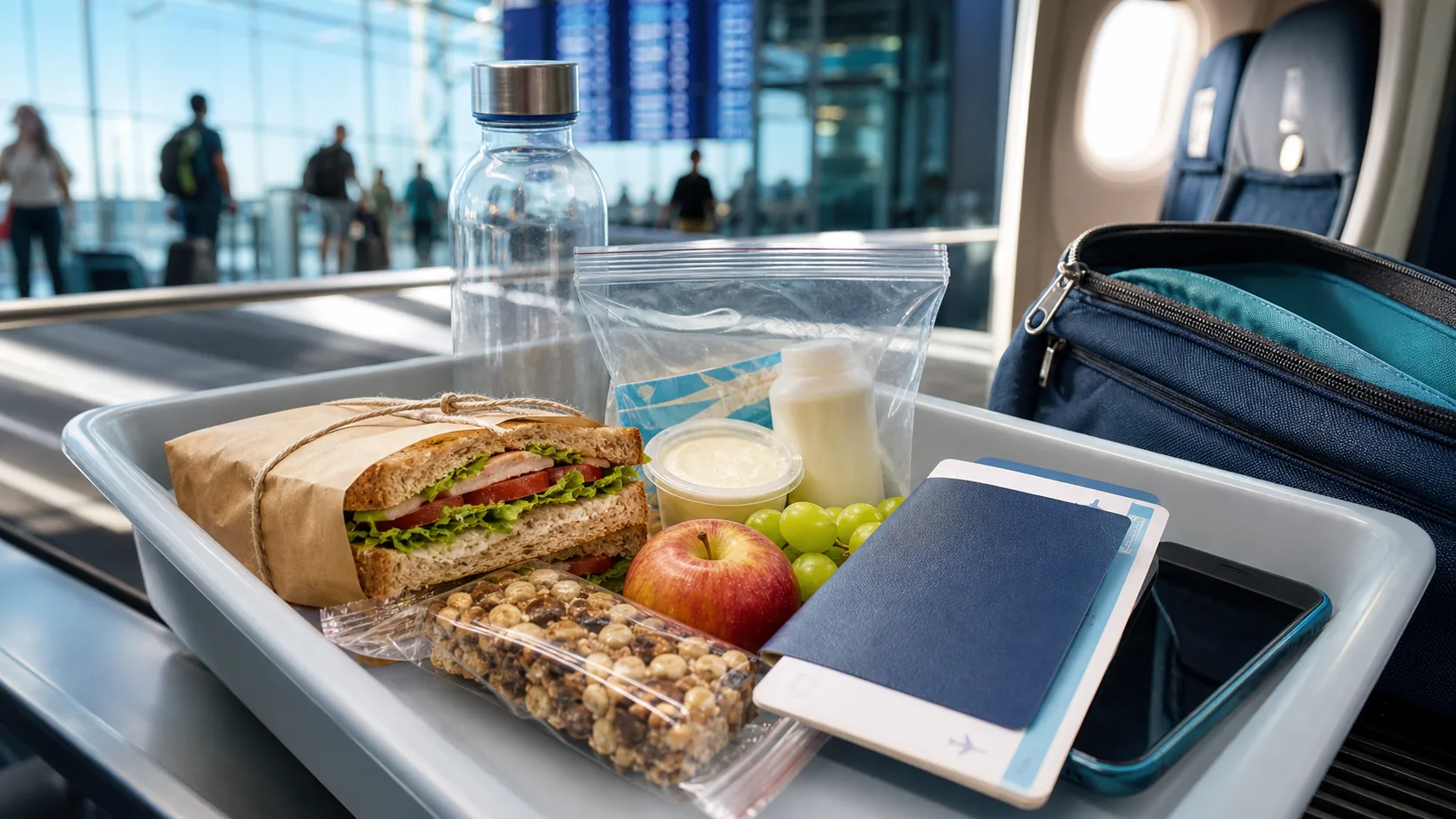
Can you bring food on a plane? Yes — solid food is allowed through airport security in unlimited quantities in your carry-on. The catch is liquid, gel and spreadable food: things like peanut butter, yogurt, honey and soup count as liquids, so they must follow the 100ml (3.4oz) rule. Baby food and formula are exempt, food is fine in checked luggage too — but if you’re flying internationally, customs rules on meat, dairy and fresh produce matter far more than security. Here’s exactly what you can bring, in the US and the UK.
Quick answer: can you take food through airport security?
- Solid food — yes, no limit in carry-on (sandwiches, snacks, chocolate, cake, whole fruit, hard cheese).
- Liquid/spreadable food — 100ml (3.4oz) rule applies (peanut butter, yogurt, honey, jam, hummus, soup).
- Baby food, formula and breast milk are exempt — larger amounts allowed; just declare them.
- Food in checked luggage is generally fine for domestic trips.
- Flying abroad? Customs limits on meat, dairy and fresh produce are strict — declare, or leave them at home.
The key rule: solid food vs liquid food
Airport security doesn’t really care about “food” as a category — it cares whether something is a solid or a liquid/gel. Solid food has no quantity limit in your carry-on. But anything you could pour, spread, spray or spoon is treated as a liquid and must go in a container of 100ml (3.4oz) or less, inside your clear liquids bag. That’s why a sandwich sails through but a tub of hummus doesn’t.
Which foods can you bring in carry-on?
Use this table to check before you pack. “Liquid” items are still allowed — just in 100ml containers within your clear bag (or packed in checked luggage instead):
| Food | Counts as | Carry-on rule |
|---|---|---|
| Sandwiches, wraps, rolls | Solid | Allowed, no limit |
| Crisps/chips, crackers, biscuits/cookies | Solid | Allowed, no limit |
| Chocolate, sweets/candy, cake, bread, pastries | Solid | Allowed, no limit |
| Whole fruit, nuts, dried fruit, protein bars | Solid | Allowed, no limit |
| Hard cheese, cooked meat, boiled eggs | Solid | Allowed (check customs if flying abroad) |
| Peanut butter, Nutella and other spreads | Liquid | 100ml (3.4oz) max |
| Yogurt, soft/cream cheese, dips | Liquid | 100ml (3.4oz) max |
| Honey, jam, syrup | Liquid | 100ml (3.4oz) max |
| Hummus, salsa, guacamole, sauces, gravy | Liquid | 100ml (3.4oz) max |
| Soup | Liquid | 100ml (3.4oz) max |
| Baby food, formula, breast milk, purees | Exempt | Larger amounts allowed — declare |
Tip: a peanut-butter sandwich is a solid and is fine — it’s a jar of peanut butter that’s treated as a liquid. When in doubt, pack spreadable or runny foods in your checked bag.
Can you bring food through TSA?
Yes. Solid food has no limit in carry-on through TSA; liquid or gel foods follow the 3-1-1 rule.
For US flights, the TSA food rules are simple once you know the solid/liquid split. Solid foods can go through the checkpoint in any quantity. Liquid and gel foods — peanut butter, yogurt, hummus, salsa, soup, syrup — must be 3.4oz (100ml) or less and fit in your quart-size bag. Powders are allowed, though large amounts (over about 12oz) may get extra screening. You usually don’t need to take food out of your bag, but an officer can ask you to for a closer look.
Can you bring food through UK airport security?
The UK works the same way: solid food in hand luggage is unlimited, while liquid and spreadable foods must be in 100ml containers in your clear bag. Some UK airports now allow larger liquids thanks to new scanners — check our UK airport liquid rules for which airports still enforce 100ml. Either way, solid snacks and sandwiches are always fine to bring from home.
Can you bring snacks on a plane?
Yes — solid snacks are allowed in unlimited quantities, and bringing your own is cheaper than buying airside.
Snacks are one of the easiest things to bring. Anything dry and solid is unrestricted through security. Good options to pack:
- Crisps/chips, crackers, popcorn, pretzels
- Nuts, trail mix, dried fruit, granola/protein bars
- Chocolate, sweets, biscuits/cookies
- Whole fruit, hard cheese, a sandwich or wrap
Avoid packing yogurts, dips or anything runny in your hand luggage unless it’s under 100ml — those get pulled at security.
Protein powder, coffee and other powders
Powders like protein powder, ground coffee, spices and flour are solids, not liquids, so they don’t count toward your liquids bag. They’re allowed in carry-on. In the US, a powder-like substance over 12oz (about 350g) may require additional screening, and officers can ask you to open the container — if you’re carrying a large tub, allow a little extra time or pack it in checked luggage.
Baby food, formula and breast milk
These are exempt from the 100ml rule — you can bring reasonable quantities in carry-on.
Baby food, formula, toddler drinks, purees and breast milk are allowed over 100ml and do not need to fit in your clear bag. Tell the security officer you have them and separate them out for screening. You do not need to be travelling with the baby to carry breast milk. The same exemption applies at UK and US airports.
Frozen food, ice packs and coolers
Frozen food is allowed, and a cooler bag can be your carry-on or go in checked luggage. The thing to watch is ice packs: a gel or ice pack must be frozen solid when it goes through security — if it’s slushy or melted, it’s treated as a liquid. Dry ice is allowed only in limited quantities with airline approval and vented packaging. For anything perishable, freeze it solid and keep the journey short.
Can you put food in checked luggage?
Yes — most food is fine in checked luggage, and it’s the easy answer for larger liquids like a full jar of honey or a big tub of protein powder. Wrap anything that could leak, and remember that strong smells and spillage are the main risks. The bigger issue with checked food is not the airline — it’s customs at your destination.
Bringing food into another country (customs)
Getting food through security is easy; getting it through customs abroad is where trips go wrong.
Security screens for safety; customs screens for biosecurity — and their rules on meat, dairy and fresh produce are strict. As of 2026:
| Destination | Meat & dairy | Fruit, veg & other |
|---|---|---|
| United States | Most restricted or banned — declare everything | Fresh fruit, veg, plants and seeds are restricted; undeclared items mean confiscation and a possible fine. |
| United Kingdom | Meat and dairy from outside the EU are banned (personal imports) — even a sandwich filling | Limited fish (up to 20kg) and some other items allowed. |
| European Union | No meat or dairy from non-EU countries | Limited fruit, vegetables, eggs, honey and fish allowed. |
Golden rule: if in doubt, declare it. Declared items are simply surrendered; undeclared restricted food can mean confiscation, fines or prosecution. When flying internationally, it’s often simplest to eat or bin fresh food before you land.
Can you eat your own food on a plane?
Yes — almost every airline lets you eat your own cold food that you brought through security or bought airside. You generally can’t ask crew to heat it, and it’s polite to avoid strong-smelling foods in a packed cabin. Buying a meal deal airside and taking it on board is one of the cheapest ways to eat well on a budget flight.
✓ Solid food — pack freely in carry-on
✓ Spreadable/runny food — 100ml in the clear bag, or put it in checked luggage
✓ Baby food/formula — bring what you need and declare it
✓ Ice packs — frozen solid, or they count as liquid
✓ Flying abroad? Check customs on meat, dairy and fresh produce — declare or leave behind
FAQs
Can you bring food on a plane?
Yes. Solid food is allowed through security in unlimited quantities in your carry-on. Liquid, gel and spreadable foods must follow the 100ml (3.4oz) rule.
Can you bring food through TSA?
Yes. Solid foods have no limit in carry-on; liquid or gel foods like peanut butter, yogurt and soup must be 3.4oz (100ml) or less in your quart bag. Baby food and formula are exempt.
Does food count as a liquid at airport security?
Only if it’s a liquid, gel or spreadable — peanut butter, yogurt, honey, jam, hummus, soup and sauces all count as liquids and follow the 100ml rule. Solid food does not.
Can you bring snacks on a plane?
Yes, in unlimited quantities as long as they’re solid — crisps, nuts, chocolate, biscuits, bars, sandwiches and whole fruit are all fine.
Can you bring peanut butter or yogurt on a plane?
Only up to 100ml (3.4oz) in your carry-on, because TSA and UK security treat them as liquids. Larger amounts should go in checked luggage.
Can you bring baby food and formula on a plane?
Yes. Baby food, formula, toddler drinks and breast milk are exempt from the 100ml limit. Bring reasonable quantities and declare them at security.
Can you bring protein powder on a plane?
Yes. Powders are solids, not liquids, so they’re allowed in carry-on. In the US, amounts over about 12oz may get extra screening.
Can you put food in checked luggage?
Yes, most food is fine in checked luggage, which is the easy place for larger liquids. Wrap anything that could leak, and check customs rules for international trips.
Can you bring food into another country?
Sometimes, but customs rules are strict. The US requires you to declare all agricultural items; the UK and EU ban personal imports of meat and dairy from outside the EU. Declare, or don’t bring it.
Can you eat your own food on a plane?
Yes. Airlines let you eat cold food you brought yourself, though you usually can’t have it heated, and it’s best to avoid strong-smelling foods in the cabin.
Sources
Based on TSA guidance on food and the liquids (3-1-1) rule, UK airport security liquid guidance, and customs rules from US CBP, GOV.UK and the European Union. Verified 14 July 2026 — security and customs rules change, so confirm with the relevant authority before you travel.

Reviewed by Muhammad Umar Khan
Founder and editor of TripBuffer. Reviewed against official airport, airline and transport-provider information. For our research standards, see the Editorial Policy.