
Last updated: September 2, 2026
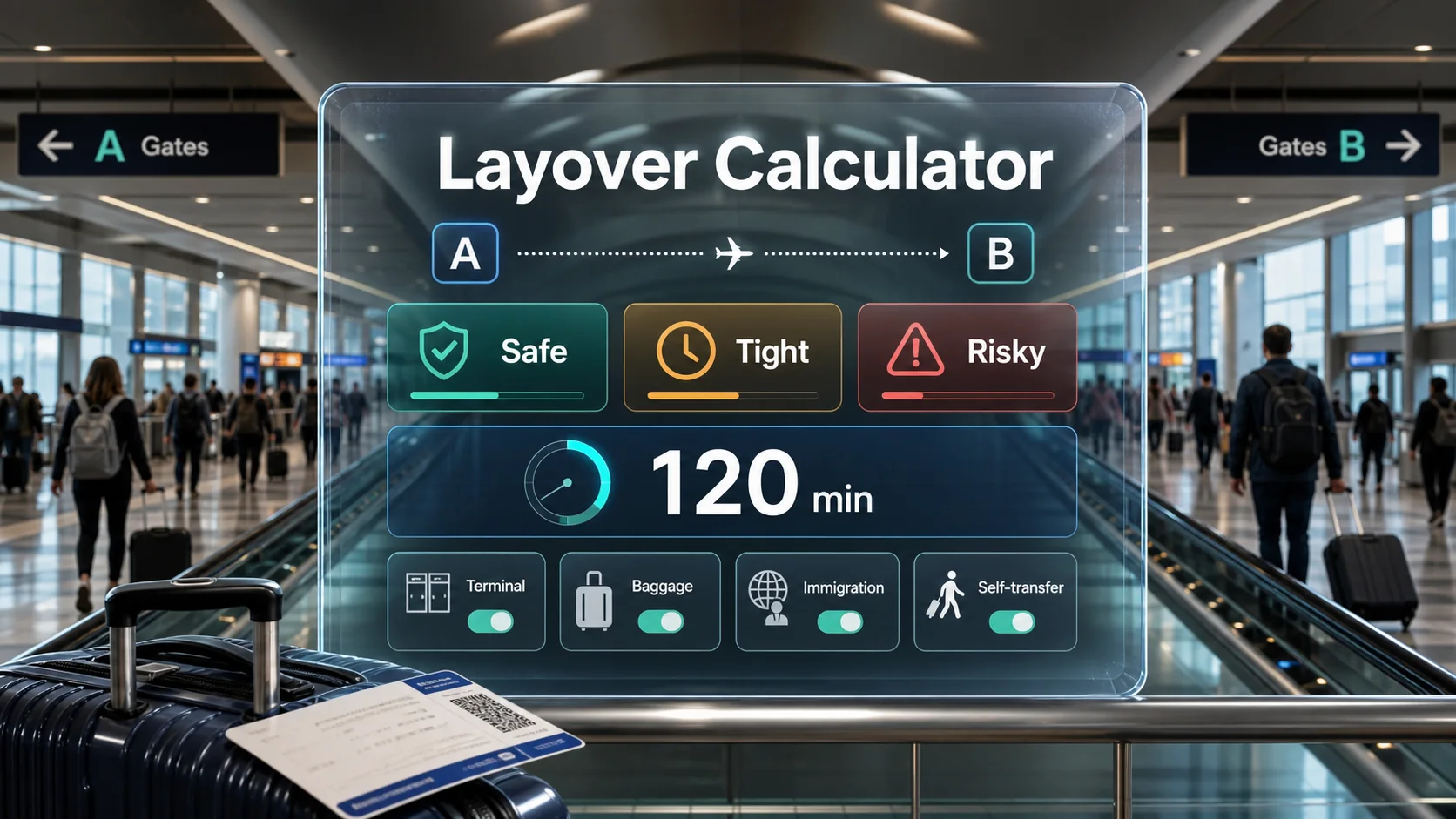
Use the estimator below to see whether a connection looks comfortable, borderline or tight against a generic planning baseline, based on your connection type, terminal or airport change, checked baggage, immigration and whether it’s a self-transfer. It’s a quick planning check — not a replacement for your airline’s official minimum connection time.
This tool answers “is my layover long enough?” with a generic estimate. To work from your airline’s official minimum connection time plus a comfort margin, use the Minimum Connection Time Calculator; for background on judging a connection, see the safe-connection-time guide. Reviewed and updated 14 August 2026.
Estimate your layover
See whether your connection looks Safe, Tight or Risky relative to a generic planning baseline — based on your route type and transfer complexity.
What you enter
The estimator uses six inputs — it does not ask for your specific airport, airline or flight dates, which is why it’s a generic baseline rather than an official minimum:
- Planned layover time in minutes
- Connection type (domestic or international, in each direction)
- Whether an airport change is required
- Whether a terminal change is required
- Whether it’s a self-transfer (not protected by one booking)
- Whether checked baggage is involved
- Whether immigration / passport control is required
What your result means
The result compares your time to a generic baseline — it is planning guidance, not a guarantee, and does not check your airline’s official minimum connection time.
- Safe (vs the baseline): comfortably above the generic baseline
- Tight (vs the baseline): at or just above the baseline — timing could be stressful
- Risky (vs the baseline): below the baseline — high chance of problems if anything runs late
Methodology (version 1.0)
These are TripBuffer editorial planning baselines, reviewed 14 August 2026 — not official minimum connection times. The estimator starts from a base value for your connection type, adds a fixed allowance for each friction factor you tick, then compares your planned time to that total. The exact values:
| Factor | Minutes | Notes |
|---|---|---|
| Domestic → domestic (base) | 60 | Starting baseline for the connection type |
| Domestic → international (base) | 90 | |
| International → domestic (base) | 120 | |
| International → international (base) | 120 | |
| Airport change | +90 | A flat allowance — see limitations below |
| Terminal change | +25 | |
| Self-transfer | +60 | |
| Checked baggage | +30 | |
| Immigration / passport control | +30 |
Swipe horizontally to see all columns.
Classification thresholds: Safe = your time is 45 minutes or more above the total; Tight = 0 to 44 minutes above; Risky = below the total.
Known limitations (why this is a baseline, not a verdict): the airport-change allowance is a flat +90 minutes and cannot model a specific airport pair (for example Heathrow–Gatwick vs JFK–Newark), surface-transfer time or check-in cut-offs. Ticking several overlapping factors (say airport change + self-transfer + immigration + checked baggage) adds each allowance separately and can over-count a single combined process. The model does not use your airline’s or airport’s official minimum connection time, and does not ask for airport, airline, terminals, dates or border regime. For anything close to a tight connection, always confirm the minimum with your airline.
Sources and evidence
Official sources show that minimum connection time is airport- and itinerary-specific — there is no single worldwide number, which is why this tool is framed as a generic baseline rather than an authority on your exact connection.
| Claim | Source | Evidence type | Checked |
|---|---|---|---|
| Minimum connecting time is defined per airport/location, not one global constant | IATA | Industry definition | 14 Aug 2026 |
| Connection time depends on the airline, route, terminal and baggage — no single answer | Heathrow | Airport guidance | 14 Aug 2026 |
| The base and adjustment values in this tool | TripBuffer | Editorial planning baseline (v1.0) | 14 Aug 2026 |
Swipe horizontally to see all columns.
Worked examples
These examples are generated from the same values the calculator uses, so the copy always matches the tool:
Example 1: 220 minutes, international to international, same airport, terminal change, immigration required.
Baseline 120 + 25 + 30 = 175 minutes; you have 45 minutes over, so the tool returns Safe against the generic baseline.
Example 2: 95 minutes, domestic to international, same airport, no checked bags, terminal change required.
Baseline 90 + 25 = 115 minutes; you are 20 minutes short, so the tool returns Risky against the generic baseline — international departures often need more time for document checks, security and gate cut-offs.
Example 3: 120 minutes, international to domestic, self-transfer, checked bags, immigration required.
Baseline 120 + 60 + 30 + 30 = 240 minutes; you are well short, so the tool returns Risky — baggage reclaim, re-check, immigration and a self-transfer create several failure points.
Generic baselines by connection type
These rows use the calculator’s base values with no extra factors ticked. Adding a terminal change, airport change, self-transfer, checked bags or immigration raises the baseline (and the Safe threshold) accordingly.
| Connection type | Generic baseline (this tool) | Tight range | Safe from |
|---|---|---|---|
| Domestic → domestic | 60 min | 60–104 min | 105 min |
| Domestic → international | 90 min | 90–134 min | 135 min |
| International → domestic | 120 min | 120–164 min | 165 min |
| International → international | 120 min | 120–164 min | 165 min |
Swipe horizontally to see all columns. Ranges exclude airport/terminal changes, self-transfer, checked bags and immigration — tick those in the tool to add their allowances.
When this estimator can be wrong
This is a planning tool, not a guarantee. Results can change if your airline uses a different minimum connection rule, if the airport is unusually busy, if immigration lines are long, if you must reclaim and re-check baggage, or if your onward flight closes boarding earlier than expected. Treat it as a first-pass sense check, then verify with your airline.
Related tools and guides
- Minimum Connection Time Calculator — estimate a safer connection buffer from bags, terminals and ticket type
- How Long Layover Do I Need at Heathrow?
- Heathrow Terminal Transfer Times
- Dubai Airport Self-Transfer Guide
- Missed Connecting Flight Compensation — what you’re owed if a tight connection fails
- Airport Arrival Time Calculator
Frequently asked questions
What is a safe layover for an international flight?
There is no universal safe international layover. Start with the minimum your airline accepts for that specific airport and itinerary, then add margin for immigration, terminal changes, security and baggage reclaim. This estimator gives a generic baseline to sense-check that against, but your airline’s minimum is the number that counts.
How much layover do I need if I must change terminals?
Terminal changes add time, especially at large airports, because you move between buildings and usually pass a security check before the onward flight. The more transfers and checks involved, the more buffer you should allow — and confirm the airline’s minimum for your route.
Is a self-transfer riskier than a same-airline connection?
Yes. Self-transfers are usually riskier because you may need to collect bags, re-check in and clear security again, with no airline protection if the first flight is late. Allow substantially more time than a protected connection.
Should I count checked baggage when planning a layover?
Yes. Checked baggage can make a connection much tighter, especially on self-transfers or airport changes where you reclaim and re-check it. If your bags are through-checked on one ticket, the airline handles them, but confirm that when you book.
Does this tool tell me the official minimum connection time?
No. It gives a generic TripBuffer planning baseline, not an official minimum connection time, which is set per airport and airline. To estimate a safer connection buffer for your bags, terminals and ticket type, use the Minimum Connection Time Calculator, and always confirm the minimum with your airline before booking.
Need a stricter booking floor?
If your real question is not just whether a layover works, but what the safer booking floor looks like, use the Minimum Connection Time Calculator. It pairs especially well with the one-hour Heathrow self-transfer guide and the Terminal 3 to Terminal 4 transfer guide.
Need a more specific layover explainer?
Popular airport transfer guides

Reviewed by Muhammad Umar Khan
Founder and editor of TripBuffer. Reviewed against official airport, airline and transport-provider information. For our research standards, see the Editorial Policy.