
Last updated: September 2, 2026
How early you need to arrive at London St Pancras for Eurostar depends on your ticket class and the day — but as a guide, allow around 75 minutes in Standard and Plus, and 45 minutes in Premier, with more on busy days. Check-in gates close about 30 minutes before departure (15 minutes for Premier), and if you miss them you miss the train. The single most reliable answer is on your ticket: it shows a recommended arrival time that already factors in security, two passport controls and the new EU Entry/Exit System (EES). This 2026 guide explains exactly how the timing works.
Key facts: arriving at St Pancras for Eurostar
- Standard & Plus: allow about 75 minutes before departure.
- Premier: about 45 minutes (priority gates stay open longer).
- Check-in gates close around 30 minutes before departure (15 minutes for Premier).
- Busy days (Friday, Sunday, school holidays): allow more than the standard 75 minutes.
- Always check your ticket — the recommended arrival time on it is definitive and includes EES.
How early do you need to arrive at St Pancras for Eurostar?
As a general rule, arrive 75 minutes before departure in Standard or Plus, and 45 minutes in Premier. Those are Eurostar’s recommended arrival times — less than the old 90-minute routine, though the exact figure varies by day and by whether you need EES registration.
| Ticket class | Recommended arrival | Gates close |
|---|---|---|
| Standard | 75 minutes before | ~30 min before |
| Plus | 75 minutes before | ~30 min before |
| Premier | 45 minutes before | ~15 min before |
The most accurate number is always the one printed on your ticket or in the Eurostar app, because it’s adjusted for your departure and for how EES is operating on the day. If in doubt, err towards the longer end — missing the gate means missing the train, and Eurostar tickets are far less forgiving than a walk-up train fare.
When does Eurostar check-in close?
Check-in gates close roughly 30 minutes before departure for most passengers, and about 15 minutes before for Premier, who keep their priority gates open a little longer. Once the gate closes you cannot check in, even if the train hasn’t left — there’s simply no time to complete security and the border checks. That’s why the recommended arrival time matters: it’s built around getting you through the gate comfortably, not just to the station.
The St Pancras check-in process, step by step
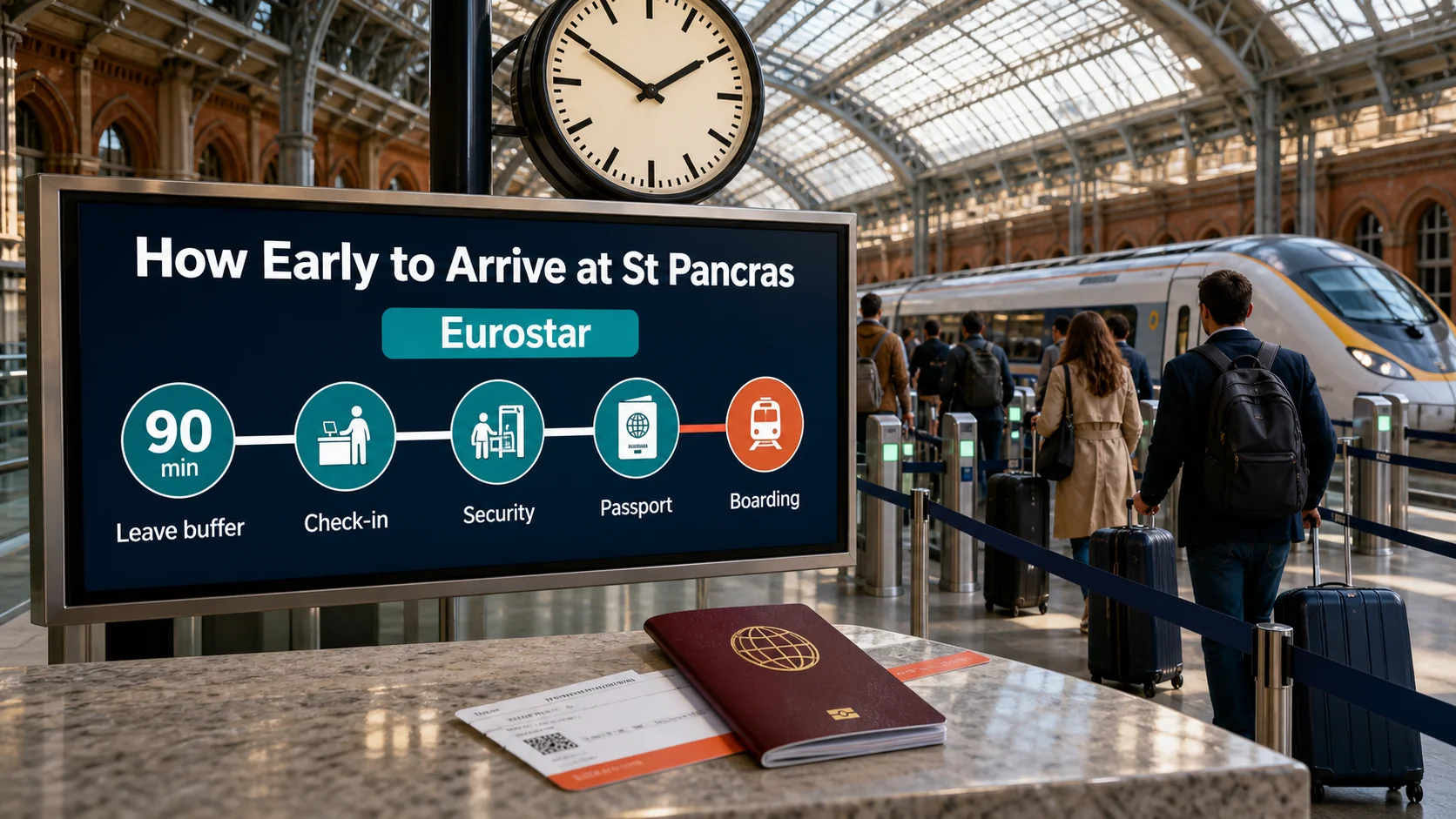
Eurostar feels a bit like a fast, compact airport. There are four stages between the departure gates and your platform:
- Ticket check — scan your ticket or use SmartCheck facial recognition at the gate.
- Security screening — bags through the X-ray and a metal-detector walk-through. There’s no 100ml liquids rule, so it’s quicker than airport security.
- UK exit passport control — usually the UK eGates for eligible passports.
- EU entry / EES border checks — French (or Belgian/Dutch) border control for entering the Schengen area, including EES registration if required.
Off-peak, security itself can take just 2–5 minutes; the border stages are what vary most, especially as EES rolls out.
What is EES, and does it affect your Eurostar timing?
The EU Entry/Exit System (EES) is a new biometric border system for non-EU nationals — including British travellers — entering the Schengen area. On your first crossing, you register at a kiosk by having your photo taken and fingerprints scanned; on later trips the check is much quicker. EES has been phasing in through 2026 rather than switching on all at once, and full checks for Eurostar were being introduced around the peak-season period. The practical effect: first-time EES registration adds a few minutes, and Eurostar builds this into the recommended arrival time on your ticket. If it’s your first EU trip since EES began, lean towards arriving at the earlier end of the range.
Busy times when you should allow extra
- Friday and Sunday departures — the busiest of the week for leisure travel.
- School holidays and bank holidays, especially the summer and Christmas peaks.
- Early-morning trains, when several departures cluster together.
- Your first EU trip under EES, because of the one-off biometric registration.
On any of these, allow more than the usual 75 minutes even in Standard, and check the live guidance in the Eurostar app on the day.
Getting to St Pancras in time
Work backwards from the recommended arrival time on your ticket, not the departure time. If you’re flying into London first, be generous: from Heathrow, for example, allow time to land, clear immigration, collect bags and travel into central London before the Eurostar check-in window even begins — many people underestimate this and it’s the classic way to miss a train. If you’re travelling on the day of your flight, build in a large buffer or consider arriving in London the night before. Planning a flight connection? Our airport arrival time calculator and layover calculator can help you sanity-check tight timings.
Frequently asked questions
How early do you need to arrive at St Pancras for Eurostar?
Generally 75 minutes before departure in Standard or Plus, and 45 minutes in Premier, with more on busy days. Always follow the recommended arrival time on your ticket, which factors in EES.
What time does Eurostar check-in close?
Check-in gates close about 30 minutes before departure for most passengers, and around 15 minutes before for Premier. Once the gate closes you can’t board, even if the train is still there.
How long does Eurostar check-in and security take?
Off-peak, security can take just 2–5 minutes, and the whole process is quicker than an airport because there’s no liquids rule. Passport control and EES border checks are the most variable part, particularly at busy times.
Do you need to arrive earlier because of EES?
Only really for your first crossing, when you register your biometrics at a kiosk. Eurostar already builds EES time into the recommended arrival on your ticket, but first-time users should aim for the earlier end of the range.
What is EES and does it affect Eurostar?
EES is the EU’s Entry/Exit System, a biometric border check for non-EU nationals entering the Schengen area. First-time users scan a photo and fingerprints at a kiosk; later trips are faster. It has been phasing in through 2026 and applies at Eurostar’s EU border control.
How early should Premier passengers arrive?
About 45 minutes before departure. Premier passengers use priority gates that stay open longer, closing around 15 minutes before the train leaves.
Can you arrive 30 minutes before a Eurostar?
In Premier the gate closes 15 minutes before departure, so 30 minutes works — though Eurostar recommends 45. In Standard the gate closes 30 minutes before, so arriving 30 minutes before leaves no margin for security and the border checks; aim for the recommended 75 minutes.
What happens if you miss Eurostar check-in?
If you arrive after the gates close you’ll miss the train. Depending on your fare, you may be able to pay to transfer to a later service, but flexible changes aren’t guaranteed — which is why arriving within the recommended window matters.
Is there security at St Pancras like an airport?
Yes, but faster. Your bags go through an X-ray and you walk through a metal detector, but there’s no 100ml liquids rule and no shoe or laptop palaver, so it’s typically much quicker than airport security.
Do you go through passport control on Eurostar?
Yes — there are two: UK exit control (usually eGates), then the destination country’s entry control, including EES. Both are completed at St Pancras before you board, so you walk straight out at the other end.
How busy is St Pancras Eurostar at weekends?
Fridays and Sundays are the busiest days, along with school and bank holidays. On these, allow the full 75 minutes, or more, even in Standard and check the Eurostar app for live guidance.
How much time do I need from Heathrow to a Eurostar at St Pancras?
A lot — plan the whole chain. Allow time to land, clear immigration and collect bags, then around an hour into central London, and be at St Pancras before your check-in window opens. Same-day connections are risky, so many travellers arrive in London the night before.
Does the recommended arrival time include EES registration?
Yes. Eurostar adjusts the recommended arrival time shown on your ticket to account for EES and the day’s conditions, which is why it’s the most reliable figure to follow.
Related Eurostar and travel guides
- Eurostar luggage allowance — bags, sizes and the no-liquids-rule advantage
- Eurostar to Disneyland Paris — the best route now the direct train has gone
- Airport arrival time calculator — if you’re flying into London first
- All airport and travel guides
Timings, check-in rules and EES status verified September 2026 against Eurostar and border-agency guidance. Recommended arrival times, gate-closing times and EES rollout vary by date, class and station and are changing through 2026 — always follow the recommended arrival time on your ticket and check the Eurostar app before you travel.

Reviewed by Muhammad Umar Khan
Founder and editor of TripBuffer. Reviewed against official airport, airline and transport-provider information. For our research standards, see the Editorial Policy.