
Last updated: September 2, 2026
How long a layover you need at JFK depends on one thing above all: whether you have to clear US immigration and re-check a bag. For a protected domestic-to-domestic connection, 90 minutes is usually workable; for an international arrival connecting onward, plan 2.5 to 3 hours; and for separate tickets with checked bags, give yourself 3.5 to 4 hours or more. Here are the real numbers, terminal by terminal.
Times verified: July 2026.
Quick answer: how long should a JFK layover be?
As a rule of thumb for John F. Kennedy International Airport in 2026:
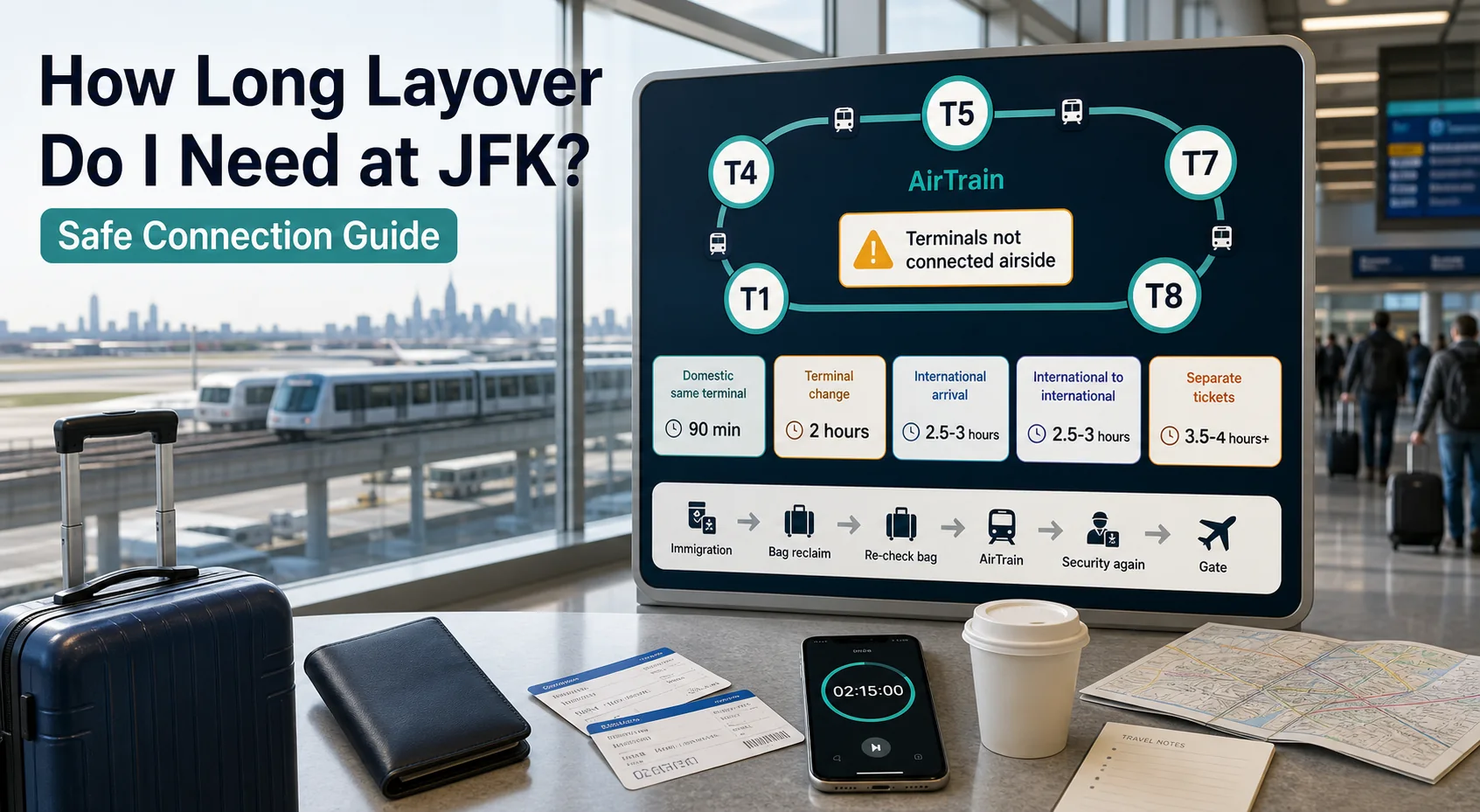
- Domestic to domestic, same terminal (one ticket): about 90 minutes is the usual minimum; 60 minutes only if you have hand luggage and the terminal is quiet.
- Domestic to domestic, changing terminals: allow 2 hours — a terminal change at JFK means exiting to the AirTrain and re-clearing security.
- International arrival to an onward flight (one ticket): plan 2.5 to 3 hours to cover immigration, baggage reclaim, re-check and security.
- International to international (one ticket): 3 to 4 hours is the safer range.
- Separate tickets with checked bags (self-transfer): 3.5 to 4 hours minimum — there is no protection if the first flight is late.
JFK layover planning table
| Connection type at JFK | Recommended layover | Bare minimum | Why it takes this long |
|---|---|---|---|
| Protected domestic → domestic, same terminal | 90 minutes | ~60 minutes (carry-on, off-peak) | No immigration, no bag re-check; just gate-to-gate plus a possible short walk. |
| Protected domestic → domestic, terminal change | 2 hours | 90 minutes | You exit security, take the AirTrain (10–20 min) and re-clear TSA at the new terminal. |
| Protected international → domestic | 2.5–3 hours | 2 hours | Clear US immigration (CBP, 45–90 min at peak), reclaim your bag, re-check it, then security again. |
| Protected international → international | 3–4 hours | 2.5 hours | Same immigration and re-check steps, often with a terminal change and a longer walk to the gate. |
| Separate tickets with checked bags (self-transfer) | 3.5–4 hours+ | 3 hours | No missed-connection protection; you reclaim, leave, re-check in (desks open ~3 hours before) and pass security. |
| Layover including a Manhattan visit | 6–7 hours minimum (ideally overnight) | — | AirTrain plus subway or LIRR is roughly 50–75 minutes each way before you add security back in. |
These are planning ranges, not guarantees. On a single ticket the airline must re-book you if a tight connection fails; on separate tickets it will not. When in doubt, feed your own flight times into the Layover Calculator.
Will you make your connecting flight? Put your connection into the Minimum Connection Time Calculator to estimate a safer connection buffer for your bags, terminals and ticket type.
JFK terminals and the AirTrain
JFK operates five terminals: 1, 4, 5, 7 and 8, and there is no single international terminal — airlines are grouped by alliance. The terminals are not connected airside, so moving between them means leaving security and taking the AirTrain. The airline terminal loop is free between terminals, runs 24/7 roughly every 10–15 minutes, and takes about 10–20 minutes including the walk to and from the platform.
The practical consequence: any JFK terminal change adds an AirTrain ride and a second security screening. That is why a same-terminal connection can work on 90 minutes while a terminal change wants closer to 2 hours.
Immigration and baggage: why international connections need more time
The United States has no “sterile transit” area, so every international arrival must clear US Customs and Border Protection (CBP), collect their checked bags, and re-check them for the onward flight — even if you are only connecting. CBP processing alone commonly takes 45 to 90 minutes during busy arrival banks (Terminals 1 and 4 tend to have the longest queues; 5 and 7 are often lighter). Add baggage reclaim, the re-check desk, the AirTrain if you change terminals, and a second security screening, and a comfortable international-to-onward buffer lands at 2.5 to 3 hours.
Worked example: an international arrival connecting to a US domestic flight
Scenario: You land at JFK Terminal 4 at 8:00am from London on one ticket, connecting to a domestic flight from Terminal 5.
- Taxi in and walk to immigration: ~15 min → 8:15
- CBP immigration queue (morning bank): ~60 min → 9:15
- Reclaim checked bag: ~20 min → 9:35
- Drop bag at the re-check desk: ~10 min → 9:45
- AirTrain to Terminal 5 + walk: ~20 min → 10:05
- Security screening at T5: ~25 min → 10:30
- Walk to gate and settle: ~15 min → 10:45
Total used: about 2 hours 45 minutes. A departure before roughly 10:45–11:00am would be uncomfortably tight, which is why we suggest a 2.5–3 hour buffer for this kind of connection.
When you can safely use less time
- Global Entry or Mobile Passport Control can cut CBP from an hour to a few minutes, and TSA PreCheck shortens the security step.
- Hand luggage only removes the reclaim-and-re-check delay on international connections.
- Same-terminal, single-ticket domestic connections at off-peak times are the one case where 60 minutes can work.
- A protected itinerary means the airline re-books you for free if a tight connection fails — the risk is missed time, not a lost fare.
When you should add even more time
- You are on separate tickets — no protection, and re-check desks may not open until ~3 hours before departure.
- You are connecting during a peak immigration bank (early morning transatlantic, mid-morning European, evening Asia-Pacific).
- You have reduced mobility, are travelling with children, or need to collect a gate-checked buggy or special baggage.
- Winter weather or a known-delay-prone inbound flight means you want extra slack.
Methodology
The ranges above combine published airline minimum connection times for JFK (90 minutes domestic-to-domestic; roughly 2 hours international-to-domestic) with real-world reports of CBP and security waits, then add a practical safety margin for baggage, the AirTrain and terminal changes. They are planning guidance, not a guarantee: your airline sets the official minimum, and actual waits vary by time of day and season. For your specific flights, the Layover Calculator applies the same logic to your times.
Official sources
- Port Authority of NY & NJ — JFK terminals & AirTrain
- US Customs & Border Protection — airport wait times
- MTA — getting to and from JFK on public transit
- NYC TLC — taxi fare information
Minimum connection times are set by each airline and can differ from the ranges above; immigration and security waits change by the hour. Always check your airline’s connection rules and current wait times before you travel. Last verified July 2026.
FAQs
How long should a layover at JFK be?
For a protected domestic-to-domestic connection in the same terminal, about 90 minutes; for an international arrival connecting onward, 2.5 to 3 hours; and for separate tickets with checked bags, 3.5 to 4 hours or more.
Is 90 minutes enough to connect at JFK?
Usually yes for a single-ticket domestic-to-domestic connection in the same terminal. It is tight if you change terminals (which needs the AirTrain and a second security check) and not enough for an international arrival that must clear immigration and re-check a bag.
How much time do I need for an international-to-domestic connection at JFK?
Plan 2.5 to 3 hours. You must clear CBP immigration (often 45 to 90 minutes at peak), reclaim your checked bag, re-check it, take the AirTrain if the terminal changes, and pass security again.
Does changing terminals at JFK need more time?
Yes. JFK terminals are not connected airside, so a terminal change means leaving security, riding the free AirTrain (about 10 to 20 minutes) and re-clearing TSA. Allow around 2 hours for a domestic terminal-change connection.
Should I allow more time on separate tickets at JFK?
Yes — allow 3.5 to 4 hours or more. On separate tickets there is no missed-connection protection, and the onward airline’s check-in desk may not open until about 3 hours before departure.
Can I leave JFK to visit Manhattan during a layover?
Only with a genuinely long layover. AirTrain plus the subway or LIRR is roughly 50 to 75 minutes each way, so you realistically want 6 to 7 hours minimum — and an overnight stay is safer — once airport exit, the return trip and another security screening are added back in.

Reviewed by Muhammad Umar Khan
Founder and editor of TripBuffer. Reviewed against official airport, airline and transport-provider information. For our research standards, see the Editorial Policy.