
Last updated: August 17, 2026
This is a guide to how to choose compression packing cubes for long flights — what actually matters, which current brands fit which travel style, and what to check on the manufacturer’s page before you buy. The goal is to save space without making your bag heavier, harder to repack or more likely to trigger baggage fees.
Manufacturer specifications last checked: 14 August 2026. This is a research-based decision guide, not a hands-on lab test — see the methodology and sources below.
Quick answer
The right compression packing cubes for long flights are usually the ones that balance moderate compression, lower empty weight and easy repacking. Most travelers do better with a lighter, simpler set they will actually use well than with the most aggressive compression zipper on the market.
TripBuffer has not independently lab-tested these packing cubes. The shortlist below is a research-based buying framework: the material, compression mechanism and warranty facts come from each manufacturer’s current product page (linked), while the “best for” column is TripBuffer’s editorial read of who each style suits. Nothing here is a TripBuffer hands-on test, and prices and availability change — always confirm the current spec on the official page before buying.
Regular vs compression cubes — and who they suit
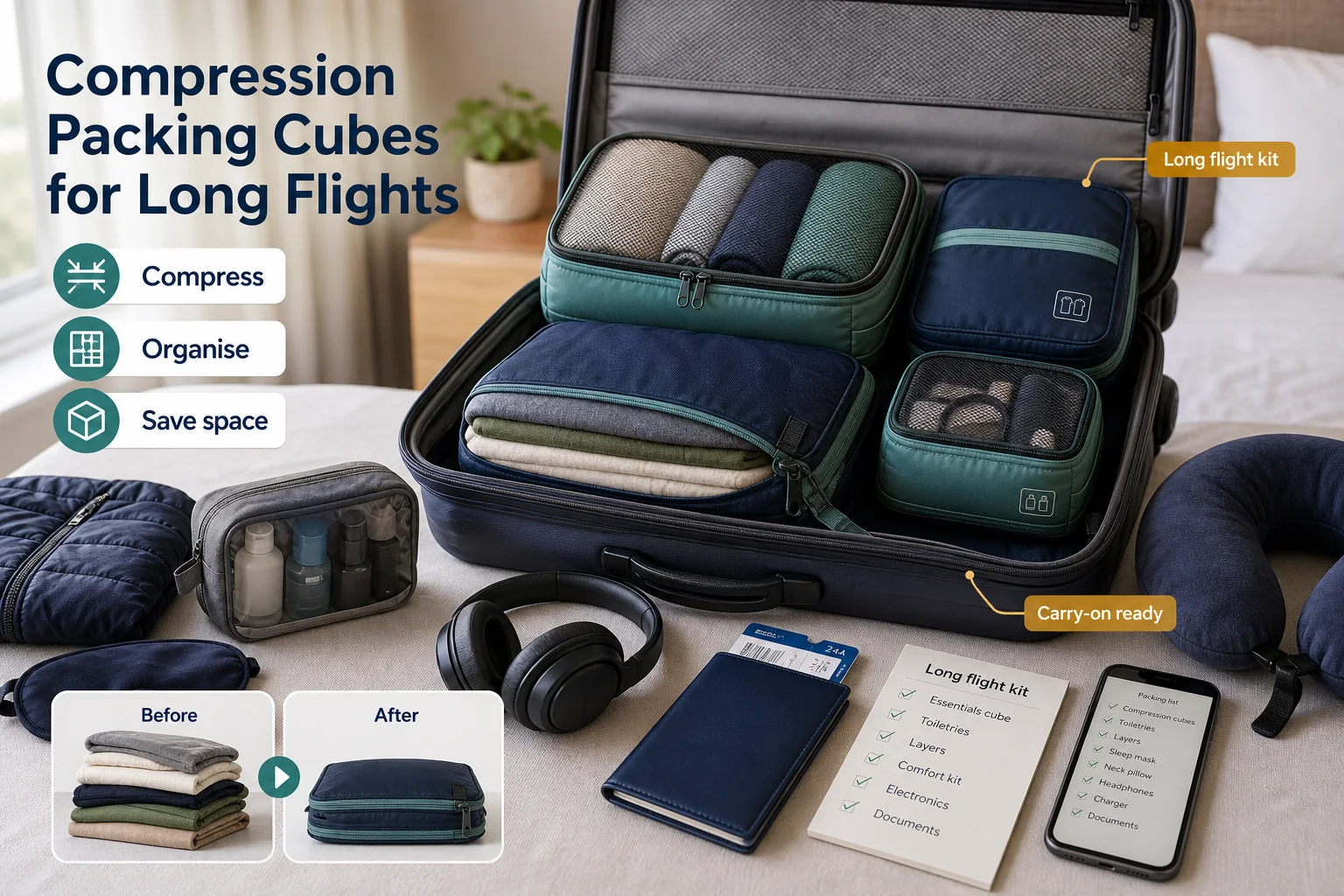
Regular packing cubes organise clothes into zipped compartments. Compression packing cubes add a second zip that pushes the air out, so soft clothing packs down smaller — handy on a long-haul flight when you want to stay carry-on or keep room for the journey home. Neither type reduces the weight of what you pack.
Compression cubes are best for: soft, packable clothing; carry-on-only long-haul trips; leaving space for what you buy on the way home; and keeping sleepwear or an arrival outfit separate on a long flight.
They’re not the answer for: cutting airline weight (they don’t); rigid items like shoes, toiletries and electronics; or travellers who already pack light and only want organisation — regular cubes are lighter and cheaper for that.
Brand examples by travel style (2026)
| Brand example (official page) | Material & compression (manufacturer spec) | Warranty (manufacturer) | Set contents & published size/weight | Best for (TripBuffer view) |
|---|---|---|---|---|
| Peak Design Packing Cube | 100% recycled 70D ripstop; expansion/compression zip; internal clean/dirty divider; tear-away UltraZip access. | Lifetime warranty | Sold individually in Small, Smedium, Medium and Large; per-size dimensions and weight are on the manufacturer’s spec tab (not published in a form we could verify to quote here). | Premium carry-on structure and quick access. |
| Thule Compression Cube Set | 100D bluesign-approved ripstop nylon; YKK zippers; expand/compress zip; water-repellent. | Limited lifetime warranty | Two cubes — small (expanded 26 × 18 × 11 cm) + medium (36 × 25 × 15 cm); set weight 0.46 lb (~209 g), per Thule. | Durable ripstop, YKK zips and a lifetime warranty. |
| Eagle Creek Pack-It Isolate Compression Cube Set | 100% ocean-recycled, water-resistant fabric; compression zippers. | No Matter What lifetime warranty | Two-cube set (small + medium); exact dimensions and empty weight are on the manufacturer’s product page — not published in a form we could verify here. | Lightweight organisation with some compression. |
| Gonex Compression Packing Cubes | Extensible ripstop nylon; mesh panels; double compression zippers. | 90-day warranty (manufacturer page, checked 14 Aug 2026) | Sold in 3-, 4- and 6+-piece sets; dimensions vary by set and size; official listing was out of stock when checked (14 Aug 2026). | Budget, multi-size starter sets. |
Swipe horizontally to see all columns. Material, compression, warranty, set contents and any dimensions/weights are manufacturer specifications (linked); dimensions are quoted only where we could verify them on the official page. “Best for” is TripBuffer’s editorial view. Checked 14 August 2026 — TripBuffer has not physically measured these products.
Peak Design Packing Cube
The Peak Design Packing Cube is the premium, structured pick: 100% recycled 70D ripstop with a dedicated expansion/compression zip, an internal clean/dirty divider and a tear-away UltraZip opening, backed by a lifetime warranty. It suits travellers who want carry-on structure and quick access and don’t mind the higher price. What the spec sheet can’t tell you — and what we haven’t tested — is whether it genuinely repacks faster than cheaper rivals.
Thule Compression Cube Set
The Thule Compression Cube Set leans on durable materials: 100D bluesign-approved ripstop nylon, YKK zippers, an expand/compress zip and a water-repellent finish, under a limited lifetime warranty. It’s aimed at travellers who prioritise fabric and zip quality. We haven’t independently compared its empty weight with the other sets here, so check the current weight and regional availability if those matter to you.
Eagle Creek Pack-It Isolate Compression Cube Set
Eagle Creek’s Pack-It Isolate Compression Cube Set is the lightweight option: 100% ocean-recycled, water-resistant fabric with compression zippers in a small-plus-medium set, covered by the brand’s No Matter What lifetime warranty. It fits travellers who want light organisation with some compression rather than maximum squeeze. We haven’t measured its real-world compression against bulkier sets.
Gonex Compression Packing Cubes
The Gonex Compression Packing Cubes are the budget, multi-size choice: extensible ripstop nylon, mesh panels and double compression zippers in 3-, 4- and 6+-piece sets, with a 90-day warranty (per the manufacturer page, checked 14 August 2026). They suit travellers who want an inexpensive starter set in several sizes. The trade-offs are unproven long-term zip and fabric life against premium brands, and the official listing was out of stock when we checked — so availability varies by set and region.
What actually matters on long flights
- Empty weight matters. A heavy cube set can erase the packing advantage if your airline also enforces cabin weight limits.
- Compression helps soft clothing more than rigid items. T-shirts, underwear and light layers compress better than shoes, power banks and toiletries.
- Repacking matters. On a long trip you may reopen the bag multiple times, so cubes that become chaotic after one use are not really helping.
- Airline rules still win. Carry-on and checked baggage rules remain airline specific, so a better cube system does not replace checking your route rules — use the airline bag fee estimator.
What’s different about packing cubes for a long-haul flight
A lot of packing-cube advice applies to any trip. A few things matter more once you’re flying long-haul:
- Weight limit vs size limit. Many long-haul carriers police cabin-bag weight (often around 7–10 kg), not just size. Compression frees up space but doesn’t cut weight, so squeezing more in can push you over the scale — watch both, and check your airline’s rule.
- Repacking on multi-stop itineraries. If you connect or change hotels, you’ll open, compress and re-close cubes repeatedly; sturdier zips and fabrics matter more than on a single-base trip.
- Sleepwear and an arrival outfit. On an overnight flight it helps to keep pyjamas or a change of clothes in one easy-to-reach cube, so you’re not unpacking the whole bag on the plane or in an arrivals bathroom.
- Clean vs dirty over a longer trip. Over 10–14 days, a dedicated dirty-laundry cube (or one with a clean/dirty divider) keeps worn clothes separate — more useful the longer you’re away.
- Warm vs winter long-haul. Bulky winter layers gain the most from compression; a warm-weather capsule may not need it, so a lighter, simpler set can be the better buy.
- Does a two-cube set fit your cabin bag? Check your chosen cubes actually lie flat in your carry-on’s main compartment before you rely on them — a medium cube that won’t sit flat wastes the space it’s meant to save.
These are practical planning points, not universal rules — your airline’s cabin allowance and your own packing list still decide what’s worth it.
When compression cubes help most
| Situation | Usually worth it? | Why |
|---|---|---|
| Carry-on only trip with mostly soft clothing | Yes | This is where compression cubes are most likely to buy real space. |
| Winter trip with bulky knits and outer layers | Sometimes | They can help, but coats and shoes still dominate the bag. |
| Tech-heavy business trip | Limited help | Cubes organize clothing well, but electronics and shoes often decide the bag size. |
| Family packing with mixed clothing sizes | Yes | Color-coded or labeled cubes help keep everyone separated and reduce unpacking chaos. |
| Already-checked bag with lots of spare room | Low urgency | Organization still helps, but compression is less critical. |
Swipe horizontally to see all columns.
How to choose the right set
If you mostly take week-long city trips with a carry-on, prioritize lighter cubes and easier organization over maximum squeeze. If you regularly travel with a checked bag for 10- to 14-day trips, stronger zippers and more durable fabrics become more valuable because the cubes get opened, closed and compressed repeatedly.
- Choose cube sizes that match how you actually pack: one medium plus one small often beats many tiny cubes.
- Do not buy the bulkiest set just because it looks durable if you are trying to stay under cabin weight limits.
- If you share luggage space with a partner or family, color or shape distinction becomes more useful than a tiny compression advantage.
- If your main goal is avoiding baggage fees, pair this decision with your airline bag rules and your actual packing list, not just the cube marketing.
Before you buy, check on the manufacturer’s page: the set contents, expanded and compressed dimensions, empty weight, fabric, compression mechanism, warranty and current price for your region — these change between models and markets.
When compression cubes do not fix the real problem
Compression cubes are not the answer when the real space problem comes from shoes, jackets, electronics, souvenirs or oversized toiletries. In those cases the better move may be a lighter packing list, one less pair of shoes, or a decision to pay for a checked bag instead of turning the whole carry-on into a fight.
Worked examples
- 7-day summer city break: A lighter two-cube system is often enough if you are already using the Packing List Generator and limiting shoes.
- 10-day mixed-work trip: Premium or sturdier cubes make more sense because you will repack shirts, chargers and meeting clothes more often.
- Family long-haul holiday: Multiple labeled cubes usually help more than extreme compression because fast access becomes part of the value.
Methodology and sources
This is a research-based decision guide, not a lab test. The manufacturer specifications were last checked 14 August 2026. TripBuffer did not purchase, receive or physically handle these products. The material, compression mechanism, warranty, set contents and any dimensions or weights in the table are taken from each manufacturer’s current official product page (linked in the table), and were checked on that date; product lines, dimensions, set contents and prices change, so confirm the current spec before buying. The “best for” and travel-style guidance is TripBuffer’s editorial inference based on common long-haul packing requirements, cross-checked against independent travel-gear coverage and airline baggage rules. We have deliberately not published invented compression percentages, weights we could not verify, or a scored ranking, because we did not run a controlled comparison. TripBuffer is independent and earns nothing from the brands listed; if you spot a changed product, tell us via the contact page.
- Manufacturer specifications: Peak Design Packing Cube, Thule Compression Cube Set, Eagle Creek Pack-It Isolate Compression Cube Set, Gonex Compression Packing Cubes.
- Independent travel-gear coverage: Pack Hacker: Best Packing Cubes.
- Baggage-rule context: IATA Travel & Baggage, TSA: What Can I Bring? (security limits, not cube performance).
Related tools and guides
- Best Packing List Generator
- Best Checked Bag vs Carry-On Cost Calculator
- Best Airline Bag Fee Estimator
- Checked Bag vs Carry-On for a 7-Day Trip
- Best Travel Budget Splitter
Frequently asked questions
Do compression packing cubes reduce bag weight?
No. Compression cubes reduce bulk, not airline weight. They help you fit clothing more neatly, but they can also tempt you to overpack if you stop watching the bag scale.
Are compression packing cubes worth it for carry-on only trips?
Usually yes if you already pack fairly efficiently and want to squeeze softer items into a smaller carry-on. They are less useful if your main problem is shoes, electronics or a heavy toiletry bag.
What matters most for long flights: stronger compression or lower weight?
For most long-haul travelers, lower weight and easier organization matter more than maximum compression. Over-compressing clothing can create bulk in awkward places and make repacking more frustrating at the airport or hotel.
Can compression cubes help avoid checked bag fees?
Sometimes. They can help some travelers stay carry-on only, but only if the airline size and weight rules still work in your favor after shoes, toiletries, chargers and heavier clothing are packed.
Do compression packing cubes actually work?
Yes, for bulk. A compression cube squeezes soft clothing into less space by pushing air out through a second zip, so you can fit more into the same bag or move down to a smaller one. What they don’t do is cut weight, and they help far less with rigid items like shoes, toiletries or electronics — so they work best for a wardrobe of soft, packable clothing.
Do packing cubes save space?
Regular packing cubes mostly organise rather than shrink your load; compression packing cubes are the ones that save space, by squeezing soft items down with a compression zip. The saving is real for clothing but modest — expect neater packing and a bit more room, not a dramatic size drop — and keep an eye on the scale, because the space you free up makes it easy to overpack past your weight limit.

Reviewed by Muhammad Umar Khan
Founder and editor of TripBuffer. Reviewed using current manufacturer specifications, independent travel-gear coverage and airline baggage considerations. TripBuffer did not independently lab-test every shortlisted product. For our research standards, see the Editorial Policy.